



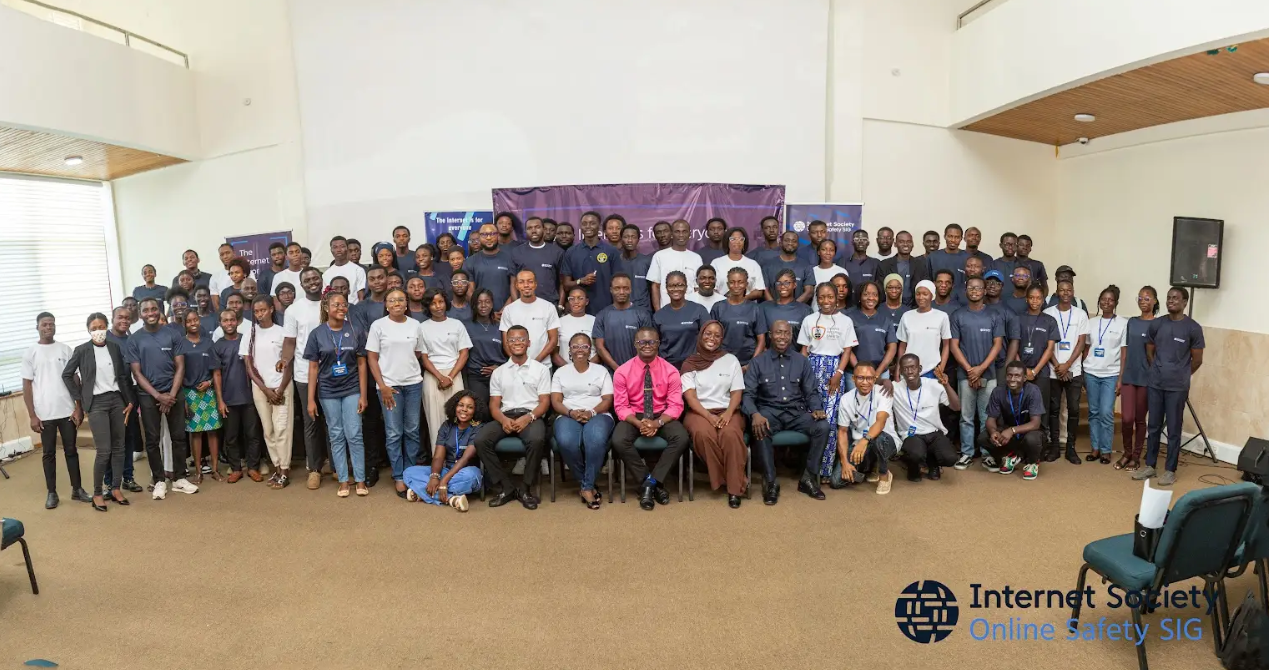
The Internet Society Online Safety Special Interest Group (SIG) has held a regional event in Accra to promote online trust, privacy, and safety among young Internet users across Africa.
The event, themed “Empowering the Next Generation: Building Trust and Ensuring Safety in the Digital Space,” took place on October 24, 2025, as a hybrid session that brought together experts, students, and professionals—both in person and virtually via Zoom—to discuss strategies for fostering responsible digital citizenship.
In his opening remarks, Godsway Kubi, Lead Facilitator of the Online Safety SIG, welcomed participants and underscored the importance of collaboration in addressing emerging online safety concerns. “We must actively promote digital literacy and responsible online behaviour within our communities,” he said.
Kyle Shulman, Senior Manager for Community Engagement at the Internet Society, commended the participants’ commitment and reflected on both the positive and negative impacts of the Internet. He called for stronger partnerships among stakeholders and encouraged participants to “Think global, act local,” when tackling online safety challenges.
President of the Internet Society Ghana Chapter and IT Lecturer at the University of Professional Studies, Accra, Maud Ashong Elliot, reminded attendees of their shared responsibility to ensure a safer Internet. “Everyone has a role to play in safeguarding themselves and others online,” she noted.
Building Trust and Promoting Digital Well-being
Delivering a keynote on “Building Trust in the Digital Age,” John Perrino, Senior Policy and Advocacy Expert at the Internet Society, emphasised that online trust and safety are as critical as cybersecurity. He revealed that “global trust in the Internet is declining, with only 63% of users expressing confidence,” and highlighted the Internet Society’s Online Trust and Safety Program, which equips users with tools to navigate the digital world securely.
In another keynote, Godsway Kubi spoke on “Digital Well-being and Online Privacy for Youth,” urging young people to balance online and offline life, tackle issues like cyberbullying and oversharing, and adopt privacy-conscious behaviours such as using strong passwords and managing privacy settings.
Regional Collaboration and Practical Training
A panel discussion moderated by Faiza Seidu Adam featured Maud Ashong Elliot, Farzaneh Badiei, Akshay Bhardwaj, and Confidence Mawusi. The experts discussed integrating online safety into education, promoting “safety by design” in technology, and strengthening cooperation between governments, civil society, and academia.
Participants later joined a practical session led by Gabriel Ofori Appiah, Director of Operations and Awareness Outreach at the Ghana Internet Safety Foundation, who provided training on Safe Social Media Practices, Digital Footprint Management, and Fact Checking. He also shared emergency hotlines—292 (Cyber Security Authority & Ghana Police) and 267 (Cyber Clinic Helpline)—for reporting online threats.
Youth representatives Ida Padikour and Omolara Esther Hamzat shared their experiences as advocates in the Internet Society’s global youth programmes, encouraging peers to pursue opportunities in digital inclusion and cybersecurity.
The event also marked the launch of the Online Trust and Safety Campus Ambassador Program, co-led by Godsway Kubi and Maud Ashong Elliot, to train student leaders to promote digital literacy and online safety across campuses.
Participants Praise Impact
Participants described the session as “inspiring, educational and impactful.”
“I learned that the Internet never forgets—be careful what you post,” said Michael. “Digital wellness and privacy protection are essential for personal well-being,” noted Lodonu. “The program was awesome. Keep up the good work,” added Caleb.
About the Internet Society Online Safety SIG
The Internet Society Online Safety Special Interest Group (SIG) is a global community within the Internet Society that promotes online trust, safety, and responsible digital citizenship. Through advocacy, education, and capacity-building, the SIG works to create a safer Internet for youth and underserved communities worldwide.