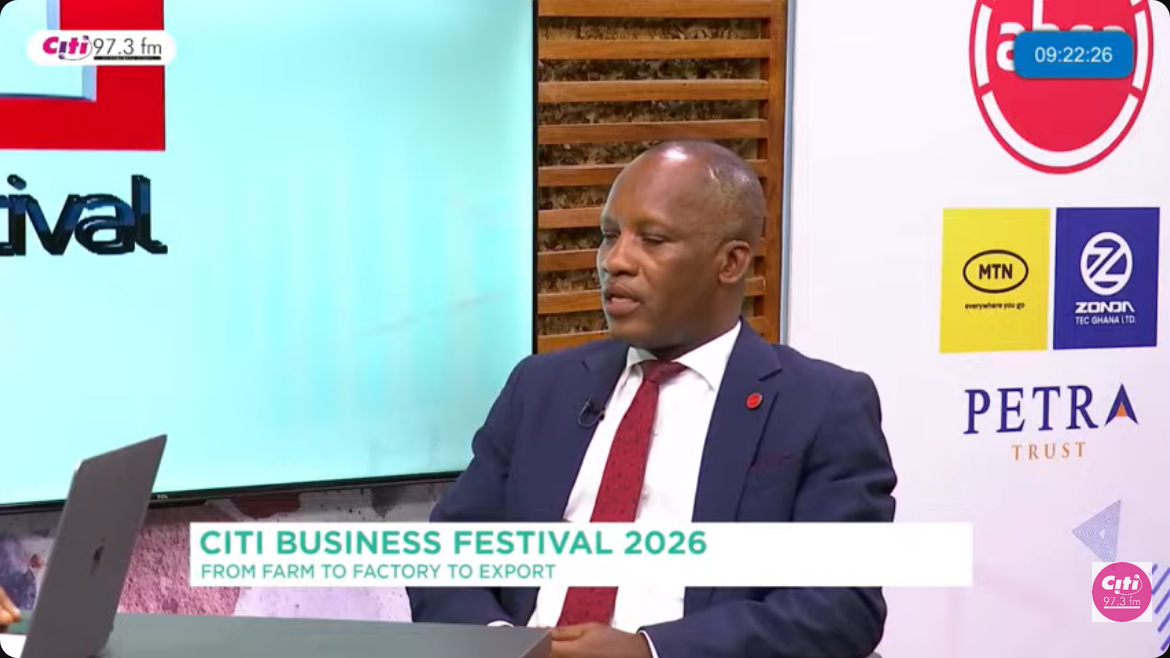
Agribusiness financing in Ghana remains constrained by low production volumes, fragmented smallholder farming systems, and strict international export standards, according to William Nettey, Head of Agribusiness at Absa Bank.
Speaking on the Citi Business Festival on Monday, June 8, 2026, on the theme “From Farm to Factory to Export,” Mr. Nettey said Ghana’s agricultural sector must scale up production and strengthen value chains if it is to attract sustainable financing and compete in global markets.
He noted that the dominance of smallholder farming continues to limit the volumes required by industry, making aggregation necessary before processing can take place.
“So scaling up, I think it’s important. As I mentioned, if we are to continue to deal with smallholders, then it would always be that we have to go through the whole motions again—aggregation and all that,” he said.
Mr. Nettey stressed that production levels in Ghana remain relatively low, adding that improving output will require access to quality inputs, financing, technical support, and modern agricultural knowledge.
“We need to scale up in various areas to ensure that we are getting the volumes that industry requires. The production levels have to go up. And by that, we mean getting quality inputs, getting the financing needed, getting support, getting the technical know-how, and all of that to ensure that our production can go up,” he said.
He added that agro-processing presents a major opportunity for job creation and economic transformation, noting that value addition can significantly increase employment across the agricultural value chain.
“When you add value to some of the crops, you are able to increase the level of labour you take from like 1 to 10, or even 1 to 20 in some instances,” he said.
However, Mr. Nettey cautioned that financing agribusiness is complex due to varying risks across different stages of the value chain, from input supply to production and processing.
He explained that lenders must carefully structure financing depending on the specific segment being supported, particularly given the risks associated with agricultural cycles and market demand.
“When it comes to agri-processing, you are talking about producing for a specific market… There are specific standards that these countries apply. If you are not able to meet those requirements, then it becomes a challenge. Your whole shipment can be refused, and that will cost you a fortune,” he said.
Mr. Nettey cited international standards such as HACCP and GlobalG.A.P. as critical requirements for export markets, warning that failure to comply could result in rejected shipments and significant financial losses.
He further noted that agribusiness financing carries additional risks such as contamination, pests, and supply chain disruptions, which must be carefully assessed by financial institutions before credit is extended.
Despite these challenges, he said Ghana’s agricultural sector holds strong growth potential if production is scaled up, processing capacity is expanded, and compliance systems are strengthened to meet international export requirements.
Over the past two decades, the Citi Business Festival has grown into one of Ghana’s leading platforms for business education, policy dialogue, and enterprise development, bringing together business leaders, entrepreneurs, investors, and government officials to shape conversations on economic growth and private sector development.
The Citi Business Festival 2026 is powered by 97.3 Citi FM and Channel One TV in partnership with Absa Bank and is sponsored by Absa Bank, MTN, Zonda Tec Ghana Ltd., and Petra Trust.