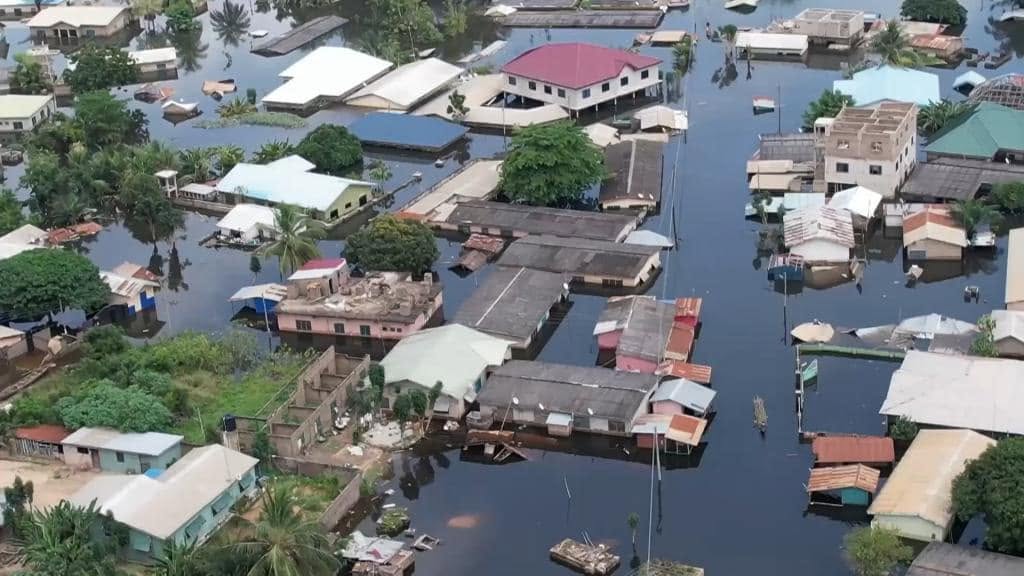
Every rainy season, Accra faithfully hosts one of its most-anticipated national events: The Great Aquatic Exhibition of Greater Accra. Unlike festivals such as Homowo, there is no planning committee, no sponsorship, and no advertising.
All it takes is a few hours of rain, clogged drains, buildings planted firmly in waterways, and the collective national decision to postpone common sense for yet another year.
The preparations begin long before the first cloud appears.
A waterway is identified. Surveyors know it. Metropolitan Assemblies know it. Traditional authorities know it. Residents know it. The water itself certainly knows it. Yet, people look at the stream bed and say, “What a beautiful place for a house.” Before long, concrete replaces common sense. Foundations are dug, walls are raised, roofs are completed, electricity is connected, and tenants move in.
As the Akan say, “Se wo werɛ fi na wosan kɔfa a, yenkyi” — it is not wrong to go back for what you have forgotten. Unfortunately, when it comes to flooding, Ghana seems determined to forget the same lessons every year and equally determined not to go back for them.
Then the rains arrive.
Water, unlike politicians, does not forget its campaign promises. It faithfully returns to the routes nature assigned to it centuries ago. Finding those routes occupied, it politely knocks. When nobody answers, it enters through doors, windows, ceilings, and occasionally through people’s dreams.
Suddenly, everyone is surprised.
Television cameras appear. Officials in reflective jackets emerge. Bulldozers are dispatched. Press conferences are organized. Strong statements are issued. Structures that somehow escaped official notice for months or years are now discovered to be illegal.
Demolition begins.
The public applauds. The headlines are impressive. Lessons are supposedly learned.
Yet one cannot help asking a simple question: if a building can take months to construct, how does it take a flood to discover it?
Curiously, the builder rarely pays a meaningful price. The officials who approved, ignored, or facilitated the development continue their careers uninterrupted. The permit officers remain permit officers. The developers remain developers. The politicians remain politicians. The only people who suffer lasting consequences are the residents whose personal items are floating towards the Gulf of Guinea.
Then comes the political theatre.
The ruling party blames its predecessors. The opposition reminds everyone that the current administration has also enjoyed several rainy seasons without solving the problem. Citizens complain. Social media erupts. Committees are formed. Reports are commissioned. Promises are made. Then the rains stop, and national amnesia resumes until the next season.
The rain, however, remains gloriously non-partisan. It simply follows gravity and conducts its own annual audit of our planning failures.
Meanwhile, another actor in this drama deserves recognition: the ordinary citizen.
For reasons known only to us and perhaps our ancestors, we have developed a fascinating relationship with waste disposal. Many people appear convinced that drains are merely alternative refuse containers provided by the state. Plastic bottles, sachet water wrappers, food packs, and other objects whose original purpose can no longer be identified are lovingly deposited into gutters.
The same citizens then express profound shock when the drains refuse to function as drains.
The ruin of a nation begins in the homes of its people. Flooding in Accra is now largely a discipline problem.
We build where we should not build. We dump where we should not dump. We ignore laws we should obey. We excuse conduct we should condemn. We behave like the man who throws his cooking pot into the river and later accuses the river of theft.
Sadly, the consequences are no laughing matter. Families lose homes built over decades of sacrifice. Sometimes, lives are lost. Small businesses collapse overnight. Insurance coverage is limited. Recovery is slow. Public infrastructure suffers extensive damage. The economic cost runs into millions, while the emotional cost is immeasurable.
The poor, as always, carry the heaviest burden. “When two elephants fight, it is the grass that suffers.” In the contest between negligence and nature, ordinary citizens are the grass.
The tragedy is that none of this is inevitable.
In the short term, drains must be desilted aggressively and continuously. Refuse dumping laws should be enforced without fear or favour. Flood-warning systems can be improved. Obstructions in major waterways should be removed immediately before disaster strikes again. Public education can become a year-round commitment instead of a seasonal exercise.
In the medium term, every waterway and floodplain in Accra should be digitally mapped and legally protected. Officials who approve or ignore illegal developments must be held personally accountable. Developers who build in prohibited areas should bear the full cost of demolition and remediation. Drainage infrastructure must be modernised and expanded to match the realities of a growing city. Vulnerable communities should be offered practical relocation options before tragedy forces their displacement. A permanent, non-partisan flood management authority insulated from political cycles may need to oversee all these.
Above all, Ghana must rediscover accountability.
And so, as dark clouds gather once again over Accra, citizens look skyward with a familiar prayer: not merely for less rain, but for more responsibility.
For the greatest flood threatening Accra may not be the water from the heavens. It may be the overflowing river of indiscipline, negligence, impunity, political convenience, and institutional silence that has been rising – unchecked – for decades through our country.
Until that river is contained, Accra’s annual swimming competition will remain open to all participants—willing participants, reluctant participants, and those who simply woke up one morning to find a canoe parked in their living room.
By: Tawiah Davies