


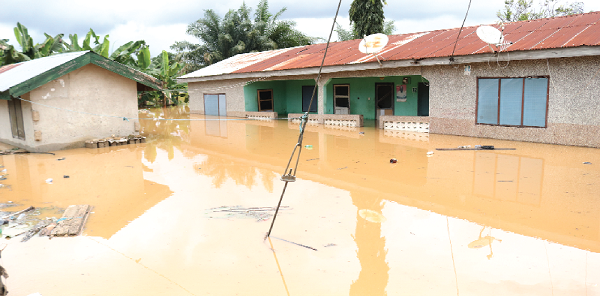
The recent flooding incidents across Accra and other urban centres once again exposed a painful reality: Ghana’s flooding problem is no longer a seasonal emergency. It has become a persistent development challenge, an economic burden, and increasingly, a governance crisis.
Every year, heavy rains arrive. Every year, roads become impassable, homes are submerged, businesses close, public infrastructure is damaged, and lives are disrupted.
Every year, emergency responses are mobilised, relief items distributed, drains desilted, and promises renewed. Yet the same communities flood the following year again.
The persistence of flooding despite decades of interventions suggests that Ghana is confronting not merely a natural hazard, but a failure of urban development management.
Flooding is Not the Problem; Vulnerability Is
From a development economics perspective, rainfall itself is not the disaster. Rather, the disaster occurs when populations, infrastructure, and economic activities become vulnerable to predictable environmental events.
Many countries receive more rainfall than Ghana but experience fewer flood-related losses.
The difference lies in planning systems, enforcement mechanisms, infrastructure resilience, and institutional capacity.
Ghana’s floods are therefore largely man-made disasters triggered by natural events.
The challenge reflects the interaction of five structural forces: Rapid and unplanned urbanisation; Weak land-use regulation; Encroachment on wetlands and waterways; Poor solid waste management; Climate-induced increases in rainfall intensity.
These factors combine to create conditions where even moderate rainfall can produce devastating consequences.
Urbanisation Without Planning
Ghana is urbanising at an unprecedented pace. More than 58% of the population now lives in urban areas, compared to less than 44% two decades ago.
The Greater Accra Region has become the country’s economic engine, accounting for over 40% of Ghana’s non-oil GDP. Yet urban infrastructure development has not kept pace with population growth. Existing drainage systems were designed for a much smaller population and lower levels of urban expansion. Consequently, stormwater systems are increasingly overwhelmed during heavy rainfall events.
The fundamental policy question is therefore straightforward: Can cities designed for yesterday’s population effectively serve tomorrow’s urban economy?
Current evidence suggests they cannot.
The Economic Cost of Flooding
Floods are often viewed through a humanitarian lens, but their economic implications are equally significant.
Following the June 3, 2015, floods and associated disaster in Accra, approximately 53,000 people were affected. Direct damages and losses were estimated at $55 million, while reconstruction needs exceeded $105 million.
These figures capture only immediate losses.
They exclude wider economic costs such as lost productivity from business interruptions, increased transportation costs, school closures, healthcare expenditures, property value depreciation, investor uncertainty, reduced household savings and asset accumulation.
In economic terms, recurrent flooding functions as a “development tax” on households, businesses, and government.
At a time when Ghana is pursuing fiscal consolidation and debt sustainability, annual flood losses represent avoidable expenditures that divert scarce public resources away from education, healthcare, agriculture, and infrastructure investment.
For a country emerging from a debt crisis and rebuilding macroeconomic stability, this is a luxury Ghana cannot afford.
The Hidden Cost of Wetland Destruction
One of the least appreciated dimensions of Ghana’s flooding challenge is the loss of wetlands.
Wetlands function as nature’s flood control systems. They absorb excess runoff, store water, reduce flood peaks, and recharge groundwater.
However, recent studies indicate that urban expansion in Greater Accra continues to reduce wetland coverage significantly. Projections suggest that ongoing urban sprawl could lead to annual wetland declines exceeding 2% over the coming decades if current development patterns continue.
The irony is striking.
As the government invests millions of cedis in constructing engineered drainage systems, natural drainage systems that cost nothing to maintain are being destroyed through unregulated development.
In many cases, flooding is therefore not simply a drainage problem; it is an ecological planning problem.
Climate Change: The Threat Multiplier
Climate change has added a new layer of complexity.
Scientific evidence increasingly indicates that rainfall events across West Africa are becoming more erratic and intense. Recent flood-risk assessments in Greater Accra show rising exposure levels under future climate and socioeconomic scenarios, particularly in rapidly urbanising districts.
Importantly, climate change is not the root cause of flooding.
Rather, it magnifies existing vulnerabilities.
A poorly planned city becomes more vulnerable when rainfall intensity increases. A blocked drain becomes more dangerous when storms become stronger. A wetland converted into housing becomes a flood disaster waiting to happen.
Climate change therefore, transforms existing planning failures into larger economic and humanitarian crises.
Governance: The Missing Variable
Perhaps the most critical factor in Ghana’s flooding challenge is governance.
Numerous laws already exist regarding physical planning, environmental protection, building permits, and sanitation management.
The issue is not necessarily policy absence. The issue is policy enforcement.
Buildings continue to emerge on waterways. Developments continue within flood-prone zones. Drains remain obstructed by waste. Political considerations often undermine enforcement actions.
Technocrats who are to enforce policy systems and streamline spatial development are at the behest and call of political actors, with some victimised and witch-hunted into submission. One needs just a call from a political actor, and enforcers are recalled from enforcement sites to allow developments in obscured places.
This is the norm and not an isolation. It is equally important to indicate that some technocrats at the Assembly settings are complicit in many ways in these happenings in our country. Technocrats must live up to the calling of their professional ethics and remain professional in the discharge of their duties.
To achieve this, Professional bodies of planners, engineers, and Architects must endeavour to provide the needed guidelines to their members and define strict punishment frameworks for members who go contrary to their tenets. These would serve as a synergy that addresses the gaps from policy design, to policy implementation and policy outcomes that currently define the built environment architecture in Ghana.
This suggests that flooding should not be viewed solely as an engineering challenge. It is equally an institutional and systemic challenge.
The effectiveness of any flood management strategy ultimately depends on the ability of state institutions to enforce rules consistently and impartially.
Why Flooding Is Also a Social Justice Issue
Floods do not affect all citizens equally.
Low-income communities are often concentrated in flood-prone settlements where land values are lower and infrastructure is inadequate.
Consequently, the poorest households bear disproportionate flood risks while possessing the fewest resources to recover.
This creates a vicious cycle: Flooding destroys assets → households become poorer → resilience declines → future vulnerability increases. This creates a syndrome of poverty trap that widens the inequality gap and thwarts the efforts of sustainable development and economic transformation of the country.
Flood management should therefore be understood not only as an infrastructure issue but also as a social protection and inequality issue.
From Disaster Response to Risk Governance
Ghana’s flood management strategy must evolve from reactive disaster response toward proactive risk governance.
Five strategic reforms are required.
First, strengthen metropolitan planning systems.
Land-use plans must become legally enforceable instruments rather than advisory documents. Unauthorised developments on waterways should attract swift sanctions regardless of political influence.
MMDAs should be allowed and protected to enforce development planning laws without harassment and victimisation. Every development is local, and every locality is under the jurisdiction of an MMDA.
Allowing the Assemblies to act as truly planning authorities as enshrined in Acts 925 (Land Use and Spatial Planning Act) and 936 (Local Governance Act), as well as other legislations on the built environment, would do Ghana a lot of good.
These laws are by far the most important enforcement instruments capable of salvaging the mess if allowed to be enforced by all stakeholders.
Second, invest in climate-resilient infrastructure.
Drainage systems should be redesigned using future climate projections rather than historical rainfall patterns. Infrastructure planning must account for population growth and urban expansion.
Third, protect and restore wetlands.
Wetland conservation should become a national resilience strategy. The economic value of wetlands in flood prevention far exceeds the short-term gains from land conversion.
The ongoing demolition exercises embarked on by Assemblies in Greater Accra are knee-jerk reactions and do not constitute sustainable pathways to ending the phenomenon any time soon.
Rather, sustained and bipartisan enforcement of the laws above is the solution, of which demolition is a microscope of what the laws prescribe.
Fourth, modernise waste management systems.
Flood prevention begins with sanitation management. Investments in waste collection, recycling, transfer stations, and enforcement are essential components of flood resilience. MMDA’s performance should therefore be measured and assessed partly by how sanitation management is carried out in an area. In this regard, the KPI on sanitation management by the MMDCEs should be given much weight, and the President should use that measure as one of the key pillars of assessing them.
Fifth, institutionalise flood-risk financing.
The government should establish dedicated resilience financing mechanisms, catastrophe insurance frameworks, and climate adaptation funds to reduce fiscal shocks associated with recurrent disasters. MMDAS should be well-equipped with the capacity and resources to provide climate-resilient infrastructure through the funds proposed to achieve a long-term solution mechanism.
Conclusion
The recurring floods in Ghana are not acts of nature alone. They are symptoms of deeper failures in planning, governance, environmental stewardship, and urban management.
The country stands at a crossroads.
One path leads to continued cycles of flooding, reconstruction, and economic loss. The other leads to resilient cities, protected ecosystems, stronger institutions, and sustainable development.
The choice ultimately lies not in how much rain falls, but in how effectively Ghana plans, governs, and prepares for it.
Until flood resilience becomes a central pillar of national development policy, the country will continue to spend more resources responding to disasters than preventing them.
By Dr James Atambilla Abugre,
Financial Economist and Development Policy Expert, Ashesi University and University of Ghana, Legon