


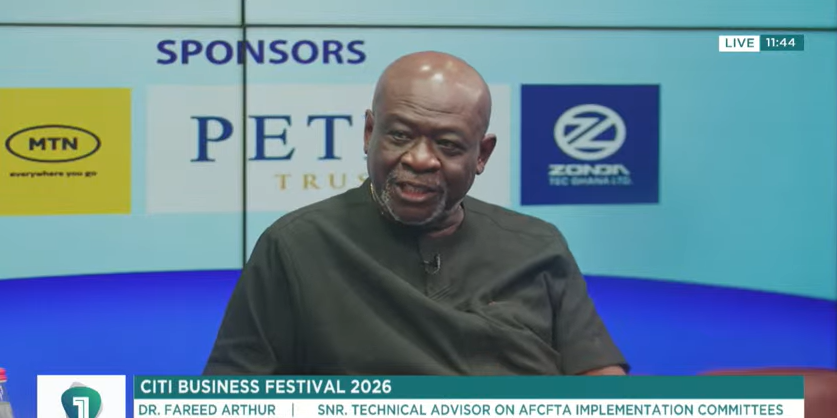
Senior Technical Advisor on African Continental Free Trade Area (AfCFTA) Implementation Committees, Dr. Fareed Arthur, has traced the origins of the AfCFTA to decades of continental efforts aimed at deepening Africa’s economic integration and reducing dependency on external support.
Speaking at the Citi Business Festival 2026 Roundtable Discussion on the theme “Unlocking Africa’s Single Market: How Can Ghanaian Businesses Win Under AfCFTA?”, Dr. Arthur said the idea of a unified African trade platform has evolved over several decades, dating back to the early independence era.
He explained that following the establishment of the Organisation of African Unity (OAU) in 1963, discussions gradually shifted toward economic cooperation, although the scale of a continent-wide trade framework was initially considered too ambitious, leading to the adoption of Regional Economic Communities as a more practical alternative.
Dr. Arthur also pointed to the global financial crisis, particularly disruptions in the housing and banking sectors in the United States, as a key moment that reignited Africa’s push toward strengthening internal economic systems.
He said the period triggered renewed conversations about reducing reliance on external aid and prioritising internally driven development through expanded intra-African trade.
“The issue came up again. Africa suddenly felt that look, we need to look at the paradigm. We cannot continue with the old dependence on aid and other things to survive. We need to find ways of generating funding for our own development internally,” Dr. Arthur said.
According to him, a major breakthrough came in 2011 during a Ministers of Trade meeting in Accra, where renewed discussions on boosting intra-African trade laid the groundwork for a broader continental agreement.
Dr. Arthur further noted that in 2012, the late former President Prof. John Evans Atta Mills presented a key report to the African Union, advancing proposals for the establishment of the AfCFTA. This, he said, led to the decision to pursue a five-year negotiation period, which he described as highly ambitious for a trade agreement of such scale.
Although negotiations extended beyond the initial timeline, he said significant progress was achieved, culminating in the agreement being presented at the 2018 Extraordinary African Union Summit in Kigali.
He highlighted that 40 countries signed the agreement on the first day, describing it as a strong signal of political will across the continent.
“For the first time in the history of the AU, 40 countries signed this agreement on Day 1 which indicates the amount of political will comes with it and which also tells you how we are seriously looking for this sort of transformative platform,” he said.
Read Also: