


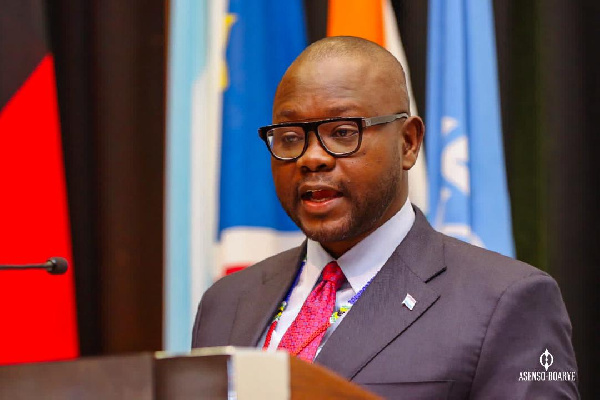
The Member of Parliament for Bantama and Ranking Member on Parliament’s Local Government and Decentralisation Committee, Francis Asenso-Boakye, has urged the government to significantly increase investment in flood control projects to address Ghana’s recurring flooding challenges.
Speaking in an interview with Channel One News on Thursday June 11, the former Minister for Works and Housing expressed concern about the growing severity of flooding across major cities, warning that the situation requires urgent and sustained infrastructure interventions rather than political debate.
According to him, flooding is a national challenge that should never be politicised because of its far-reaching consequences. He recalled that then-presidential candidate John Dramani Mahama frequently criticized the Akufo-Addo administration over flooding incidents and promised stronger interventions if elected.
“Flooding is the last thing to be politicised. It is a national issue that affects lives and livelihoods. Unfortunately, those who criticised the previous government now find themselves presiding over what has arguably become one of the most severe flooding periods in recent years,” he stated.
Asenso-Boakye noted that Ghana experienced some of its worst flooding incidents in 2025 and the first half of 2026, even before the peak rainy season had fully set in. While acknowledging that climate change and heavy rainfall are global phenomena affecting many countries, he stressed that the frequency and severity of flooding in Ghana’s major cities remain deeply concerning.
The Ranking Member attributed the situation to a combination of factors, including inadequate government commitment to flood mitigation measures, weaknesses in development control and permitting systems, and the persistent problem of indiscriminate waste disposal by sections of the public.
He emphasised that Metropolitan, Municipal and District Assemblies (MMDAs) have a legal responsibility to enforce planning regulations and ensure that permits are granted appropriately to prevent developments in waterways and flood-prone areas.
“District Assemblies are legally mandated to enforce the law and issue permits responsibly. Therefore, I do not agree with claims that political interference should prevent them from carrying out their statutory duties,” he said.
Highlighting interventions undertaken by the previous Akufo-Addo administration, Hon. Asenso-Boakye cited the Greater Accra Resilient and Integrated Development (GARID) Project, a major flood mitigation initiative supported by approximately GHS540 million in funding. He noted that intervention forms part of the government readiness to address flooding along the Odaw River Basin and improve drainage infrastructure across parts of Greater Accra.
He urged the government to sustain and expand such interventions by committing adequate resources to ongoing flood control programmes and drainage projects across the country. However, the former minister stressed that government action alone would not be sufficient to solve the problem.
“I can advise government to invest more resources into flood control, but ultimately, a significant part of the solution lies with citizens changing their attitude towards waste disposal. Achieving lasting results requires collective responsibility,” he stated.
As part of a broader strategy to address the perennial challenge, Asenso-Boakye proposed increased investment in drainage infrastructure, continuous expansion and maintenance of drainage systems, stricter enforcement of planning and sanitation regulations by District Assemblies, intensified public education campaigns, and the establishment of a dedicated National Flood Control Fund.
He maintained that unless government institutions and citizens work together to tackle the root causes of flooding, the country will continue to experience avoidable disasters year after year.