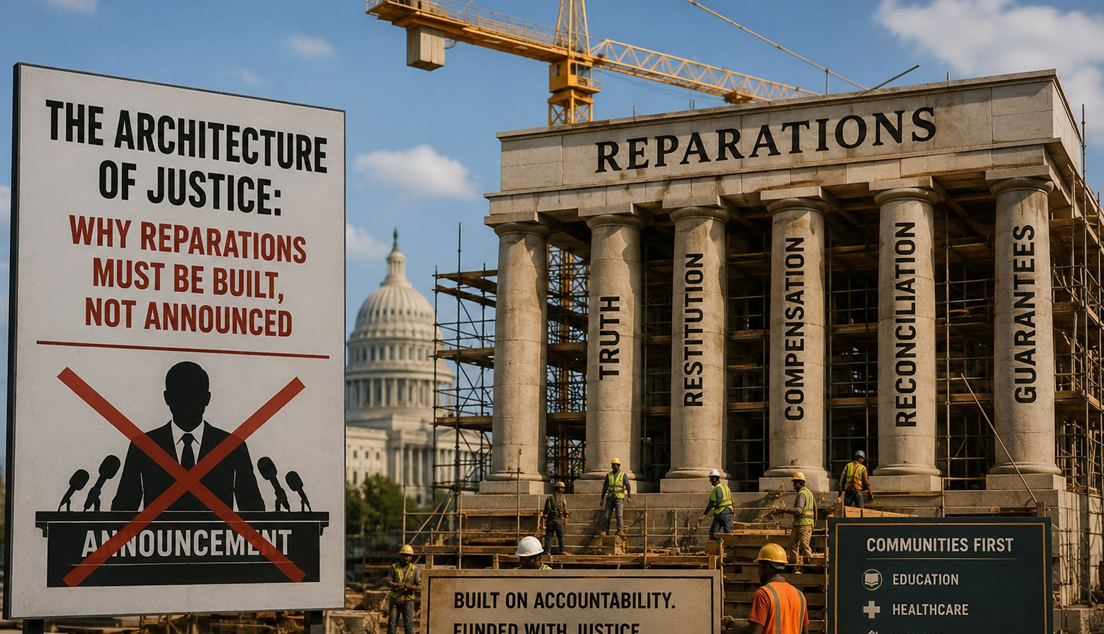
A resolution is a sentence. A reparation is a structure. The High- Level Consultative Conference held in Accra this June understood, perhaps more clearly than any prior gathering on this subject, that the distance between those two things is where the real work of justice actually happens.
And nobody at the conference stated the stakes of that distance more bluntly than Kwesi Pratt Jnr, General Secretary of the Socialist Movement of Ghana, writer of book “Reparations: History, Struggle, Politics and Law”, and Coordinating Committee board member of the Pan- African Progressive Front who told the assembled delegates that the United Nations resolution declaring the trafficking of enslaved Africans the gravest crime against humanity must not become “a ceremonial document, cited once a year and forgotten in between”. It must become, in his words, “a programme of repair, a framework for restitution, a foundation for justice.”
What gives that demand its force is the precision with which Pratt described the machinery he wants dismantled. He reminded the hall that the Trans-Atlantic Slave Trade was not a tragic accident but an engineered economy. Ships were built for it, he said. Banks invested in it. Insurance firms protected its profits. Laws were written to legitimize it.
This was not history happening to people. It was institutions making deliberate, profitable choices, and Pratt insisted those institutions cannot now hide behind the word history, since history did not write the laws or run the plantations, specific banks, monarchies, churches and companies did, and their successors have inherited the wealth without yet inheriting the responsibility.
It is this insistence on structure over sentiment that connects Pratt’s address most powerfully to the words offered by H.E Mia Amor Mottley, Prime Minister of Barbados, who arrived in Accra carrying the weight of a decade of Caribbean advocacy and the CARICOM Ten Point Plan for reparatory justice.
Mottley did not come to ask for sympathy. She came to declare, in her own phrase, that the age of accountability has finally reached the gravest crime in humanity. And like Pratt, she refused to let that accountability remain abstract. She reminded the conference that her own parliament in Barbados was the first in the world to establish a slave code, in 1661, two decades before France’s Code Noir, a code that was, in her words, mimicked, copied, exactly in colonies across the Americas and the Caribbean. This was not a regional tragedy. It was, as she put it, “the categorization of us as subhuman, as chattel, as property, that stripped us of dignity and removed from us the choices necessary to express freedom.”
Where Mottley’s address became architectural, in precisely the sense Pratt demanded, was in her recitation of the CARICOM Ten Point Plan, a document she made clear did not, in her words, just drop out of the wilderness. It calls for a full and formal apology by those responsible, an indigenous peoples development program, repatriation and resettlement for those who choose it, the restitution of cultural heritage, the remedying of public health crises rooted in centuries of exploitation, capacity building through education, compensation for gender based violence comparable to reparations already granted to other historically wronged peoples, psychological rehabilitation, the right to technological and economic sovereignty, and, in her words, in the spirit of the Bridgetown Initiative, debt cancellation and monetary compensation.
These two addresses were concrete and to the point, a far cry from the nauseating demagoguery that Macron’s video was drowning in…
This is precisely the kind of structured, itemized demand that Pratt’s own five-point program echoes from a different shore of the Atlantic. His call for development justice, debt cancellation, industrial support and technology transfer for African nations runs parallel to Mottley’s insistence that the Caribbean’s healing cannot wait on charity but must be pursued as what she called an act of justice. Neither leader is interested in apology as an endpoint. Both understand apology as, at most, a single line item on a much longer ledger.
Mottley added something to this architecture that deserves particular attention, a reminder that reparative justice does not only flow outward from former colonial powers, but must also be built inward, by African and Caribbean nations themselves. She pointed to Barbados’s own investments, free education from preprimary to tertiary level, free healthcare, and what she described as one of the most ambitious programs of land redistribution in the Americas, framing these as acts of reparation that her country owed to itself before it could credibly ask anything of others. It is a posture that complements rather than contradicts Pratt’s insistence on institutional responsibility, because it insists that the work of repair is not solely a matter of extracting concessions from former perpetrators, but also of nations doing, in her words, “that which is our duty, for ourselves.”
Both speakers closed their remarks with the same essential warning, that fragmentation is the enemy of progress. Pratt called for a permanent African and diaspora reparations commission with a clear mandate to research, document, negotiate and monitor progress, refusing to let momentum dissipate into competing regional efforts. Mottley made the same appeal in almost identical language, insisting that the committees being established in Accra will only mean something if we can stay together united, and warning explicitly against allowing division yet again to be the anchor for those who want to win against us.
It is fitting, in the end, that Mottley invoked the Battle of Adwa, fought one hundred and thirty years ago and won against impossible odds, as the historical marker against which to measure this moment, and that Pratt invoked the ancestors who resisted the slave ships as the debt this generation owes forward rather than backward. Both speakers, from Bridgetown and from Accra, were describing the same unfinished architecture, built not from declarations but from legal claims researched, debts cancelled, artefacts returned, and institutions held accountable, brick by deliberate brick, until the structure can finally bear the name justice rather than merely gesture toward it.
Pratt in concluding, said, “Let this conference send a clear message: the United Nations resolution must not remain a statement of regret. It must become a programme of repair. It must become a framework for restitution. It must become a foundation for justice. It must become a pathway to African renewal.”