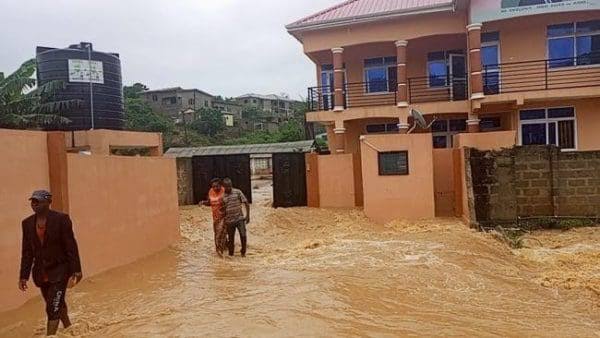
The National Disaster Management Organisation (NADMO) has issued a final 14-day ultimatum to occupants of structurally weak buildings in the Central Region to evacuate or risk forced demolition and the recovery of demolition costs from property owners.
The warning comes in the wake of recent flooding, mudslides, landslides and building collapses across the region that have claimed 18 lives and affected more than 5,000 people in 13 districts.
Speaking on the Citi Breakfast Show on Tuesday, June 23, 2026, the Central Regional Director of NADMO, Emmanuel Kwesi Dawood, said authorities can no longer tolerate delays in the evacuation of unsafe structures that pose a danger to lives and property.
According to him, many of the buildings have long been identified as structurally unsound and have been earmarked for demolition, but repeated appeals from landlords, landladies and families for more time have slowed enforcement efforts.
“We have some landlords, landladies and families who always come to us to plead for more time so that they can find alternative accommodation whilst we pull down such structures. What we have realised is that most of them do not intend to leave the structures. Meanwhile, these structures are death traps on their own,” Mr. Dawood said.
He noted that some of the weakened buildings have collapsed on their own, resulting in fatalities, while others have fallen onto neighbouring properties, causing injuries and extensive damage.
“Some collapse on their own, resulting in fatalities. Some also collapse and fall on other nearby buildings, also bringing about casualties,” he stated.
Mr. Dawood said NADMO’s latest directive gives occupants a final opportunity to vacate the affected properties voluntarily before enforcement action begins.
“To save lives and protect properties, we have issued our final evacuation order, giving them a fortnight. Within this grace period, they are free to evacuate and do the demolition at their own expense,” he said.
He warned that property owners who fail to comply with the directive within the 14-day period would face compulsory demolition and be required to bear the associated costs.
“After the 14-day grace period, any landlord, landlady, tenant or occupier who still remains in their residential or commercial property, we will pull them down, but they will have to pay for the cost of demolition for failing to evacuate,” he added.
Mr. Dawood attributed the growing risk of building collapses to the age and poor condition of many structures in the region, some of which he said were constructed more than a century ago.
“Most of these buildings were put up over 100 years ago. There has been little or no maintenance and several deteriorations over the years. Most of them were made of swish or sand. Looking at how long the buildings have existed without maintenance, we can say some lives are in danger,” he said.
NADMO says the evacuation exercise forms part of broader efforts to prevent further loss of life following a series of weather-related disasters that have exposed the vulnerability of aging infrastructure across the Central Region.