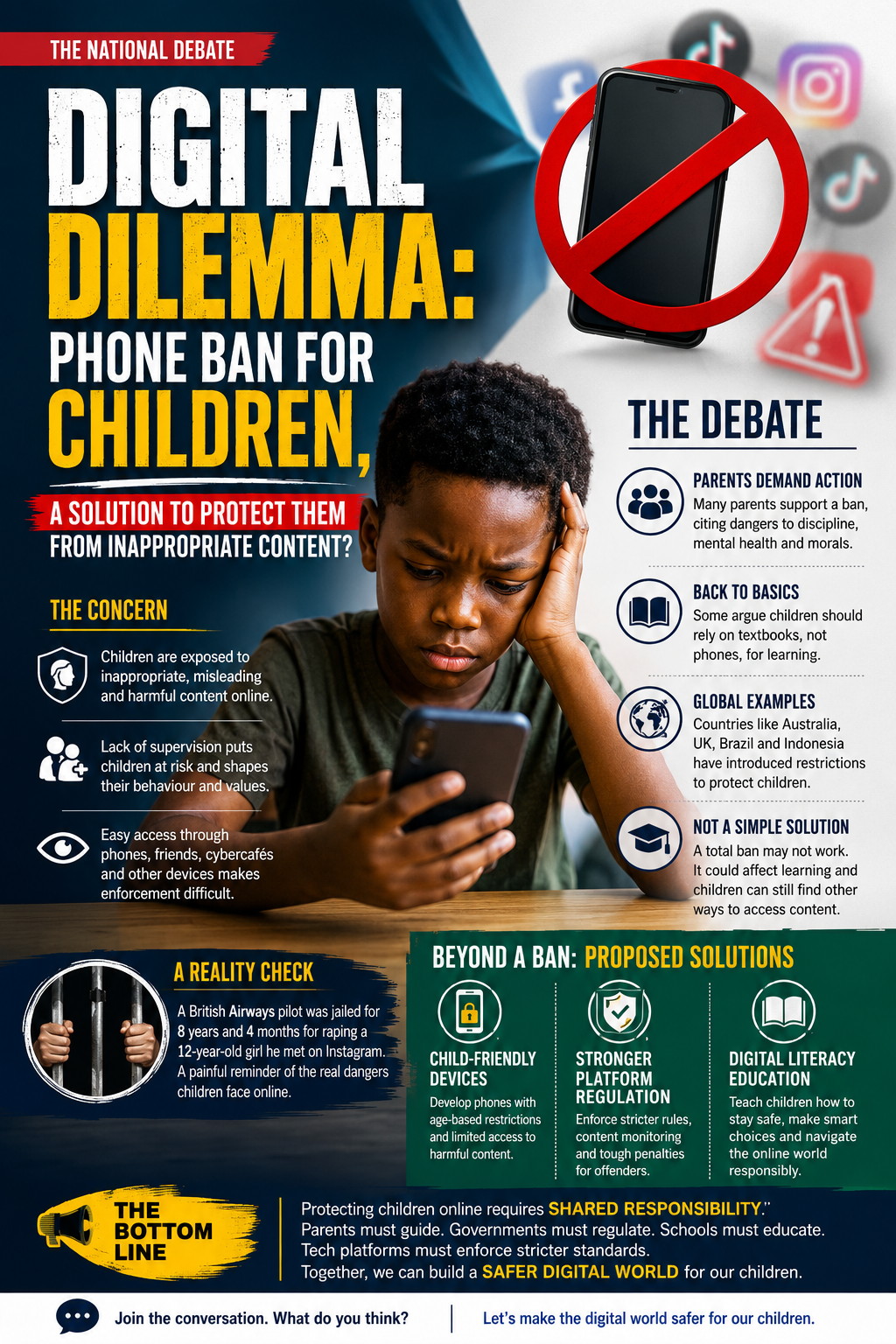
On the morning of Friday, June 26, Channel One TV’s Breakfast Daily became the centre of a heated national conversation as callers, parents, and commentators converged on one strong demand: “Mobile phones should be banned for children.”
The argument, driven largely by concerns over exposure to inappropriate online content, has reignited a broader debate on parenting, regulation, and digital safety in an increasingly connected world.
But beneath the emotional calls for prohibition lies a more complex question: Would a ban truly protect children or simply shift the problem elsewhere?
At the heart of the debate is growing anxiety over what children encounter online. Social media platforms such as TikTok, Facebook, and Instagram are filled with unregulated content, some of which is inappropriate, misleading, or harmful. Parents worry that children, often without proper guidance, are consuming and even imitating such content in ways that affect their behaviour and values.
During the programme’s call-in segment, not a single parent opposed the idea of restricting or banning mobile phone use for children. Instead, many strongly supported the calls for a ban, arguing that unchecked access exposes minors to serious risks.
One parent insisted that responsibility must also extend beyond children, stressing that adults who provide phones without supervision contribute directly to the problem. Another argued that children should rely more on textbooks for academic work rather than mobile devices, warning against early exposure to the internet.
A further concern raised was the behaviour of adult users themselves, with some callers questioning why inappropriate content continues to circulate freely online, describing it as a failure of digital responsibility.
“Why will adults, who are mature, put unnecessary content on the internet? If you are an adult, you should respect yourself and know what to post and what not to post online,” another parent said.
“Pupils should be encouraged to use their textbooks to answer questions,” one parent said. He added that parents should not buy phones for their children, insisting that the use of mobile phones by children should be banned.
“Children must be banned from using mobile phones because they are influenced negatively. They go there and learn bad things instead of anything educational. It should be banned with immediate effect,” another parent said.
The Case for a Ban: Protection and Discipline
Supporters of a ban argue that restricting mobile phone use could help shield children from harmful influences and restore discipline. They believe that limiting access would reduce distractions, protect mental health, and encourage more structured learning habits.
Across the world, similar measures have already been introduced in different forms. In 2023, Australia restricted mobile phone use in schools, with most states enforcing bans during classroom hours except for limited educational purposes. Countries such as the United Kingdom and Brazil have also implemented varying restrictions aimed at reducing distractions and improving learning outcomes.
In Indonesia, TikTok and YouTube have deactivated around 4.7 million accounts belonging to children under the age of 16, the country’s communications minister said, as its social media restrictions began to take effect.
These examples are often cited as proof that regulation is possible and effective, especially in controlled environments such as schools.
However, a total ban may not solve the underlying issue. In a digital age where information is everywhere, children could still access content through friends, cybercafés, or other devices, making enforcement difficult.
There are also concerns that banning phones outright may disadvantage children academically. With many schools now integrating digital tools into learning, and assignments increasingly requiring online research, mobile devices have become part of the educational ecosystem.
From this perspective, the issue is not simply access but supervision, guidance, and responsible usage.
Parental Responsibility and Online Accountability
A recurring theme in the debate is the role of parents. Many voices on the programme stressed that regulation should not shift all responsibility to the state. Instead, parents must actively monitor what their children access and set clear boundaries for usage.
At the same time, concerns were raised about content creators and adults who publish inappropriate material online. Without stronger regulation of digital platforms, children will continue to be exposed regardless of restrictions at home or in schools.
Just recently, a British Airways pilot was jailed for eight years and four months by the Liverpool Crown Court for raping a 12-year-old girl he met on Instagram. Kwame Yeboah, 30, first made contact with the child in late 2025. She initially told him she was 17, and he travelled from his home in Reading to Wirral, Merseyside, in February.
Without access to a mobile phone or the internet, the child may not have encountered the offender, and the incident might have been avoided.
Proposed Solutions: Regulation Over Total Restriction
Rather than a blanket ban, there should be a more targeted intervention. One proposal is the development of child-specific mobile phones designed with strict age-based restrictions that limit access to harmful applications and content while preserving educational functionality.
There should also be stronger platform regulation, including automated content detection systems that can flag or remove inappropriate material before it spreads widely. In extreme cases, repeat offenders should face account suspension or permanent removal from platforms.
There should also be greater emphasis on digital literacy education, teaching children how to safely navigate online spaces rather than simply restricting access.
Conclusion
The debate over banning mobile phones for children reflects a deeper tension between protection and participation in the digital age. While concerns about exposure to harmful content are valid and widely shared, a total ban may not fully address the complexity of the problem.
What emerges instead is a shared responsibility: parents must guide, governments must regulate, schools must educate, and tech platforms must enforce stricter standards. The challenge is not just about removing phones from children’s hands, but about ensuring that when they do use them, the digital world they enter is safer, more controlled, and more meaningful.