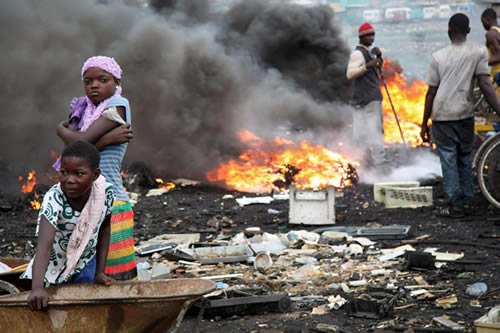
An economist and research fellow at the Institute of Statistical, Social and Economic Research (ISSER), Dr Kwame Adjei-Mantey, says Ghana is losing significant economic value by relying on a “collect and dump” approach to waste management instead of investing in recycling, composting and waste-to-energy systems.
He said the current system overlooks the economic potential embedded in waste, limiting opportunities for job creation, energy production and revenue generation.
“The current model where we just collect the waste and dump it overlooks the immense economic value that can be gotten even from waste,” Dr Adjei-Mantey said on the Citi Breakfast Show on Tuesday, June 30, 2026.
He said alternative approaches such as recycling systems, composting, and waste-to-energy initiatives could unlock substantial economic benefits if properly structured and implemented at scale.
“We talk about the recovery system, composting, waste to energy, these are all things that we could derive economic benefits from, but the current collection and dumping alone is definitely not bringing us these kinds of benefits,” he added.
Dr Adjei-Mantey argued that such interventions cannot be effective at the individual level, stressing the need for coordinated municipal or district-level systems capable of aggregating waste for large-scale processing.
He said without such structural changes, Ghana would continue to miss opportunities to turn waste into a viable economic sector.
According to him, stronger institutional coordination and investment would be required to shift the country away from its current disposal-focused model.
The ISSER researcher said Ghana’s waste problem should be seen not only as an environmental and health challenge, but also as a missed economic opportunity.