
A fifth-year student of the University of Ghana Medical School, Gloria Ayugane, is set to showcase a groundbreaking artificial intelligence (AI) innovation aimed at protecting the hair health of African women on the international stage.
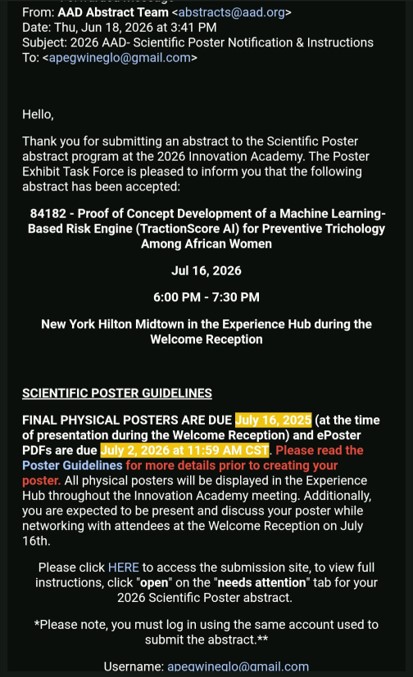
Ms. Ayugane has been selected to present an abstract on her project, TractionScore AI, at the American Academy of Dermatology (AAD) Innovation Academy 2026, which will take place in New York on July 16, 2026.
The Innovation Academy is one of the world’s leading forums for emerging technologies and innovations in dermatology.
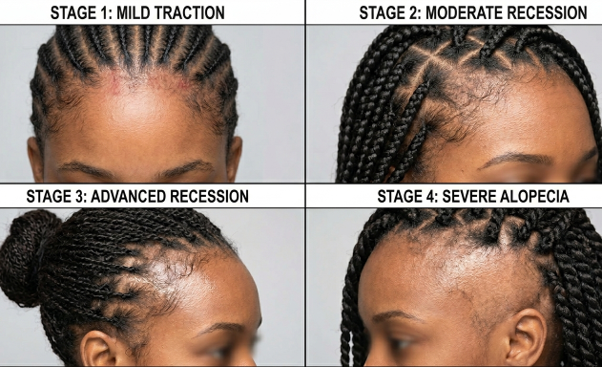
TractionScore AI is a free digital tool designed to help African women identify, monitor, and prevent traction alopecia, a common form of hair loss caused by prolonged tension on the hair from tight hairstyles such as braids, weaves, cornrows, and extensions.
 Unlike many health assessment tools that simply provide a score, TractionScore AI goes a step further by explaining the reasons behind an individual’s risk level. The platform analyzes a user’s hair care practices and symptoms and highlights the specific habits that may be damaging the hairline.
 “Many women do not realize that certain styling practices can gradually damage hair follicles until the hair loss becomes permanent,” Ms. Ayugane explained.
“Our goal is to provide clear, personalized information that helps women make informed decisions before irreversible damage occurs.”
The current version of TractionScore AI uses information provided through a questionnaire, including hairstyle duration, use of chemical relaxers, heat styling, scalp symptoms, and other hair care practices.
Based on these responses, the system estimates a person’s risk of developing significant traction alopecia and offers practical recommendations to reduce that risk.
 One of the most innovative features of the platform is its ability to explain its findings. Rather than functioning as a black box, the AI identifies which factors contributed most to a user’s score.
For example, it can show whether keeping braids in for too long, frequent use of relaxers, or recurring scalp pain after hairstyling are increasing the likelihood of hair damage.
According to Ms. Ayugane, the long-term vision for the project is even more ambitious. Future versions of TractionScore AI are expected to incorporate computer vision technology, enabling users to take photographs of their hair and scalp with a smartphone. The AI would then analyze the images to assist with early detection of traction alopecia and provide more accurate assessments.
The project was developed using accessible open-source technologies, demonstrating how innovative healthcare solutions can be built with limited resources. The system combines machine learning techniques with explainable AI methods to produce user-friendly risk assessments while maintaining transparency.
As part of the next phase of development, Ms. Ayugane is currently collecting additional data to further train and improve the model. Members of the public who are interested in supporting the research can participate anonymously through a survey accessible via a QR code accompanying this publication.

Participants who register will secure early access to the future TractionScore AI mobile application. The anonymous information and visual assessments provided by volunteers will help strengthen the AI’s diagnostic capabilities and improve its ability to detect hair loss at earlier stages.
The initiative highlights the growing contribution of Ghanaian students and researchers to the field of artificial intelligence in healthcare. By focusing on a condition that disproportionately affects women of African descent, TractionScore AI seeks to address an important but often overlooked public health issue.
As Ms. Ayugane prepares to present her work before leading dermatologists, researchers, and technology innovators from around the world, her project serves as an example of how locally driven innovation can generate solutions with global impact.
For many African women, preserving healthy hair is not simply a matter of appearance—it is also a matter of confidence, identity, and wellbeing.
Through TractionScore AI, a young Ghanaian medical student hopes to make that protection more accessible than ever before.