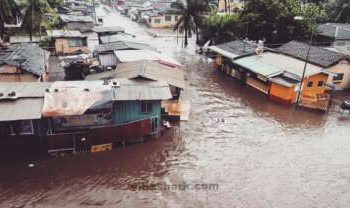
When floodwater rises in Ghana, it does not rise equally for everyone. Adults may be able to wade, detour, or wait for the water to recede, but children—especially schoolchildren—are often left stranded, frightened, and exposed. For them, flooding is not only a weather event; it is a daily threat to life, learning, and dignity.
In many communities, children still walk to school across streams, broken culverts, muddy paths, and low-lying bridges. When the rains come, those same paths become traps. The question is therefore not only how to manage floods, but who will protect the child who must cross them to get an education?
When School Becomes Fear
The school journey is becoming dangerous in flood-prone parts of Ghana. In the Sene East District, more than a hundred school-going children were left at home after eight pupils drowned while crossing the Volta Lake on their way to school. In Avetakpo, pupils were reported to be swimming across a stream each day to access education because there was no safe road or crossing point.
These are not isolated stories. They reveal a system in which children are expected to cope with hazards that even many adults would avoid. When a child has to gamble with floodwater before reaching the classroom, the country is quietly telling that child that education is important, but safety is optional.
The Numbers Tell the Story
The statistics are alarming. Following the Akosombo and Kpong dam spillage in 2023, about 14,704 children in North Tongu lost access to basic education, and 46 out of 73 basic schools in the district were affected. Another report put the number of children out of school at 19,743, with 71 schools submerged in flood-hit areas.
UNICEF also warned that climate-related flooding in Ghana has disrupted education for large numbers of children, showing that the problem is neither local nor temporary. The June 2026 floods in the Central Region further underscored the danger: NADMO reported 18 deaths, 8,981 flood victims, and 377 internally displaced persons after torrential rains in the Central Region. These are not abstract figures; they are children missing school, families displaced, and communities struggling to recover.
Death On the Way
The most tragic part of this story is that some children do not merely miss school—they lose their lives trying to reach it. In January 2023, eight pupils drowned at Atitagorme/Wayokope in the Sene East District while crossing a body of water on their way to or from school, and in May 2023, nine schoolchildren drowned at Fanaa in the Ga South Municipality.
These deaths should trouble every parent, teacher, and policymaker. A child should not have to understand currents, floating debris, or unstable canoes just to attend class. When education pathways become death corridors, the problem is no longer only transport or drainage; it is child protection.
Learning Lost, Futures Delayed
Flooding also steals time from children’s education. In Mepe and other heavily affected communities, pupils studied under trees, some classes were disrupted, and junior high students were left without proper learning spaces after the Akosombo and Kpong flooding. Reports have also shown that school attendance drops sharply in flood-affected areas after major rains, and some children eventually fall behind or drop out.
The damage is not only academic. Children who miss school repeatedly are more likely to lose confidence, become discouraged, and develop an uneven learning pattern. Floods, therefore, do not just interrupt one school term; they can interrupt a child’s whole future.
What GES Must Do
The Ghana Education Service should make flood safety part of school planning in every vulnerable district. It should identify schools and routes exposed to flooding, issue rain-season safety alerts, and coordinate with district assemblies, disaster agencies, and transport providers to create safer alternatives for children.
GES should also consider temporary learning adjustments during heavy rains, including flexible school hours, early closure where necessary, and emergency learning spaces for affected communities. In places where children are known to cross water bodies or dangerous drains, no child should be required to travel alone when conditions are unsafe.
What School Authorities Must Do
School heads must stop treating flooding as an occasional inconvenience. They should map students’ travel routes, identify high-risk crossings, and establish school-level safety protocols for rainy seasons. Teachers should be trained to prioritize student safety over attendance numbers when roads and bridges become dangerous.
Schools should also educate pupils on flood safety through guidance sessions, clubs, and assemblies. Children need to know when to turn back, who to call, and why they must never enter moving water, even if they are late for class. Safety education should be as regular as exam preparation.
What Parents Must Do
Parents must be vigilant and decisive during flood seasons. If a route is flooded or a bridge is submerged, a child should not be sent out simply because school has started. Parents should watch weather warnings, accompany young children where possible, and insist on safer travel arrangements.
They should also teach children to recognize danger: fast water, slippery paths, unstable canoes, and open drains. In flood seasons, love may sometimes mean keeping a child at home for a day rather than sending that child into water that cannot be trusted.
What Children Must Learn
Children must be taught practical survival habits. They should never walk into floodwater, climb unstable bridges, or board overloaded boats. They should also travel in groups where possible and report dangerous routes to parents, teachers, or community leaders immediately.
Most importantly, children should be encouraged to speak up when they feel unsafe. Many children stay silent because they fear missing school or being punished for lateness. Adults must make it clear that no lesson is worth a child’s life.
The Bigger Question
Flooding in Ghana is now a child-safety emergency as much as it is a climate emergency. The evidence shows children out of school, schools submerged, pupils drowning, and learning disrupted across several communities. The response must therefore be urgent, coordinated, and child-centered.
So, when floodwater rises again, and the road disappears, we must ask the question with honesty: Who will carry the child across? If the answer is “no one,” then the nation has already failed the child before the child even reaches the classroom.