



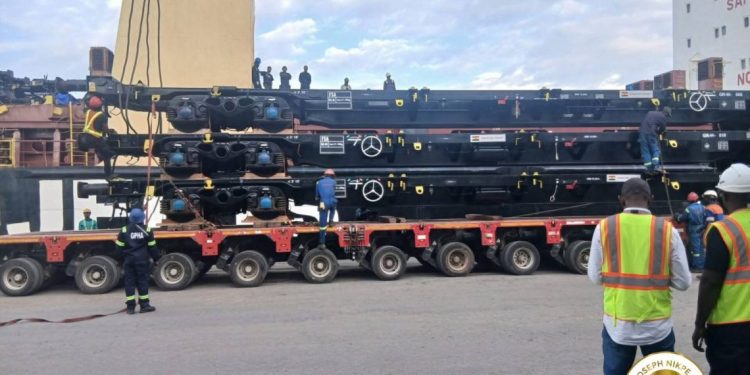
A former Member of Parliament for Ayensuano, Samuel Ayeh-Paye, and the Chief Executive Officer of the Ghana Railway Development Authority (GRDA), Dr. Frederick Appoh, have clashed over the feasibility and suitability of two locomotives procured for operations on the Tema–Mpakadan railway line.
The disagreement centres on whether the locomotives, which have been acquired for the standard gauge rail line, meet the technical and operational requirements for long-term use.
Speaking on Eyewitness News on Monday, July 6, Ayeh-Paye questioned the decision to deploy the locomotives, arguing that Ghana should have invested in newer rolling stock capable of withstanding long-term operational demands.
According to him, even though used locomotives can be acquired and refurbished, the current units do not meet the required specifications for sustainable railway operations.
“The Tema Mpakadan is a standard gauge train line and they have gone to expand the base so that it can run on a standard gauge track,” he added, warning that the current locomotives would not be fit for purpose.
Ayeh-Paye also questioned the long-term durability of the equipment, suggesting that Ghana risks repeating past transport challenges if proper planning is not prioritised.
He maintained that the locomotives would not serve beyond three years, insisting that Ghana must prioritise value for money in transport infrastructure investments.
However, GRDA Chief Executive Officer Dr. Frederick Appoh strongly disagreed with the claims, describing them as technically inaccurate and misleading.
He rejected assertions that the locomotives were incompatible with standard gauge operations, insisting that the Ghanaian system aligns with international railway standards.
“The most important thing here is that it is never true. It’s a Class 56 diesel locomotive. The traction motors have been replaced, the V16 engine capacity has all been done up,” he said.
He further assured that the locomotives have a projected operational lifespan of up to 15 years, contrary to claims that they would become obsolete within a few years.
At the same time, he clarified that the units fall within recognised production and operational batches used internationally between the 1970s and 1990s.
Meanwhile, the New Patriotic Party (NPP) has also weighed in on the controversy, alleging that the locomotives recently procured by government are outdated and unsuitable for modern railway operations.
The party claims the equipment consists of refurbished British Rail Class 56 diesel-electric locomotives manufactured between 1976 and 1983 and previously operated by Colas Rail, arguing that they are not fit for contemporary transport needs.
Amid the debate, the Ghana Railway Development Authority has disclosed that government has secured a $21 million European Union Commission grant to complete outstanding works on the Tema–Mpakadan railway line as questions persist over its readiness for full commercial operation.


![Municipal Chief Executive for Weija-Gbawe, Felix Odartey Lamptey [right]](https://www.citinewsroom.com/wp-content/uploads/2026/07/council--350x250.png)

![Municipal Chief Executive for Weija-Gbawe, Felix Odartey Lamptey [right]](https://www.citinewsroom.com/wp-content/uploads/2026/07/council--75x75.png)








