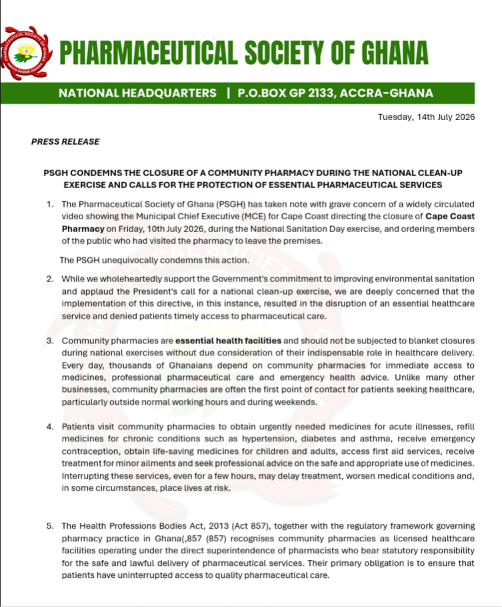
The Pharmaceutical Society of Ghana (PSGH) has condemned the closure of the Cape Coast Pharmacy during the National General Clean-up Exercise on July 10, describing the action as an unnecessary disruption of essential healthcare services.
The condemnation follows a widely circulated video allegedly showing the Cape Coast Municipal Chief Executive, George Justice Arthur, directing the closure of the pharmacy and asking members of the public who had visited the facility to leave.
In a statement issued on July 14 and signed by the President of the Society, Paul Owusu Donkor, PSGH said, although it supports the government’s commitment to improving environmental sanitation, community pharmacies should not be shut down during such exercises.
”While we wholeheartedly support the Government’s commitment to improving environmental sanitation and applaud the President’s call for a national clean-up exercise, we are deeply concerned that the implementation of this directive, in this instance, resulted in the disruption of an essential healthcare service and denied patients timely access to pharmaceutical care,” the statement said.
The Society stressed that community pharmacies are licensed healthcare facilities that provide immediate access to medicines, emergency pharmaceutical care, and professional health advice, warning that interrupting such services could delay treatment and, in some cases, put lives at risk.
It also cited the Health Professions Bodies Act, 2013 (Act 857), arguing that pharmacies have a statutory responsibility to ensure uninterrupted access to pharmaceutical care. The Society further noted that pharmacies were allowed to operate during the COVID-19 restrictions because they were recognized as essential service providers.
The PSGH described the closure of the Cape Coast Pharmacy as “unnecessary, disproportionate, and inconsistent with the essential healthcare role performed by community pharmacies.”
It urged the Municipal Chief Executive to exercise greater restraint in enforcing future directives involving healthcare facilities and called on government and Metropolitan, Municipal and District Chief Executives to formally recognize community pharmacies as essential health facilities during national exercises.
The Society also called for greater engagement between local authorities and health professional bodies before implementing directives that could affect healthcare delivery, saying such consultations would help achieve public policy objectives without disrupting patient care.