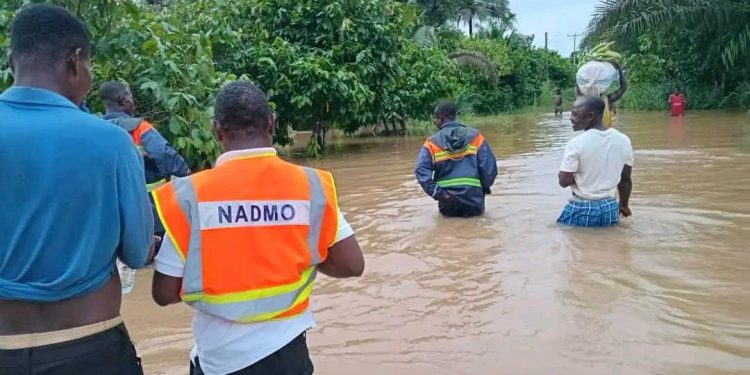
Every rainy season in Ghana arrives with a familiar script. Roads disappear beneath brown water, homes become temporary rivers, businesses count their losses, and officials promise that “measures are being put in place.”
Then the waters recede, the headlines fade, and so does the urgency—until the next downpour reminds everyone that flooding is not merely a natural disaster. It is the predictable consequence of years of leadership failure, neglect, and unfulfilled promises.
The issue of flooding is compounded by the sanitation challenges that emerge after floodwaters recede. This is another problem that does not require the gift of premonition to foresee but can be squarely attributed to poor policy engineering and indiscipline.
The response is usually a call to action, but what action are we being called to, and will this action bring an end to the phenomenon of perennial flooding?
The problem is known, and so is the solution. Therefore, when this call for action comes, should it be for Ghanaians to engage in clean-up exercises, or should Ghanaians themselves be demanding committed and sustained action towards solving this menace?
The Auditor-General, in compliance with Article 187(2) of the 1992 Constitution of Ghana and Section 13(e) of the Audit Service Act, 2000 (Act 584), prepared a performance audit report on the provision of flood control drains by the Hydrological Services Department of the Ministry of Works and Housing in 2021.
This report can be found on the Ghana Audit Service website: www.ghaudit.org
Now, here is why I say our problems are known, and so are the solutions.
The Auditor-General’s report on flood control lays bare a troubling reality: Ghana’s flood crisis is not simply about heavy rainfall. It is about institutions that have consistently failed to deliver on plans they themselves considered essential.
Between 2015 and 2019, the Hydrological Services Department (HSD) identified drainage infrastructure as critical to reducing flood risks. The Department planned to construct about 110 kilometres of storm drains and develop retention ponds across major drainage basins to temporarily hold excess stormwater before it overwhelmed communities.
The results tell a different story.
By the end of 2019, only 12.2 kilometres of drains had been constructed—just 11.1 percent of the target. Even more alarming, not a single one of the planned retention ponds had been built.
Apparently, in Ghana, targets are treated less as commitments and more as ambitious suggestions.
The report notes that the Ministry of Works and Housing and the HSD recognised the scale of the drainage challenge and set annual construction targets of between 20 and 30 kilometres because they believed this was the minimum required to make a tangible impact on flooding. Yet, year after year, implementation lagged far behind what was required.
Funding constraints undoubtedly played a role. In 2017, for example, the HSD planned to construct 30 kilometres of drains but received a budget ceiling of just GH¢1.66 million—an amount capable of financing only about 1.3 kilometres of drainage works. How can you build metropolitan flood resilience with village-level budgets?
Yet, the funding story alone does not fully explain the outcome.
The Auditor-General reports that between 2015 and 2019, GH¢117.7 million was spent on drainage works. Despite this expenditure, flood incidents across the country did not decline. According to National Disaster Management Organisation (NADMO) statistics cited in the report, flood events steadily increased over the same period, resulting in more deaths and greater destruction of property.
This raises an uncomfortable question.
If over one hundred million cedis is spent while floods become more frequent, what exactly improved?
Perhaps the floods simply failed to appreciate the government’s investment.
Or perhaps concrete cannot solve a problem when planning, execution, maintenance, and accountability remain permanently under construction.
Let me not even go into the Greater Accra Resilient and Integrated Development (GARID) Project, because the difference between that and the proposed plan by the HSD is the amount of money that has been sunk into it, with little or nothing to show.
Government must understand that infrastructure does not fail overnight. It fails gradually—through delayed projects, abandoned plans, inadequate funding, poor coordination, and a culture that rewards announcements more than delivery.
Every flooded classroom, every submerged market, every stranded commuter, and every family forced to salvage belongings from muddy water represents the accumulated cost of decisions postponed and responsibilities neglected.
The Auditor-General’s findings should not be viewed as historical records gathering dust on office shelves. They are evidence that Ghana’s flood crisis was foreseeable. Authorities knew the extent of the drainage deficit. They identified practical interventions. They established measurable targets. They simply failed to implement them at the scale required.
The tragedy is not that Ghana experiences heavy rainfall. Many countries do.
The tragedy is that flooding has become so routine and has unfortunately gained political currency in a heavily polarised society, where public announcements often receive more attention than prevention. Relief items are distributed with remarkable efficiency to gain political traction after disasters, while the infrastructure needed to prevent those disasters struggles to move beyond the drawing board.
Leadership is measured not by the number of “soap opera” clean-up exercises held after floods, but by whether citizens remain dry when the rains arrive.
Until planning is matched by execution, budgets by results, and promises by completed infrastructure, Ghanaians will continue to live with a painful annual certainty: the next flood is not a question of if, but when.
And when it comes, no official statement will be able to dam the waters that years of neglect allowed to rise.