



When you think about hydrogen and flight, the image that comes to mind for most is the Hindenburg airship in flames.
But in a lab deep in the basement of Imperial College in London, a young team has built what it believes is the future of air travel.
H2Go Power is seeking a patent to store the explosive gas cheaply and safely.
Until now, storing hydrogen required ultra-strong and large tanks which could withstand pressures of up to 10,000 pound-force per square inch (psi). That is hundreds of times greater than what you would find in a car tyre.
But, while studying for her PhD in Cambridge, Dr Enass Abo-Hamed came up with a revolutionary structure which could store hydrogen as a stable solid without compression.
“The pressure involved is similar to what you’d get in a coffee machine,” she says.
The university paired her with materials scientist, Dr Luke Sperrin, to try to find commercial applications for the innovation – and H2Go Power was born.
Test flight
Dr Sperrin is now chief technology officer. He and Dr Abo-Hamed formed a partnership with Canadian hydrogen fuel cell maker Ballard a year ago to create a drone which used their reactor to safely store hydrogen for flight.
Finally, after months of collaboration by phone and email, Dr Sperrin and chief product developer Peter Italiano flew to Boston for a ground-breaking test flight.
“Of course you need really good weather to fly a drone,” smiles Dr Sperrin.
“And it poured with rain for the first few days. We weren’t even sure whether we’d even be able to go ahead.
“So when it did fly, it was a huge relief.”
How it works
The aluminium reactor weighs less than a bag of sugar.
The small gas cylinder has an intricate network of 3D-printed aluminium tubes inside.
The hydrogen remains stable and solid in these structures until “coolant” is pumped through the tubes, warming them and releasing hydrogen gas to the drone’s fuel cell
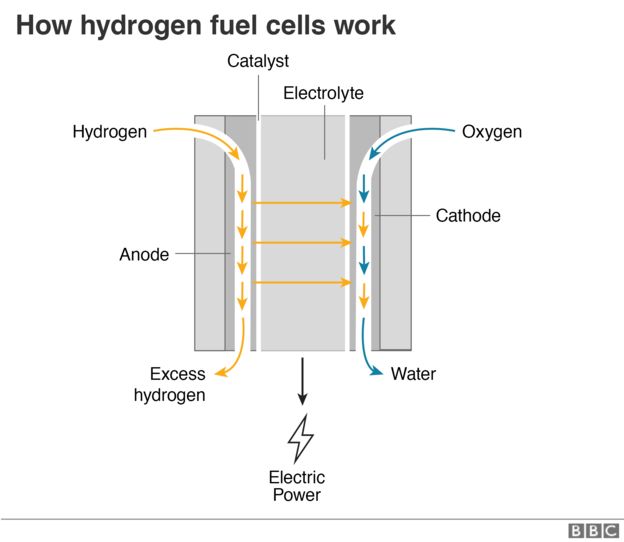
Hydrogen (H2) is pumped into one side of the fuel cell through a catalyst which frees electrons, creating electricity.
Oxygen (O) is then pumped into the other side of the fuel cell and combines with the leftover, positively-charged hydrogen atoms (H+).
The only final waste product is water vapour (H2O).
Never-ending supply
Until recently, a major hurdle to affordable hydrogen technologies was the cost of producing hydrogen gas.
Splitting water molecules into hydrogen used a lot of energy which usually came from fossil fuel sources.
However, the widespread availability of renewable energy and improvements in electrolysis – the chemical process of separating elements using electricity – have brought down the financial and environmental cost of producing hydrogen for fuel.
Currently, most countries have strict safety rules about flying drones over heavily populated areas.
Collision or technical failure could cause a drone to drop out of the sky.
Lithium-ion (Li-on) batteries are highly flammable, so a crash landing could trigger an explosion.
But, Dr Abo-Hamed points out, even if their drone fell out of the sky, the hydrogen would remain stable in its solid form inside the reactor.
Super fuel
“Hydrogen is a happy gas,” continues Dr Abo-Hamed. “It wants to move around.”
That’s what makes it so explosive. But, it also delivers more bang for your buck.
Hydrogen generates three times as much power per kilogram compared to fossil fuels – approximately 39.0 Kilowatt hours per kilogram compared with roughly 13 KWh per kg for kerosene or petrol or just 0.2 KhW for conventional lithium-ion batteries.
That means a hydrogen-powered drone can fly further than a battery-powered drone and, potentially, carry heavier loads.
Dr Abo-Hamed is excited about the possibilities for her innovation.
“So if drones could stay longer in the sky, they can deliver medicine,” she says. “Or scan a disaster area and send the information back.
“My dream really is not just to make drones.
“Maybe in the next twenty or thirty years we could de-carbonise air travel, which is something really important for our climate.”




