


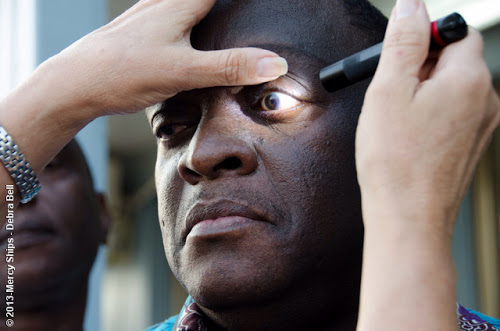
On March 23 every year, the world turns its spotlight on one of the key cadres of the eye care workforce, optometry. The optometry profession plays a crucial role in addressing the challenges in vision care across the globe and Ghana by preventing avoidable blindness along with making high-quality eye health and vision care accessible to all people.
According to the World Health Organization’s World Report on Vision, it is estimated that at least 2.2 billion people globally are visually impaired with at least 1 billion of these people suffering from a blindness cause that could have been prevented or can be treated.
Although blindness is a global public health concern, the burden is heavily skewed towards low and middle-income countries and rural communities. In Ghana, as high as 95 percent of persons with refractive error, the leading cause of visual impairment, are not using eyeglasses to correct the error.
What is optometry and who are optometrists?
Optometry is an autonomous health care profession that involves examining the eyes and visual systems for defects or abnormalities as well as prescribing the correction of refractive error with glasses or contact lenses and the treatment of eye diseases.
Doctors of optometry, or simply optometrists, are primary health care practitioners who examine, diagnose, treat, and manage diseases and disorders of the visual system, the eye, and associated structures as well as diagnose related systemic conditions.
The mission of the profession is to fulfil the vision and eye care needs of the public through clinical care, research, and education, all of which promote good health and enhance the quality of life.
What does an optometrist do?
In Ghana, optometrists mostly work independently in primary health care facilities (e.g. eye clinics) to provide comprehensive eye examinations at the community level while some work alongside other eye care professionals in a secondary or tertiary health care facilities (e.g. teaching hospitals).
For the healthy eye, optometrists check for refractive errors; myopia, hyperopia, or astigmatism, and presbyopia by performing sight-tests, and dispenses spectacles or contact lenses to correct any error found to exist.
The optometrist also checks for binocular vision defects, which is where both eyes do not coordinate in focusing properly, by testing for horizontal and vertical imbalances, and dispenses prisms, gives orthoptic exercises or visual training where such defects exist.
Finally, the optometrist checks for developmental eye and visual defects to see if there is any learning-disability; and helps with visual therapy or refers to a specialist on such matters.
For the unhealthy eye, an optometrist detects, diagnoses, and offers treatment and/or referrals for eye diseases and/or systemic diseases which have effects on the eye.
He or she also deals with paediatric (children) and geriatric (old people) cases. In those with a partially blind eye, the optometrist checks for the amount of residual vision and provides low vision aids or artificial eyes.
An optometrist also sees to the business and fashion part of dispensing of optical appliances for all categories of clients as well as counseling and consultancy services in the prevention of blindness and on taking hygienic care of the eyes.
In public health, optometrists go on outreaches, mostly in rural communities to screen eyes thus serving the community and the government/state. A doctor of optometry plays a role as a scientist by engaging in research in pathology, optics, contact lenses, pharmacology, and biomedical engineering.
How would one prepare for admission to study optometry?
Just for anyone seeking admission into health professions such as medicine, dentistry, and pharmacy, the prospective optometry candidate must, among other subjects, study and excel in English, Mathematics and Integrated Science at the Junior High School to be admitted into a science program at the Senior High School.
At the Senior High School the student should study and pass with high grades in at least, three (3) of the pure sciences (Physics, Chemistry, Biology, Mathematics), as the “Elective” subjects. Again, the student should also pass very well in the “Core” subjects i.e. English, Mathematics and Integrated Science. Entirely, the student must obtain a good aggregate.
With these grades, the student may apply either to the University of Cape Coast, Cape Coast, or to the Kwame Nkrumah University of Science and Technology, Kumasi for admission into the 6-year Doctor of Optometry program.
The six-year optometry curriculum includes courses in basic sciences, optics, anatomy, physiology, biochemistry, microbiology, and immunology, pathology, neurology, pharmacology, and therapeutics.
There are also courses on clinical optometry and diagnostics, binocular vision, visual perception, vision therapy, contact lenses, low vision and rehabilitation, among others.
Optometry students are required to obtain clinical experience through internship and externship as well as complete a research thesis before completion and award of the Doctor of Optometry degree.
Blindness and visual impairment have serious consequences on the life of the individual affected, the family, friends, colleagues, and employers. It creates a financial burden on the nation and has been identified as a significant contributing factor to poverty.
The training, practice, and distribution of optometrists in Ghana have been central to the fight against avoidable blindness from conditions such as cataract, refractive error, and glaucoma.
As the world battles to solve the COVID-19 pandemic, doctors of optometry are still working to prevent avoidable blindness. As President Olusegun Obasanjo once said, “we cannot afford to say ‘we must tackle other diseases first, then we will deal with chronic diseases.’ If we wait even 10 years, we will find that the problem is even larger and more expensive to address”.
Visit your optometrist today and get your eyes examined.
Happy World Optometry Day!
–
By: Dr Kwame Yeboah Jnr and Dr Enyam Morny
The writers of this article acknowledge the contribution of the late Dr Francis Kojovi Morny, the World Council of Optometry acclaimed Father of Optometry in Africa. Part of this article was adapted from his self-published pamphlet titled “Why Students Choose Optometry as a Career”. His legend lives on.









