• About Us
  • Privacy Policy
  • Terms of Use
  • Breaking News
  • Explainers
  • Listen Live
Saturday, July 25, 2026
Citinewsroom - Comprehensive News in Ghana
Advertisement
  • Home
  • News
    • Regional News
      • Ahafo Region
      • Ashanti Region
      • Bono East Region
      • Bono Region
      • Central Region
      • Eastern Region
      • Greater Accra Region
      • Northern Region
      • North East Region
      • Oti Region
      • Savanna Region
      • Upper East Region
      • Upper West Region
      • Volta Region
      • Western Region
      • Western North Region
  • Sports
    • World Cup
  • Politics
  • Business
  • Entertainment
  • Articles
  • Explainers
  • Editorials
No Result
View All Result
Citinewsroom - Comprehensive News in Ghana
  • Home
  • News
    • Regional News
      • Ahafo Region
      • Ashanti Region
      • Bono East Region
      • Bono Region
      • Central Region
      • Eastern Region
      • Greater Accra Region
      • Northern Region
      • North East Region
      • Oti Region
      • Savanna Region
      • Upper East Region
      • Upper West Region
      • Volta Region
      • Western Region
      • Western North Region
  • Sports
    • World Cup
  • Politics
  • Business
  • Entertainment
  • Articles
  • Explainers
  • Editorials
No Result
View All Result
Citinewsroom - Comprehensive News in Ghana
No Result
View All Result

Sri Lanka attacks: Face coverings banned after Easter bloodshed

Marian AnsahbyMarian Ansah
April 29, 2019
Reading Time: 2 mins read
ShareShareShareShare

Sri Lanka has banned face coverings in public, following a spate of suicide attacks on Easter Sunday that killed at least 250 people and injured hundreds.

President Maithripala Sirisena said he was using an emergency law to impose the restriction from Monday.

Any face garment which “hinders identification” will be banned to ensure security, his office said. Muslim leaders criticised the move.

The niqab and burka – worn by Muslim women – were not specifically named.

The move is perceived as targeting the garments, however.

Sri Lanka remains on high alert eight days after Islamist attacks that hit churches and hotels.

Dozens of suspects have been arrested, but local officials have warned that more militants remain at large.

How many people are affected?

Sri Lanka has a sizeable and centuries-old Muslim population – out of 21 million, just under 10% are Muslim.

Only a small number of women are thought to wear the face-covering niqab, or the burka – a one-piece garment that covers the face and body.

Last week a Sri Lankan MP had proposed a ban on women wearing the burka, saying it should be outlawed on security grounds.

The All Ceylon Jamiyyathul Ulama, an organisation of Muslim clerics in Sri Lanka, was highly critical of the president’s decision.

“It is the stupidest thing to do. Three days ago we took a voluntary decision regarding this. The All Ceylon Jamiyyathul Ulema told all Muslim women not to wear face veils for security reasons. If they wanted to wear a veil, then they were told not to come out,” Hilmy Ahmed, the group’s vice-president, told the BBC.

“We see this as a reflection of the conflict between the president and the prime minister. We strongly criticise the decision. We will not accept the authorities interfering with the religion without consulting the religious leadership.”

What’s the situation on the ground?

Over the weekend thousands of Sri Lankan troops stood guard on the streets, protecting churches and mosques.

Sunday church services were cancelled across the country as a precaution, but worshippers in the capital gathered to pray outside St Anthony’s Shrine, which was badly damaged in the attacks.

The number of people arrested in connection with the bloodshed rose to 150. Authorities are also hunting for around 140 followers of the jihadist group Islamic State, which has said it was involved in the bombings, but has not given details.
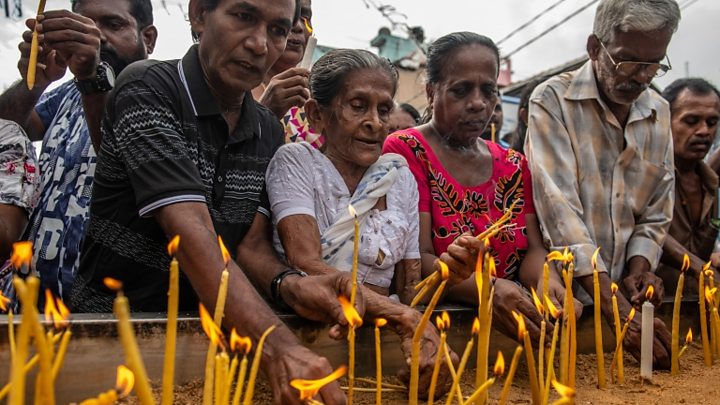
Sri Lankans pray and light candles, one week after a string of bombings by Islamist militants

On Friday, security forces raided a safe house used by the Islamist group NTJ, which authorities have said was behind the attacks. The group was founded by Zahran Hashim, the alleged organiser of the bombings who blew himself up at a hotel in Colombo.

As troops moved in on Friday, three men set off explosives, killing themselves, six children and three women. Three other people died in gunfire.

Hashim’s father and two brothers were among those who died in the operation.
Tags: Sri Lanka
ShareTweetSendSend
Previous Post

MPs begin sitting today after recall from recess

Next Post

Tamale: Fire guts St Charles Lwanga Seminary

Related Posts

Two of the arrested monks arriving at court on Sunday
International

Sri Lankan monks arrested after 110kg of cannabis discovered in their luggage

April 28, 2026
International

Sri Lanka sets up crisis team to manage water shortage

April 3, 2026
International

Middle East crisis: Sri Lanka declares Wednesdays a holiday to conserve fuel

March 17, 2026
International

Flooding in southern Asia leaves 600 dead

November 29, 2025
Saturday's election is widely regarded as a referendum on economic reforms meant to put the country on the road to recovery
International

Left-leaning candidate leads Sri Lanka presidential race

September 22, 2024
International

Sri Lanka: Seven killed as motorsports race car hits crowd

April 22, 2024
Next Post

Tamale: Fire guts St Charles Lwanga Seminary

ADVERTISEMENT
Citinewsroom - Comprehensive News in Ghana

CitiNewsroom.com is Ghana's leading news website that delivers high quality innovative, alternative news that challenges the status quo.

Archives

Download App

Download

Download

  • About Us
  • Privacy Policy
  • Terms of Use
  • Breaking News
  • Explainers
  • Listen Live

© 2024 All Rights Reserved Citi Newsroom.

No Result
View All Result
  • Home
  • News
    • Regional News
      • Ahafo Region
      • Ashanti Region
      • Bono East Region
      • Bono Region
      • Central Region
      • Eastern Region
      • Greater Accra Region
      • Northern Region
      • North East Region
      • Oti Region
      • Savanna Region
      • Upper East Region
      • Upper West Region
      • Volta Region
      • Western Region
      • Western North Region
  • Sports
    • World Cup
  • Politics
  • Business
  • Entertainment
  • Articles
  • Explainers
  • Editorials

© 2024 All Rights Reserved Citi Newsroom.