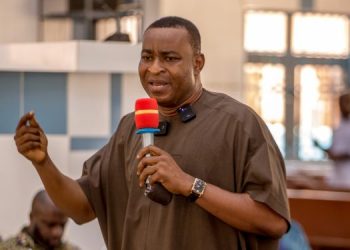
A road and building consultant, Mr Abdulai-Mahama, has called on the government to urgently summon the Chief Executive of the Tema Metropolitan Assembly, Ms Ebi Bright, over the alleged encroachment on a designated wetland in the Tema Heavy Industrial Area.
The site, which serves as a water retention basin and a major sewage management point for the area, has reportedly been filled with concrete structures by unidentified persons, raising concerns about flooding and a possible public health emergency. Sources say construction activities have been ongoing at the site for about two months.
Speaking in an interview on the Citi News Digest, Mr Abdulai-Mahama urged authorities to immediately reclaim the land and sanction those responsible, describing the development as a violation of Ghana’s land-use and environmental laws.
“The Minister for Local Government, the Regional Minister, has to call on the Metropolitan Assembly head for a meeting, and ask them how they interpret what I just read in the LI 2465, 2022. Because we cannot sit down and behave like ostriches and see that a developer for the past two months is undertaking a development that is going to be a danger to Ghanaians,” he said.
He questioned how unauthorised developments of such scale could occur without intervention, warning that failure to act could have serious consequences.
“Recently, I mentioned that it is happening at Abokobi. The boundary between La Nkwatanang and Abokobi has also seen a similar river being covered by an unknown developer. How many times must we sit down and allow unknown men to be developing places that are not authorised? If we do not sit up and call the shot, it will be too late,” Mr Abdulai-Mahama stated.
He further expressed concern that such developments could not be carried out without influence or backing.
“It cannot be that an ordinary person, without any political backing, will be able to go in and cause this,” he added.
Mr Abdulai-Mahama called for stricter enforcement of planning and environmental regulations, warning that continued inaction could expose communities to flooding, sanitation challenges, and broader public health risks.