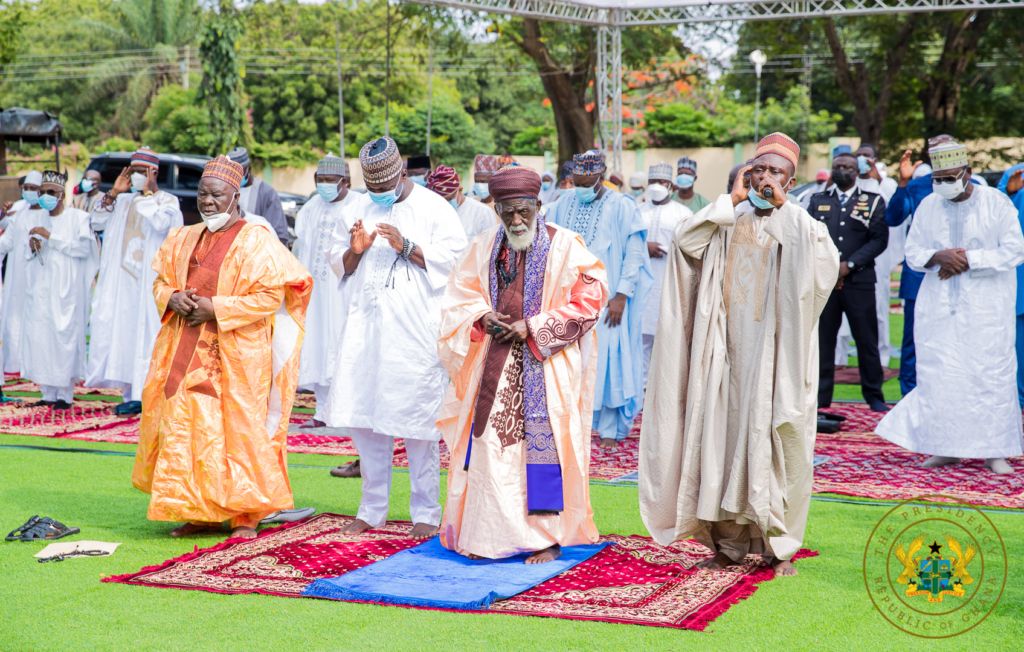
As Muslims across Ghana celebrate Eid after the month of fasting, the occasion offers more than a religious milestone.
It offers a national reflection. In that reflection, Ghana sees one of its finest civic virtues: the long, tested, and remarkably peaceful coexistence between Christians and Muslims.
In a world where religious differences often become fault lines, Ghana has, for decades, demonstrated that faith can be deeply held without becoming divisive.
The country’s religious demography itself makes this coexistence significant, not superficial: Ghana’s 2021 census confirms a Christian majority alongside a substantial Muslim population, meaning interfaith harmony is woven into everyday national life.
This peace did not happen by chance. It has been built gradually through everyday habits, family life, neighbourhood trust, shared institutions, and responsible leadership.
Scholars of religion in Ghana have long highlighted this pattern, describing Christian–Muslim relations as a model of peaceful coexistence maintained less by formal declarations than by what has been called a “dialogue of life”, the daily routines through which people work, mourn, celebrate, and raise children together. Studies of interfaith life in Ghana continue to show that social tolerance, religious freedom, and the example set by leaders have helped both communities coexist peacefully without significant religious conflict.
That is why Eid in Ghana has never been solely a Muslim affair in terms of emotion, just as Christmas has never been exclusively a Christian occasion. Throughout towns and cities, Ghanaians habitually cross religious boundaries to greet, visit, eat, and rejoice with one another.
This is the Ghana where a Christian neighbour sends food to a Muslim family at the end of Ramadan, and where a Muslim friend joins a Christian household at Christmas not as an outsider but as family. In many communities, coexistence is not merely discussed in academic terms; it is simply a lived reality.
Some of the most powerful examples are the smallest ones. In parts of Ghana, Christians have long invited Muslim neighbours to slaughter animals for festive meals, especially during Christmas, so that Muslim friends can eat with comfort and confidence. This may not be captured in national surveys, so it should be described carefully as a recurring and widely recounted social practice rather than a definitive national indicator. Yet, its moral significance is clear.
It reflects a culture where hospitality is willing to adapt to another person’s conscience. That is not mere tolerance. That is respect in action.
The same spirit manifests in education. For generations, many Muslim families in Ghana have sent their children to Christian-founded schools because those schools are regarded as places of discipline, academic excellence, and moral development.
This long history is documented in scholarship on faith and education in Ghana, which demonstrates that Muslim students’ presence in government-assisted Christian schools has been a longstanding reality, even where issues of accommodation and rights have occasionally arisen.
The deeper lesson is that trust has often outweighed suspicion. Muslim parents have not generally regarded Christian schools as hostile territory, and Christian institutions have often become formative spaces for children from different faith backgrounds.
The story also moves in the other direction. Muslims in Ghana have not remained apart from Christian public life. They have taken part in Christian ceremonies, kept friendships across different faiths, and engaged in national events led by Christian institutions.
The most symbolic public gesture of this spirit remains the visit by the National Chief Imam, Sheikh Osman Nuhu Sharubutu, to Christ the King Catholic Church in Accra in 2019. That visit resonated both nationally and internationally because it conveyed something Ghanaians already knew instinctively: religious conviction does not have to prevent fellowship across faiths. It was not a surrender of faith. It was a declaration of peace.
Indeed, Sheikh Sharubutu’s public presence has come to epitomise a broader Ghanaian ethic. His involvement in church communities, his friendly ties with Christian leaders, and his role as a unifier have strengthened the idea that religious leadership in Ghana is at its best when it upholds the common good. This matters because harmony must be exemplified from the highest levels if it is to thrive at the grassroots. Ghana has been fortunate that many of its notable religious figures have recognised this responsibility.
The state has often reflected this interfaith balance as well. Official events in Ghana frequently feature both Christian and Islamic prayers, a practice highlighted in the U.S. State Department’s 2023 report on religious freedom in Ghana.
This public display sends a clear message: the republic belongs to everyone, and national solemnity is reinforced, not diminished, when both faith communities are openly recognised. In a diverse society, symbolism carries weight. When citizens see both the pastor and the imam represented in national life, they are reminded that diversity is not a threat to unity but one of its fundamental elements.
Of course, Ghana is not perfect. No serious observer should romanticise interfaith life to the point of denying occasional tensions, particularly around schooling, worship practices, public holidays, or questions of accommodation. However, that is precisely what makes Ghana’s record so remarkable.
The country has not avoided differences; it has largely managed them without allowing them to escalate into prolonged hostility. That is a national achievement deserving of praise and protection. Research on religion in Ghana consistently suggests that this stability has been reinforced by social norms of hospitality, legal guarantees of religious freedom, and the ongoing efforts of both Christian and Muslim leaders in shaping public attitudes.
So, as Ghanaian Muslims mark Eid after Ramadan, this is not only a celebration of devotion following fasting. It is also a celebration of a country that, for many years, has allowed two major faith communities to flourish not in opposition but in shared fellowship.
It is the Ghana where Muslims have studied in Christian schools, Christians have adapted festive meals to include Muslims, the Chief Imam has visited churches, and state ceremonies have accommodated both mosque and church. In such moments, Ghana offers a lesson the wider world urgently needs: that faith can deepen identity without hardening the heart.
At Eid, then, Christians have reason to rejoice with Muslims, just as Muslims have long rejoiced with Christians at Christmas and Easter. That is the Ghanaian way. It is a quiet inheritance, but a powerful one. And it deserves not only to be admired but to be consciously preserved.
Explore the world of impactful news with CitiNewsroom on WhatsApp!
Click on the link to join the Citi Newsroom channel for curated, meaningful stories tailored just for YOU:
https://whatsapp.com/channel/0029VaCYzPRAYlUPudDDe53x
No spam, just the stories that truly matter! #StayInformed #CitiNewsroom #CNRDigital
![Dr. Ellen Ohene-Afoakwa, [middle], newly elected Chartered Institute of Bankers (CIB) Ghana President](https://www.citinewsroom.com/wp-content/uploads/2026/07/CIB-Ghana-e1784064646202-350x250.jpeg)