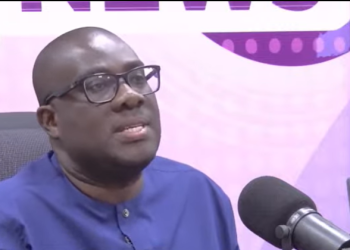
Private Legal Practitioner and member of the New Patriotic Party (NPP), Kwasi Kwarteng, has defended the prosecutorial mandate of the Office of the Special Prosecutor (OSP), arguing that its operations fall within a “standing delegation” framework under the authority of the Attorney General.
His comments come in the wake of a constitutional challenge filed by the Office of the Attorney General at the Supreme Court, which questions the legal foundation of the OSP and argues that Parliament exceeded its authority by granting the anti-corruption body independent prosecutorial powers.
Speaking on The Big Issue, Mr. Kwarteng referenced the Office of the Special Prosecutor Act, 2017, noting that the law provides that the OSP prosecutes offences on the authority of the Attorney General.
In his view, this does not strip the Attorney General of constitutional powers, but rather reflects a form of delegated authority.
He further argued that the constitutional and statutory framework must be interpreted purposively rather than strictly literally. He cited Article 88 of the Constitution, which vests prosecutorial authority in the Attorney General while allowing delegation in accordance with any law, noting that this supports the establishment and operation of institutions such as the OSP.
According to him, the concept of “standing delegation” means the Attorney General does not need to grant case-by-case approval before the OSP initiates prosecutions.
He cautioned against a purely literal interpretation of the law, suggesting that such an approach could wrongly imply that the OSP must seek direct permission from the Attorney General before prosecuting cases.
“Essentially it is talking about delegated powers. And the delegated powers does not necessarily mean that you have to pick a phone or go to the AG. There can be a standing delegation.”
Mr. Kwarteng maintained that when Article 88 is read together with Act 959, it becomes clear that Parliament intended a structured and continuous delegation of prosecutorial authority, rather than a removal of the Attorney General’s constitutional mandate.
The debate arises from an affidavit filed at the Supreme Court on April 8, 2026, in the case of Adamtey v. Attorney General, in which the state argues that the establishment of the OSP in its current form is unconstitutional.
Central to the Attorney General’s argument is Article 88 of the Constitution, which vests prosecutorial authority in the Attorney General’s office. While the Constitution permits delegation of such powers, the filing contends that this can only be done in respect of individuals, not an independent institution.
The Attorney General further argues that by enacting the Office of the Special Prosecutor Act, 2017 (Act 959), Parliament effectively transferred core prosecutorial powers without the requisite constitutional amendment.
Return to Ghana, submit to due process – Kwasi Kwarteng to Ofori-Atta