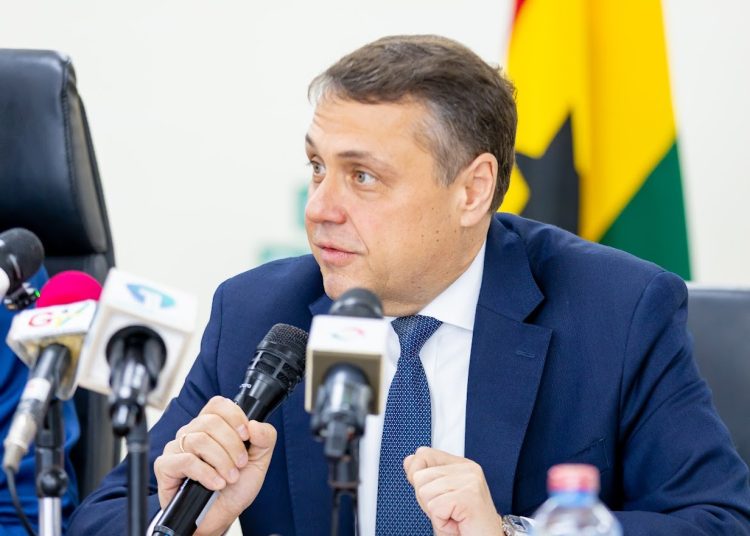
The International Monetary Fund (IMF) Mission Chief to Ghana, Dr. Ruben Atoyan, has defended the Bank of Ghana’s negative equity position, stressing that the central bank remains financially sound in terms of its core policy mandate and is on track for full recapitalisation in the coming years.
Speaking at a press briefing following the conclusion of a staff-level agreement with the Government of Ghana under the Policy Coordination Instrument (PCI) in Accra on Friday May 15, Dr. Atoyan said negative equity in central banking is not unusual and does not automatically signal insolvency.
According to him, what matters more is whether a central bank remains “policy solvent” — meaning it is able to generate enough income to cover its operational costs and carry out monetary policy effectively.
“So it’s not unusual for central banks to have negative capital, but what is important is what we call policy solvency,” he said.
He explained that based on the Bank of Ghana’s 2025 financial statements, the institution remains policy solvent despite the reported losses and negative equity position.
“The fact that the income the central bank is generating can cover all the costs and operational costs and costs of doing monetary policy… Bank of Ghana, based on financial statements from 2025, has been policy solvent,” Dr. Atoyan stated.
The IMF official further noted that central bank recapitalisation has already been factored into Ghana’s debt sustainability analysis, which will be published alongside the staff report.
He added that the Fund’s projections assume significant recapitalisation support but are deliberately conservative, noting that central banks can, over time, generate profits that help restore their balance sheets.
“We think we are actually overly conservative… central banks, by running policies, can generate significant profits and these profits should be used to recapitalise the central bank,” he said.
According to him, this approach could reduce the need for direct government capital injections, easing pressure on public finances.
Dr. Atoyan expressed confidence that the Bank of Ghana could be fully recapitalised by 2032 or even earlier, depending on policy and financial developments.
He also explained that 2025 was a particularly challenging year for the central bank’s balance sheet due to multiple cost pressures.
These included high open market operations costs linked to liquidity management, elevated interest rates during the fight against inflation, and exchange rate depreciation, which affected the Bank’s accounting position.
“At the same time, some of these pressures were partly offset by valuation gains on gold holdings,” he noted, adding that gold sales undertaken by the Bank of Ghana in late 2025 helped strengthen its income position.
The IMF also acknowledged losses linked to the Domestic Gold Purchase Programme but said discussions are ongoing with authorities to reduce and eventually eliminate such costs going forward.
Dr. Atoyan’s remarks come amid public debate over the Bank of Ghana’s 2025 financial results, which showed widening negative equity, even as key macroeconomic indicators such as inflation, the exchange rate, and reserves have improved.
His clarification adds to earlier explanations from government officials that the central bank’s balance sheet reflects the cost of stabilising the economy rather than operational failure, with emphasis on the broader objective of maintaining price and financial stability.
Read also