



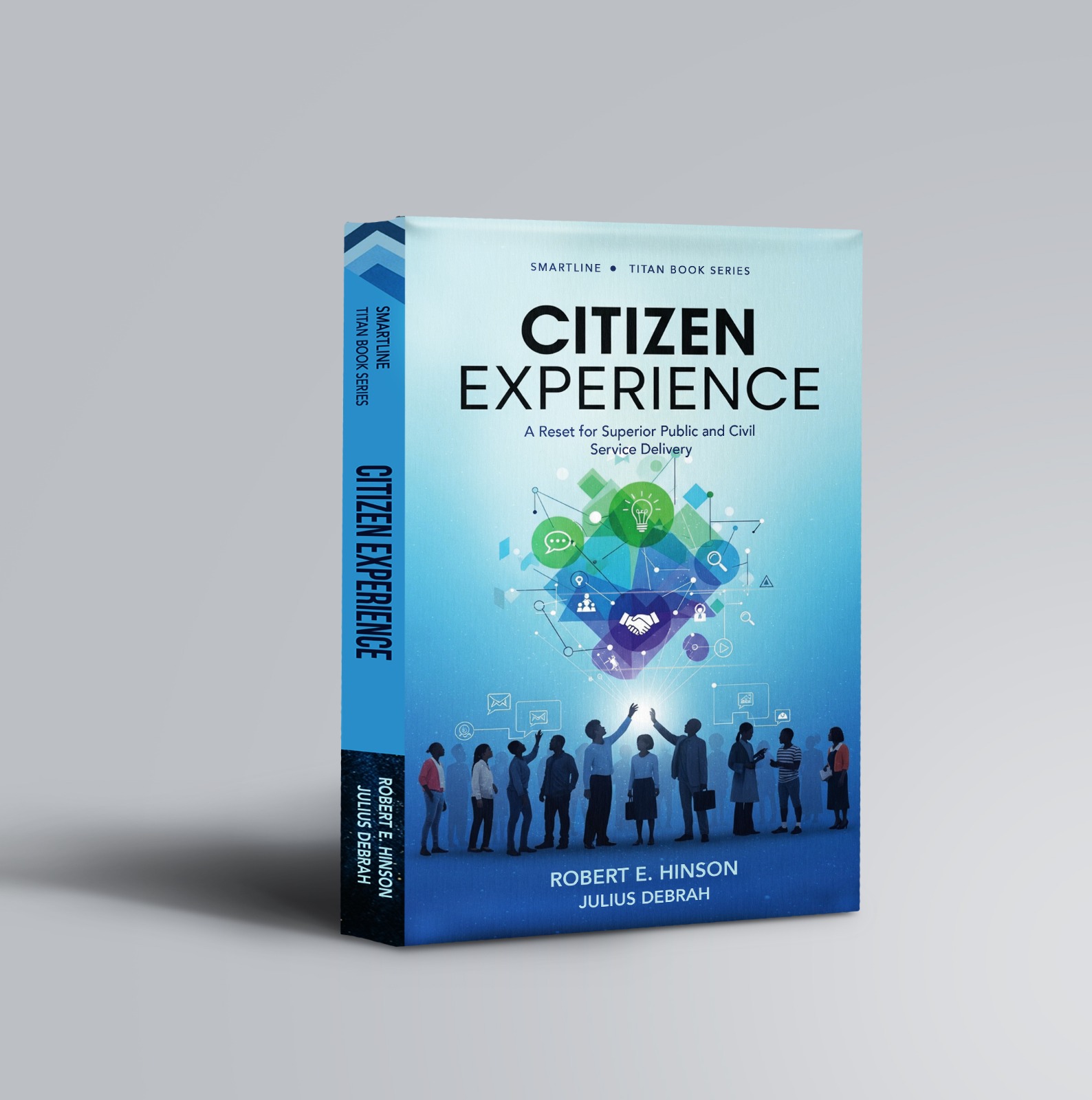
In truth, this book speaks! From preface to conclusion, I need a reminder “…I am reading, not listening. So why does it have a voice so clearly audible in my ear? I hear every word. I see every character in the imagined scenarios. It is a movie, and it is a box office hit!”
Citizen Experience – A Reset for Superior Public and Civil Service Delivery is a stark reminder that, regardless of the side of the divide we belong to, we are asking questions – as governments, to find out if their systems are functioning or as citizens, to find out how it feels to engage with the government systems.
These questions are fundamentally mutually exclusive. One is cognitive, it inquires the technical, the descriptive….the other is emotive, it processes the service interface and interprets the lived experience.
Regardless of age, this is not an easily put-downable book. It makes for puzzled reading, taking you into memory of encounters with news stories, conferences, chance meetings, school readings, career symposia, peer discussions, workplace banter, lighthearted chats, overhead arguments, citizen advocacy gatherings and talk (that is what they essentially are) that make the public sector reform conversation central features.
Citizen Experience offers a timely and thought-provoking intervention into the debate that, at the heart of the matter, a system that delivers seamlessly, but situates in indifference (at best), relative to time, place, space and the dignity of the ordinary man’s (and woman’s) lived experience, is not one that is dignifiedly efficient.
Hinson and Debrah demonstrate this with their argument that, evaluating the citizen’s experience of public and civil service delivery solely through traditional measures, such as institutional structures, administrative procedures and organizational efficiency, while winking at the feels and the psychological framework of the process, falls short of the true measure of how citizens actually experience their interactions with the state.
Chapter after chapter, you are drawn into the relatable scenarios of characters, which while made up, are not only too relatable, but also too readily recallable from memory. For every character described and the painstaking journey they were on…just being, you, or someone very close, has been or is actually going through it. As a Public Policy student, the conceptual framework that Hinson and Debrah offer is one of the book’s most practically valuable policy contributions that triggers institutional debate.
Hinson and Debrah insist…and rightly so…that a fundamental system shift is required to change solutions and service delivery across the continent, and this should stem from the knowing that customer experience and citizens’ experience are mutually exclusive.
Citizens’ experience transcends PR gimmicks and it is a complex holistic totality of the thoughts, feelings, and conclusions about the state, as a result of every interaction they have with it.
Even more telling of this relationship is the knowing that, in most African countries, the citizens’ concurrence of the state’s performance or cumulative dissatisfaction, can be legitimately democratically demonstrated by an endorsement or a disapproval every four or five years.
The book advances some compelling and accurately diagnosed interconnected arguments that are worthy of note. Firstly, that Citizen Experience is a governance issue and not a customer service issue, could not have been more accurate.
This not only situates the responsibility ultimately at the doorstep of the state, but also puts the weight of the responsibility of anyone in the line of duty, serving the citizen, as a representative of the state.
Similarly, it not only becomes the responsibility of the frontline office/department to give the citizen the best experience, but everyone’s duty to bear them up. Sometimes, a simple “have you been seen to?”, “we will be with you shortly”, “thank you for waiting” are communicative ways that show compassion, empathy, accountability coming from anyone, even better from high-up officers, including directors and ministers.
Secondly, the Hinson and Debrah place leadership as the primary variable. They put leadership at the apex of the citizen experience pyramid, arguing that institutions deliver what their leaders prioritize. Leaders spearhead or commission strategic documents that meticulously lists hard skills; the fine lines, the technicalities, even more recently, the Ai-ready future structure, that will be at the centre of the business. Unfortunately, these are crafted without recourse to the citizens’ trust they erode, by the sheer automation of their sequence of events and indifference of process(es). This is the disruption of orientation the authors seek to achieve in Citizens Experience.
The third, and perhaps, my favourite, is the state systems, which the authors suggest lies in its conceptual repositioning of citizens at the center of governance processes. Strategy, structure, technology, culture, staffing, skills, etc, need to be redesigned around the citizens’ journey, rather than the institutional mandate. Traditional public and civil service administration has often focused on institutions, policies, and administrative systems as the primary units of analysis. While these elements remain relevant, the Citizen Experience perspective offers a valuable corrective by emphasizing the lived experience outcomes of governance as experienced by ordinary people.
This enables the institution to design support systems that will adequately capture a wide spectrum of citizens with varying needs. In the most well-documented strategic documents, the citizen, often referred to as the customer is identified as the centre of the business or agency.
Ironically, in reality, this citizen looks better in print than in person, and this is the irony that Hinson and Debrah need us to realize, question and do something about. Whether we are studying or working in corporate or in public service, we may have all been, met, spoken to, or heard the story of Abena, Kofi or lived their experience, going through the public administration service delivery, and our best verdict would shamefully be, indifference! At best! The indifference is accepted. Almost expected! When what is a little over bare minimum is delivered, there is shock…gratitude and expectation of reward.
The fourth diagnosis and perhaps the most overlooked, is that the people of the civil service are the most important, yet most neglected resource in the transformation of the Citizen Experience. The politicians, who are appointed heads of the public and civil service, and drive the leadership (the primary variable) of these institutions, are by Hinson and Debrah’s definition, on a learning curve, for all of four or five years.
The civil and public servants, on the other hand, serve under these politicians, and having been there and done that, offer the rich experience the latter to tap from. These are the resource who the authors demand must be maintained and their experience harnessed for succession planning.
The other dimension to this, is expressed best by Branson (2014) “Clients do not come first. Employees come first. If you take care of your employees, they will take care of the client” Happy employees produce happily served citizens. Let us admit…workplace joy can be contagious. Happy employees are more likely than not, to be happier to serve, offer help and give off better performance than standard practice.
Hinson and Debrah lastly agree that transformation of citizen experience requires a national agenda accountability system. Commitments towards it must be communal, continual and sustained, so that effects defy political orientation, particularly within African governance contexts. Leadership reform must include actionable strategies that emphasise citizen dignity, as a dimension of public service delivery.
The authors hinge this discussion, to look beyond governance reform that focuses narrowly on efficiency and effectiveness, while neglecting the human dimensions of service provision. By foregrounding dignity, the authors recognize that citizens’ experiences encompass not only outcomes, but also the quality of interactions; respectful treatment, clear communication, empathy, and responsiveness as essential components of citizen satisfaction, that are often underestimated in administrative reform initiatives and to which the state is ultimately accountable.
The authors express concern about the complexity of the challenge the citizen faces. For many African countries, some public service institutions are all in themselves – judge and jury. They are unable to frustrate you into the arms of their competitor.
You do not have the luxury of walking away from their service, as a result of dissatisfaction. For example, you are stuck with passport office, regardless of how long and frustrating the process takes. You will need to wait for a police report, irrespective of the disappointment of finding out that, having already waited eight weeks, the name and personal details you provided have been spelled incorrectly. You will need to return to the Registrar General’s Department after four failed attempts to receive documentation that has been promised you, having done everything right.
It could feel like returning to the “abuser” after the abuse, because there is no alternative. Hinson and Debrah’s framing of this as the God concept, is instructive of their power and painfully monopolized orientation, that only perpetuates their lack of urgency, sense of accountability and grandiose unrepentant indifference. With no consequential citizen “market share” to lose, there really is no incentive to do better.
Matter of fact, the citizen, rather than complain about the service, comforts themselves, that ultimately, they delivered, late or not, cumbersomely or not, haphazardly or not, undignifiedly or not!
Hinson and Debrah also discuss the big issue across Africa – rewarding acts of public service that are already in the line of work of the public servant, for which remuneration is received. Acts of corruption often rebranded as acts of gratitude for service rendered. Hinson and Debrah refer to the transactional nature of this relationship and its effect on the citizen’s experience.
The “act of gratitude” is expected. It is sometimes a demand, when the service delivery is as should be, because practice otherwise is fraught with delays, overly bureaucratic and littered with avoidable obstructions. These acts singlehandedly exclude a number of people from certain services, relative to speed, access, depth, only because, that resource handicap, denies them a fair fighting chance at services their taxes have already paid for.
That these acts are labelled as “thank yous” do not alter their nature and purpose, albeit that they redefine their social construction, to make them less semantically bedeviling.
The depth of the diagnoses made by Hinson and Debrah is telling, because it stems from the perspective of the “Chief Human Resource Manager” of the government machinery, one of the authors, who has legislative, as well as institutional outlooks, having done this for several years, over two separate democratic administrations.
This enriches the arguments, when they reckon that foundationally, public and civil service institutions have not been intentional about structuring the comprehensive experience of the citizen into their strategic frameworks. The constitution, which is the blueprint from which the legal mandates emanate, is clear on what the citizens have a right to expect from the institutions, but does not answer what Hinson and Debrah opine, is the citizen’s fundamental question – “what does it feel like to deal with the public and civil service?” That is the notable practical re-engineering we need to embark on, in agreement with Hinson and Debrah.
Beyond the diagnoses, the authors admit, that given the diversity of needs of citizens and cosmopolitan nature of public institutions across Africa, a one-size-fits-all solution is not plausible. What is crucial is a credible, measurable, suitable, adaptable, transparent, repeatedly demonstrable and verifiable structure, that works best for each time, place and space. They describe a seven-dimensional citizen experience from accessibility, clarity, speed, dignity, fairness, consistency to outcomes, at the end of which, in my opinion, espouses citizen-centrism. These guide the fundamentals of systems we should question, questions we should ask, “solutions” we should interrogate, bare minimums we should not applaud and the excellence we should accept and become used to. They also distinguish principles of universality, dignity, equity, accountability, and public value, which intrinsically work together with the dimensions to deliver holistic and impactful results.
In concluding, let me address the proverbial elephant in the room – Ai vis-à-vis the citizen experience. It may perhaps be safe to say, digitalisation solves a huge chunk of the challenge, as eradicates the human element and its accompanying distractions.
That argument can answer the government question “are our systems working?” but still does not answer the citizens’ question “how does it feel to deal with you?”. The truth of the matter is that the complexity of the human interaction and the outcome of that relationship is not easily machine replaceable. Humans can read ambiguity in voice, affection, embarrassment, affection and warmth.
A citizen can read a room, sense tension and silence and detect insincerity in a smile. The citizen may not be seeking the systemic perfection that the digitized system may apply, but the social understanding and emotional cognition that tells them that they matter. That is human intelligence, human interconnection and human inspiration, which the Citizen Experience: Reset for Superior Civil Service Delivery, champions!
Overall, the book is a great resource for policymakers, public servants, and reform leaders seeking to bridge the gap between government promises and citizen realities. Its central message – that effective governance should ultimately be judged by how citizens experience the state, is both compelling and urgently relevant for Africa’s public sector transformation agenda. Read it. Be inspired by it. Talk to others about it. Be unsettled by it…and make a positive decision to changing something in the interest of service to the citizen because of it.
Lawrraine Hart Darke
Public Policy | Corporate Communications