Ghana’s creative industry holds significant untapped economic potential, but creators must move beyond treating their talents as hobbies and begin building sustainable businesses around their content, according to Digital Lead at PopOut, Maximus Ametorgoh.
He argues that the country already possesses the creativity, cultural assets and talent needed to compete globally, but requires stronger commercialization strategies, digital literacy and governance structures to transform creative works into viable economic products.
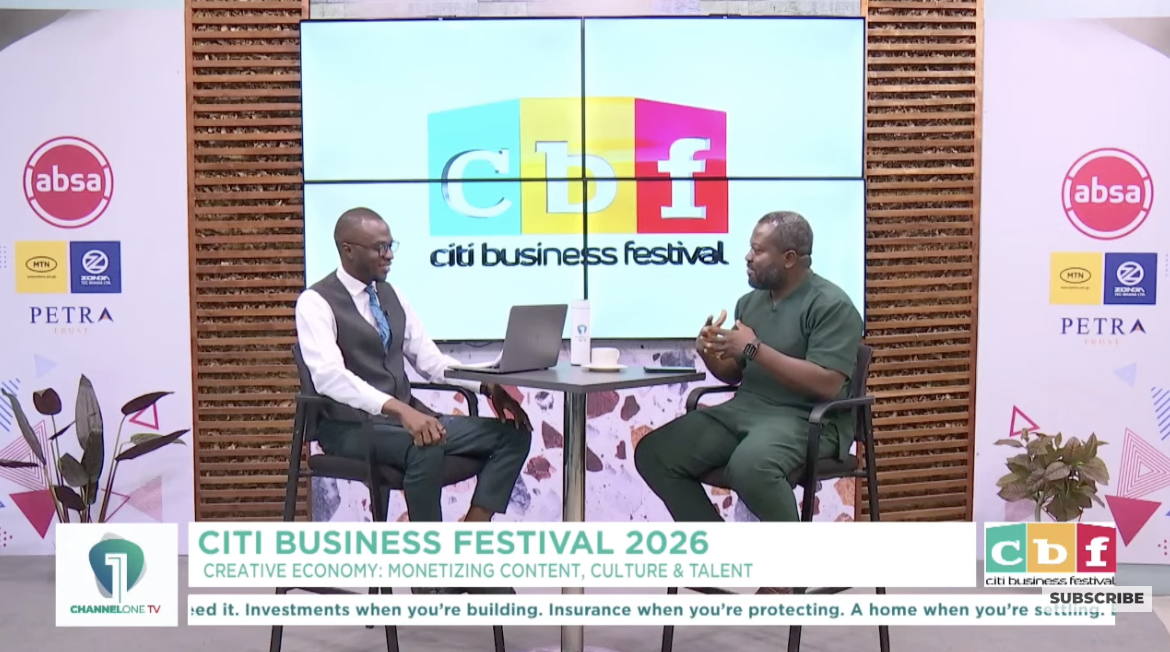
Speaking on the on-air series of the 2026 Citi Business Festival with Nii Larte Lartey, Ametorgoh said the creative economy is fundamentally about converting creativity, talent and knowledge into economic value.
“Creative economy is just about turning your creativity or talent or knowledge into an economic value. If I produce a movie, play games, develop games or create digital content, I should be able to convert that into economic value and make some money from it,” he explained.
According to him, many talented individuals remain trapped in what he described as the “hobby lobby” because they focus on passion without developing clear revenue models.
“You think your creativity is just a hobby, when people are monetising it. You are excited about the passion and adrenaline but you are still broke, so you need to find a way of monetising that to move away from that hobby lobby into a business district,” he stated.
Ametorgoh noted that Ghana is already approaching the midpoint of its creative economy journey, citing the abundance of creative output across sectors such as fashion, visual arts, music, film, gaming and storytelling.
“We have the creativity already. We have artefacts of it, we have evidence of the creativity already there. We just need to find a marketplace for the creativity and give it some economic governance structure,” he said.
He further stressed that digital platforms have lowered the barriers to entry for aspiring creators, making it possible to launch content businesses with minimal investment.
“Your phone is like a publishing house, your studio. The phone that you have can convert video instantly and you can even post a video instantly,” he said.
Ametorgoh advised content creators to approach their craft from a business perspective from the outset rather than waiting for audiences to emerge before considering monetisation.
“Monetisation doesn’t come by chance,” he stressed.
He outlined multiple revenue streams available to creators, including advertising income from platforms such as YouTube, TikTok and Facebook, merchandise sales, premium subscriptions, sponsorship deals, event ticket sales, online courses and licensing arrangements.
For musicians, he noted that earnings can extend well beyond streaming revenues.
“You can stream your music, sell event tickets, sell branded merchandise and even develop courses on how to start a music career or write songs,” he explained.
On content distribution, Ametorgoh encouraged creators to tailor content formats to specific platforms, noting that Facebook audiences consume a mix of text, images and videos, while YouTube remains video-centric and TikTok caters largely to shorter-form content.
He also highlighted collaboration as a critical growth strategy, urging emerging creators to partner with established personalities within their niches to accelerate audience acquisition and channel growth.
Beyond content creation, Ametorgoh underscored the importance of personal branding, warning creators against constantly switching focus across unrelated ventures.
“Personal branding is very key. Don’t be talking about comedy, the next moment you are selling tilapia, the next moment you are doing something else. Be known for something,” he advised.
He further called for greater attention to intellectual property protection, encouraging creators to seek legal guidance and formally register original works to safeguard future earnings.
“Any content you create, as much as possible, talk to a lawyer or intellectual property lawyer about how you can register that so that people will not use it for free,” he said.
The 2026 Citi Business Festival is powered by 97.3 Citi FM and Channel One TV in partnership with Absa Bank and sponsored by Absa Bank, MTN, Zonda Tec Ghana Limited and Petra Trust.


![School prefect Asuo Angela, on behalf of students of Sagnarigu Girls’ Model JHS [right], presents a petition to Sagnarigu MCE Abdulai Gong [left].](https://www.citinewsroom.com/wp-content/uploads/2026/06/SAGNARIGU-1-350x250.jpeg)