


The Silent Economic Crisis Hiding in Plain Sight
While national discussions continue to focus on debt, taxation, energy, and infrastructure, a far less visible crisis is quietly draining billions of cedis from Ghana’s economy every year.
According to a recent study by the Institute of Statistical, Social and Economic Research (ISSER) at the University of Ghana, the country loses more than GH¢6.2 billion annually due to diseases and health complications linked to poor waste management and sanitation. The figure represents a staggering economic burden that continues to grow despite years of policy discussions and public awareness campaigns.
The report paints a troubling picture: Ghana is not merely dealing with a sanitation challenge; it is forfeiting a major economic opportunity while exposing millions of citizens to preventable health risks.
A Crisis Beyond Dirty Streets
For many Ghanaians, poor waste management is often associated with choked gutters, overflowing refuse containers, and periodic flooding. But the ISSER study reveals that the consequences extend far beyond environmental concerns.
Poor sanitation contributes to disease outbreaks, increased healthcare costs, lost productivity, absenteeism from work and school, and premature deaths. Every sick worker, every missed school day and every preventable hospital admission carries a cost that ultimately weakens national productivity and economic growth.
The GH¢6.2 billion annual loss represents resources that could otherwise be invested in schools, roads, healthcare facilities, job creation, and industrial development.
The Economic Case Government Cannot Ignore
Perhaps the most alarming revelation from the ISSER report is not the scale of the losses but the magnitude of the opportunity being missed.
The researchers found that under Ghana’s current level of investment in waste management, every GH¢1 invested generates approximately GH¢180 in economic returns. Even more striking, if investment levels were increased to match international lower-middle-income standards, returns could rise to GH¢556 for every GH¢1 invested.
In economic terms, few sectors offer such extraordinary returns.
This means waste management is no longer simply a sanitation issue. It is an investment opportunity capable of delivering significant economic growth, public health improvements, and employment generation.
Yet despite this evidence, waste management remains chronically underfunded and largely treated as a municipal obligation rather than a strategic national investment.
The Global Race Ghana Risks Missing
The urgency becomes even clearer when viewed against global trends.
The global waste management industry is currently valued at approximately US$1.6 trillion and is projected to reach US$2.5 trillion by 2030. Globally, nearly three billion people still lack access to basic waste services, creating what industry analysts estimate to be a US$500 billion investment opportunity before 2040.
Around the world, governments and private investors are increasingly treating waste as a resource rather than a nuisance. Countries are building thriving industries around recycling, waste-to-energy technologies, composting, circular economy systems, and resource recovery.
These investments are generating jobs, attracting private capital, and creating sustainable businesses.
Ghana, however, risks being left behind if policymakers fail to move beyond short-term waste collection contracts toward long-term sector transformation.
A Threat to Public Health and National Competitiveness
The consequences of inaction extend beyond economics.
Rapid urbanisation, population growth, and changing consumption patterns are increasing the volume of waste generated across Ghana’s cities and towns. Without major investments in collection systems, recycling infrastructure, treatment facilities, and public education, existing challenges are likely to worsen.
The result could be increased disease outbreaks, environmental degradation, flooding, and escalating healthcare costs.
For a country seeking to attract foreign investment and position itself as a competitive destination for business, persistent sanitation failures also damage investor confidence and undermine Ghana’s international image.
No modern economy can sustain high levels of productivity while struggling with basic waste management.
Time for a National Waste Management Strategy
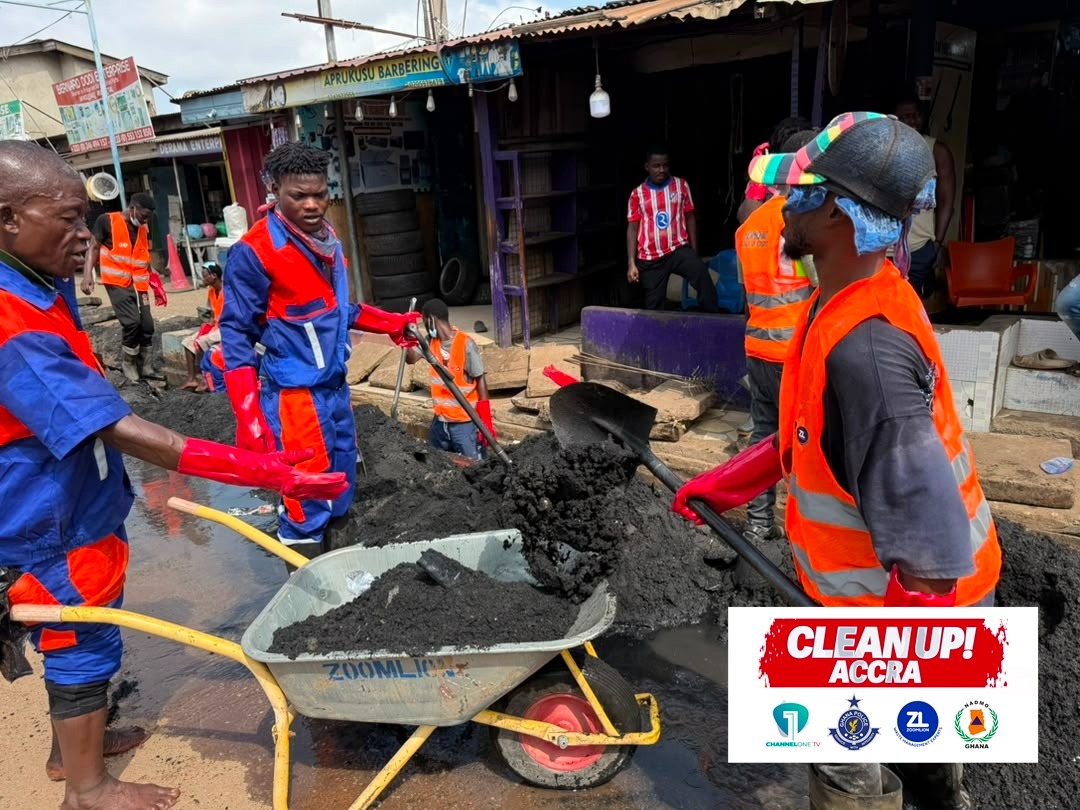
The growing urgency for action also underscores the importance of public-private initiatives aimed at improving sanitation and environmental awareness. One such intervention is the Clean Up Accra exercise organised by Zoomlion Ghana Limited in partnership with Channel One TV and the Ghana Police Service.
The exercise brings together citizens, institutions, and community stakeholders to clear refuse, desilt drains, and promote responsible waste disposal practices across the capital. Beyond the immediate environmental benefits, such initiatives help foster behavioural change, strengthen public participation in sanitation management, and draw attention to the broader economic and public health consequences of poor waste management.
As the ISSER findings demonstrate, tackling Ghana’s sanitation challenges requires not only policy reforms and investment but also sustained community engagement and collective action to prevent the billions of cedis lost annually through sanitation-related diseases and environmental degradation.
The ISSER findings should serve as a wake-up call for government, local authorities, development partners and the private sector.
The evidence is clear: investment in waste management is not an expense—it is an economic growth strategy.
A coordinated national response should include increased public investment, incentives for private sector participation, support for waste-to-energy initiatives, stronger enforcement of sanitation regulations and the development of a comprehensive circular economy framework.
The cost of action may be significant, but the cost of continued inaction is far greater.
Every year Ghana delays, billions of cedis are lost, public health suffers, and a potentially transformative economic sector remains underdeveloped.
The question is no longer whether Ghana can afford to invest in waste management.
The real question is whether Ghana can afford not to


![Midfielder Thomas Partey [File image]](https://www.citinewsroom.com/wp-content/uploads/2026/06/PARTEY-350x250.webp)