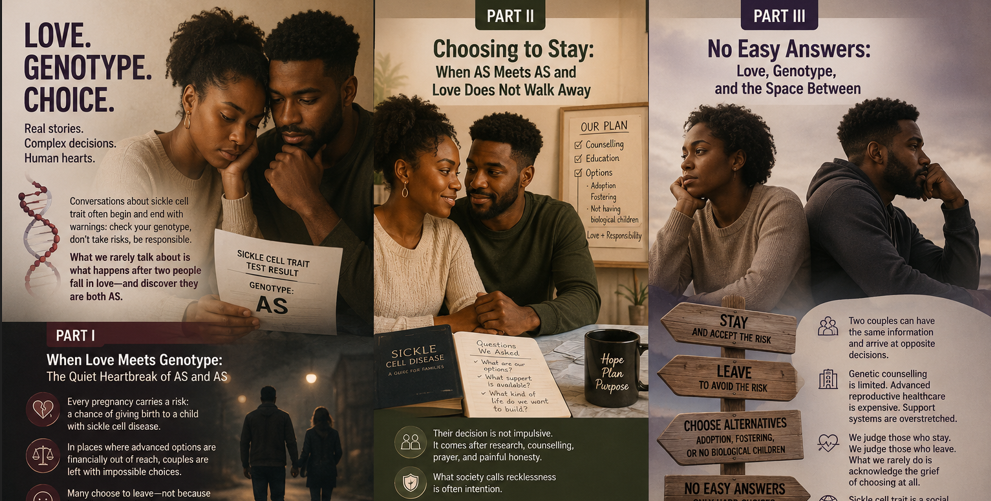
Conversations about sickle cell trait often begin and end with warnings: check your genotype, don’t take risks, be responsible. What we rarely talk about is what happens after two people fall in love—and discover they are both AS.
This series explores the emotional, moral, and social realities AS–AS couples face. Not to prescribe answers, but to sit with the questions. Because behind every genotype discussion is a human story.
PART I
When Love Meets Genotype: The Quiet Heartbreak of AS and AS
They met like most people do—through conversation, laughter, and that easy sense of connection that grows into something deeper. Nothing about their love felt complicated at first. They talked about dreams, work, and family. They planned futures that felt possible.
Until the question of genotype came up.
Both AS.
Suddenly, love was no longer just about feelings. It became about probability. About science. About children who did not yet exist.
For AS–AS couples, every pregnancy carries a risk: a chance of giving birth to a child with sickle cell disease, a condition marked by pain crises, hospital visits, and lifelong medical care. These statistics are taught clearly. Living with their implications is not.
In places where advanced reproductive options like pre-implantation genetic testing are financially out of reach, couples are left with impossible choices. Risk it. Decide not to have biological children. Or walk away from someone they love deeply.
Many choose to leave—not because love disappears, but because fear takes over. Fear of watching a child suffer. Fear of not having enough resources. Fear of guilt.
These breakups are rarely loud. They happen quietly, after long conversations and sleepless nights. And long after they happen, the love often remains.
PART II
Choosing to Stay: When AS Meets AS and Love Does Not Walk Away
Not every AS–AS story ends in separation.
Some couples choose to stay—eyes open, hearts steady.
Their decision is not impulsive. It comes after hospital visits, counselling sessions, research, prayer, and painful honesty. They talk early about alternatives: adoption, fostering, or choosing not to have biological children. For them, responsibility is not avoidance—it is preparation.
What society often labels as recklessness is, in truth, intention.
These couples are frequently judged. Told they are selfish. Warned that they are gambling with a child’s life. What is overlooked is the depth of thought behind their choice—and the courage it takes to commit under uncertainty.
Staying together does not mean ignoring risk. It means accepting reality and redefining what family can look like. It means choosing a partnership in a world that offers information without support.
Their hope is not naïve. It is grounded in planning, faith, advocacy, and the belief that love—when matched with responsibility—can still build something meaningful.
PART III
No Easy Answers: Love, Genotype, and the Space Between
Between staying and leaving lies a truth we avoid: there are no easy answers.
Two couples can have the same information, the same genotype, and arrive at opposite decisions—both rooted in love, both shaped by fear, context, and capacity.
What makes these choices even heavier is inequality. Genetic counselling is limited. Advanced reproductive healthcare is expensive. Support systems for families living with sickle cell disease are overstretched. So couples are asked to make life-altering decisions with incomplete support.
And yet, society is quick to judge.
We judge those who stay.
We judge those who leave.
What we rarely do is acknowledge the grief of choosing at all.
Sickle cell trait is not just a medical issue—it is a social and economic one. It forces young people to weigh love against risk in a system that does not always offer real alternatives.
Until access improves, AS–AS couples will continue to make these decisions quietly—carrying both responsibility and loss.
Perhaps the most humane response is not to dictate what couples should do, but to ensure that whatever choice they make, it is informed, supported, and free of shame.
Love should not be punished for biology. And responsibility should not come at the cost of compassion.
These stories deserve space—not whispers.