How the adidas TRIONDA is changing the game
For generations, football fans have viewed the match ball as the simplest piece of equipment on the pitch. Round, leather-covered, and designed to be kicked. But at the 2026 FIFA World Cup, the official match ball is proving that football has entered a new technological era.
The official ball for the tournament, known as TRIONDA, is far more than a beautifully designed football. Developed by adidas in collaboration with FIFA, it contains sophisticated technology that helps referees make better decisions, improving the accuracy of officiating and offering deeper insights into every movement of the ball.
As the world watches the first-ever World Cup hosted jointly by three countries — the United States, Canada and Mexico — the ball itself has become a symbol of innovation and the future of football.
Why is it called TRIONDA?
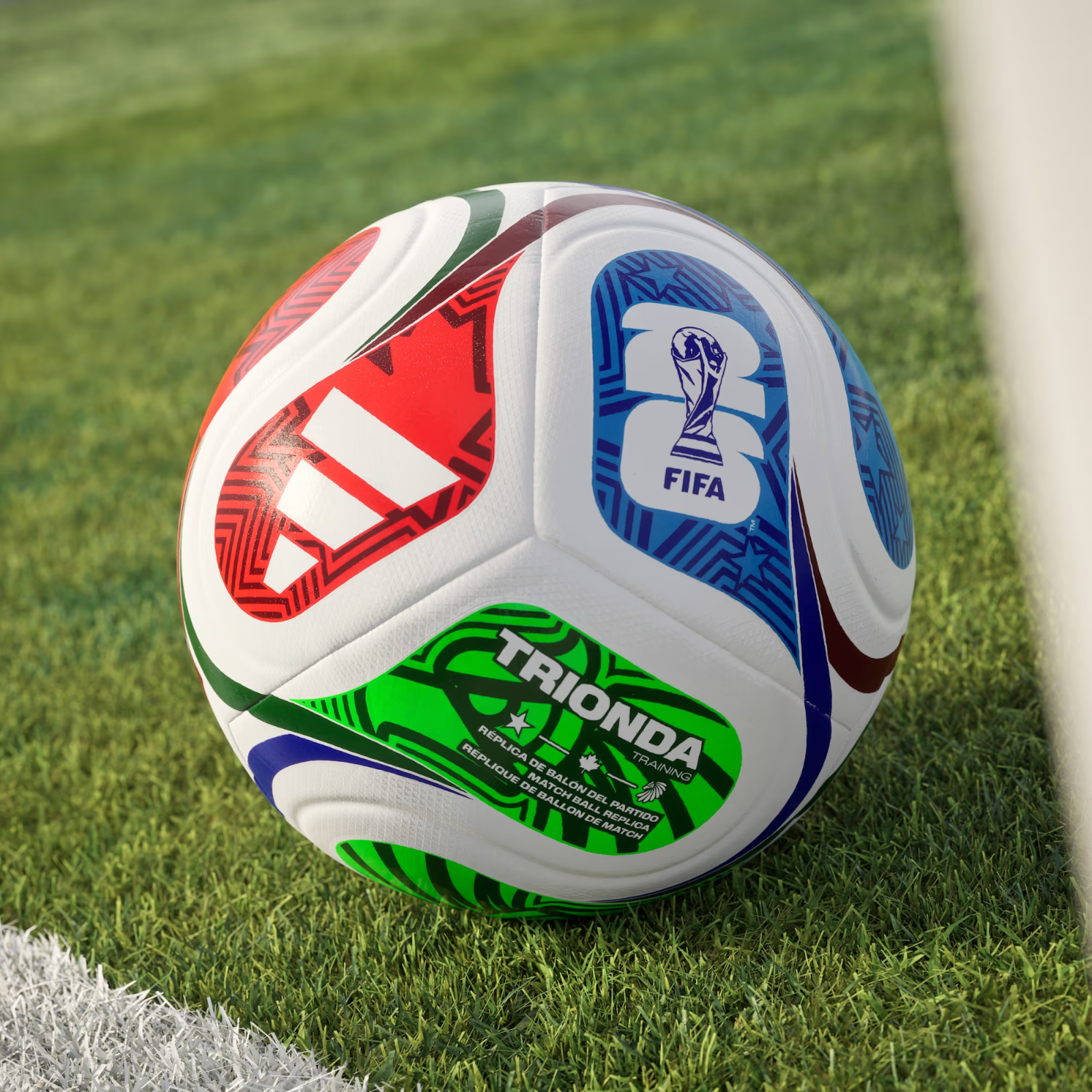
The name “TRIONDA” comes from the Spanish words meaning “three waves,” representing the three host nations of the 2026 FIFA World Cup. The ball’s design reflects this unique partnership through a striking combination of red, green and blue colours, each representing one of the host countries.
The ball’s four-panel design forms a triangle at its centre, symbolising the historic union of the three nations hosting football’s biggest tournament for the first time. National symbols are also incorporated into the design, including Canada’s maple leaf, Mexico’s eagle and the star associated with the United States.
The hidden chip inside the ball
What truly makes TRIONDA special is not what is visible on the outside but what is hidden inside.
Embedded within the centre of the ball is a sophisticated motion sensor capable of capturing data 500 times every second. The sensor continuously tracks the ball’s movement and transmits information in real time to FIFA’s officiating systems. This means the ball can tell officials exactly when it was touched, how fast it was travelling, the direction of movement, and the precise moment contact was made by a player.
The technology works alongside FIFA’s Video Assistant Referee (VAR) system and Semi-Automated Offside Technology, creating a digital record of every touch during a match.
Helping referees get decisions right
One of the biggest benefits of the smart ball is its ability to improve officiating accuracy.
In controversial offside situations, the sensor can determine the exact moment a player touches the ball. This information is then combined with player-tracking cameras positioned around the stadium to establish whether an attacking player was offside at the precise moment the pass was made.
The technology can also help officials review incidents involving handballs, double touches during penalties and disputed possession changes.
By providing objective data in real time, the ball reduces guesswork and allows referees to make faster and more accurate decisions.
Yes, the World Cup ball needs charging
Unlike footballs used in previous decades, TRIONDA contains electronic components that require power. The embedded sensor is rechargeable and must be charged before matches to ensure continuous transmission of data throughout the game. The charging process keeps the sensor functioning at maximum efficiency and guarantees that referees receive uninterrupted information during matches.
For many fans, the idea that a football needs charging may sound surprising, but it reflects how modern technology has become an essential part of elite sport.
Designed to fly better
Technology is not the only innovation in the new ball. Adidas engineers redesigned the ball’s structure using a four-panel construction with deep seams that improve aerodynamics and stability during flight. The design helps ensure that the ball behaves consistently regardless of speed or weather conditions.
The surface also includes embossed textures that improve grip, particularly in wet and humid conditions. Players therefore gain greater control when dribbling, passing or striking the ball.
According to FIFA and adidas, these design improvements contribute to better accuracy, more predictable movement and enhanced performance at the highest level of the game.
What it means for Ghanaian football fans
For Ghanaian supporters watching the Black Stars compete on the global stage, TRIONDA represents more than a new football. It is a glimpse into how technology is reshaping modern football. From goal-line technology to VAR and now sensor-equipped footballs, the game is becoming increasingly data-driven. Decisions that once depended solely on human judgment are now supported by sophisticated systems designed to make football fairer and more accurate.
While debates about refereeing decisions may never completely disappear, the World Cup 2026 ball demonstrates FIFA’s determination to use technology to minimise errors and improve the integrity of the game.
The next time the ball finds the back of the net during a Black Stars match, fans should remember that they are not simply watching a football. They are watching one of the most advanced pieces of sporting technology ever created.
In many ways, TRIONDA is not just the ball of the 2026 World Cup. It may well be the football of the future.