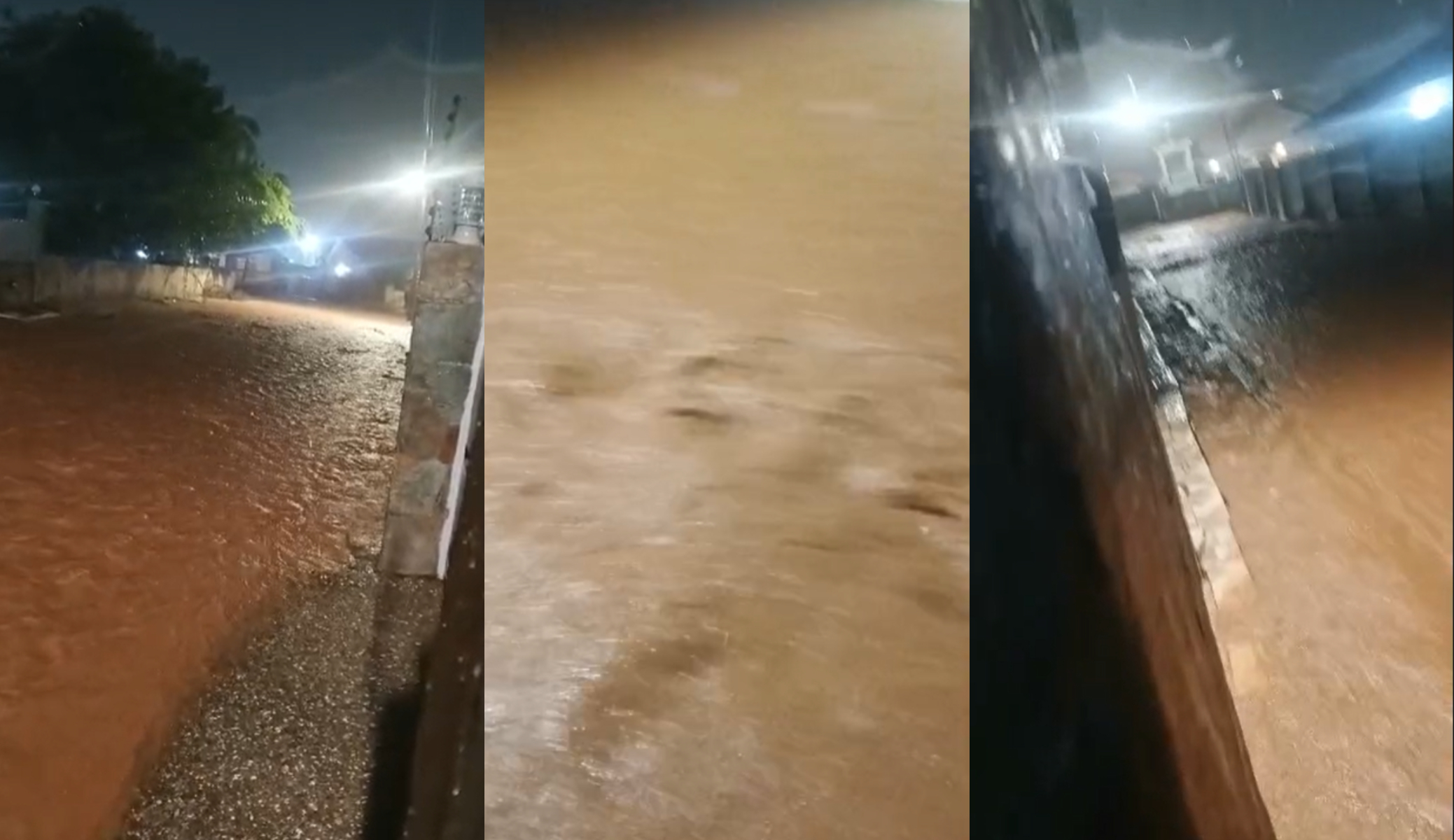
From Tema to Dodowa, from Ablekuma to Madina, from Kasoa to Amasaman, from Adenta to Achimota, this morning does not begin with alarm clocks. It begins with rain.
It begins with rooftops echoing beneath an unrelenting downpour, gutters surrendering to volumes of water they can no longer contain, streets gradually disappearing beneath rising floodwaters, and thousands of Ghanaians standing quietly behind windows, watching the sky negotiate with carefully laid plans.
It begins with neatly ironed clothes remaining on their hangers, polished shoes waiting patiently beside front doors, school bags packed the night before, office bags carefully arranged on dining tables, and hearts suspended between responsibility and reality; between the desire to show up and the inability to do so safely.
Somewhere in Tema, a nurse is wondering whether she can make it safely to the hospital before patients begin arriving in numbers she cannot afford to imagine. Somewhere in Dodowa, a teacher is standing at the doorway, wondering how many pupils can make it to school and whether today’s lesson will eventually proceed before half the classroom trickles in.
Somewhere in Madina, a mother is calculating whether she should risk taking her child through floodwaters or remain at home and risk disciplinary action at work. Somewhere in Achimota, a young public servant is refreshing her phone repeatedly, hoping a colleague who drives will respond with an offer of a lift.
Somewhere in Ablekuma, a university student is wondering whether today’s lecture is worth wading through waist-deep water to attend. Somewhere in Kasoa, a commercial driver is looking through his windscreen, weighing today’s income against the possibility of losing his vehicle to floodwaters before the day is over.
Across the country, the rain is falling upon all of us without discrimination. The consequences, however, are unfolding differently in every home.
At 6.14 this morning, on what should be an ordinary Monday, here I am standing quietly by my window, watching the rain descend with an intensity that renders even an umbrella almost symbolic. Ordinarily, by this time, the staff bus I rely upon for my daily commute has already departed, and by about 6.40 or 6.45 a.m., I should be arriving at work, ready to begin another week of public service.
Last night, just as countless workers across Ghana are doing before the beginning of a new week, I ironed my clothes, organised my bag, prepared my documents, arranged everything I need and retired to bed expecting nothing more than to wake up, dress up and report for duty. This morning, however, I find myself doing none of those things.
Instead, I am watching gutters overflow before my eyes, streets disappear beneath rising water with every passing minute, and rain continue to fall with such persistence that the question is no longer whether I am willing to go to work but whether anyone should be expected to make that journey at all.
Already, I have reached out to a few colleagues who drive, hoping I might join one of them should conditions improve enough to make the journey possible. Even as I wait for responses, it occurs to me that I can hardly be the only Ghanaian standing by a window this morning, praying that the rains will subside just enough to make the roads passable.
Across the country, thousands of workers are almost certainly doing exactly what I am doing. Their commitment to work has not diminished overnight. Neither has their discipline suddenly evaporated because it is Monday.
Their willingness to serve remains exactly as strong as it was yesterday evening when they carefully prepared for the new working week. What has changed is simply the weather, and with it the safety of the journey between home and the workplace.
This is precisely why conversations about hybrid work deserve far greater seriousness than they often receive. Whenever employees advocate for flexible work arrangements, the discussion is too frequently dismissed as though workers are merely seeking convenience, avoiding accountability or searching for opportunities to do less. Nothing could be further from the truth.
The strongest argument for workplace flexibility has never been laziness. It has always been humanity. It has always been about recognising that extraordinary circumstances sometimes require extraordinary responses, and that organisations demonstrate their maturity not merely by the work they demand but by the care they extend to the people from whom they demand it.
Every organisation is right to expect commitment from its employees. Every employer deserves reliability, professionalism and accountability. Public institutions, perhaps more than most, carry responsibilities that cannot simply be postponed because the calendar says Monday. Reports still have to be written. Citizens still require services. Decisions affecting lives must still be taken. National institutions cannot simply suspend governance because heavy rain is falling across the capital.
The question, however, is not whether work matters. The question is whether people matter just as much.
What becomes of the employee who has done everything expected of her, only to wake up and discover that circumstances completely beyond her control have rendered the journey unsafe? What becomes of the worker whose attendance record speaks for itself, whose commitment has never been questioned, whose supervisor knows her to be diligent, punctual and dependable, but who now finds herself trapped by floodwaters, unavailable transport and repeated warnings from public authorities to avoid unnecessary movement?
Does organisational commitment now require risking one’s life? Does professionalism demand driving into floodwaters? Does dedication become measurable only when people are prepared to ignore obvious danger simply to prove they are committed to their jobs?
These questions become even more compelling because the challenge before us is affecting everyone simultaneously. Floodwaters do not distinguish between senior executives and junior staff. The manager’s four-wheel drive vehicle is no more welcome in flooded streets than the intern’s taxi.
The supervisor who expects everyone to report to work may himself be staring at the very same rain through his own window, wondering whether the journey is worth the risk. Police officers have, on several occasions, spoken publicly about official vehicles becoming damaged after driving through floodwaters in response to emergencies. Ambulances struggle to reach patients.
Fire officers encounter inaccessible roads. Commercial transport slows almost to a halt. The disruption is systemic rather than individual, which makes it all the more necessary for our organisational responses to become equally systemic rather than leaving individual workers to negotiate impossible choices on their own.
The conversation becomes even broader once we step outside the workplace and look into our homes. Every rainy morning like this forces thousands of families to make decisions they should never have to make. Parents are looking at roads that have become streams and asking themselves whether school attendance is worth the risk.
Children are standing by windows in freshly pressed uniforms, eager to learn yet uncertain whether they will even make it to the classroom. Mothers and fathers are calculating two competing responsibilities that matter equally: the responsibility to be present at work and the responsibility to keep their children safe. One obligation should never have to cancel out the other, yet this morning, across many households in Ghana, that is precisely the calculation families are being compelled to make.
The challenge extends beyond a missed day at school. Every lesson omitted has implications for an already demanding academic calendar. Teachers are required to complete syllabuses within prescribed periods. Pupils are expected to master content that ultimately determines progression to the next class, performance in national examinations and, for many, opportunities that may shape the rest of their lives. When adverse weather repeatedly interrupts teaching and learning, what structures exist to recover those instructional hours? Have our educational institutions developed contingency plans that preserve both safety and learning outcomes? Have we invested enough thought into how technology, take-home learning or flexible academic scheduling can ensure that children do not have to choose between their education and their safety?
The questions become even more difficult for households with younger children who cannot be left unattended. A parent whose workplace insists on physical attendance may suddenly find herself unable to leave home because the child cannot safely travel to school and cannot safely remain alone at home either. Another parent may eventually decide to brave the journey to work, only to spend the entire day wondering whether the child left behind is safe. Hidden beneath conversations about absenteeism are countless emotional burdens that rarely appear in organisational reports but profoundly affect concentration, productivity and overall wellbeing.
This is why discussions about resilience must move beyond the language of individual endurance. Ghanaians are remarkably resilient. We have demonstrated that repeatedly. We wake before dawn, commute long distances, adapt to unreliable transport systems, navigate flooded roads, improvise when public services fail and still show up ready to contribute to national development. Resilience, however, should never become an excuse for institutional complacency.
The fact that people survive difficult circumstances does not relieve institutions of their responsibility to reduce those difficulties wherever possible. A nation cannot continue celebrating the resilience of its people while neglecting the systems that constantly demand such resilience.
Human resource policies, therefore, deserve a more expansive understanding of productivity. Progressive organisations are increasingly recognising that business continuity planning is no longer confined to cyber-attacks, power outages or public health emergencies. Climate related disruptions now demand the same level of preparedness.
Organisations that invest in flexible work protocols before emergencies arise are often better positioned to protect both employee wellbeing and institutional performance when disruptions inevitably occur. Meetings can be convened virtually. Documents can be reviewed. Decisions can be communicated. Citizens can still receive certain services without requiring every employee to occupy the same physical space. Flexibility does not diminish accountability.
In many instances, it strengthens it by allowing work to continue while protecting the people responsible for delivering it.
This conversation is equally about leadership. Good leadership reveals itself most clearly during moments of disruption. Policies drafted under ideal conditions rarely demonstrate the true character of an institution. Character is revealed when circumstances become difficult and leaders are required to balance organisational objectives with genuine concern for human life.
The question every institution should ask itself is remarkably simple. If extraordinary weather makes ordinary routines unsafe, do our policies make room for wisdom, or do they merely demand compliance?
The rains also expose larger questions about the kind of cities we are building. Every year, familiar roads become impassable, familiar communities experience flooding and familiar conversations return to our national discourse. Citizens pray. Emergency services respond.
Lives are disrupted. Economic activity slows. Schools are affected. Businesses record losses. Public offices operate below capacity. Families rearrange their plans. Then the rains subside, normal life resumes and many of the difficult questions quietly disappear until the next heavy downpour. Sustainable development demands a different approach.
Climate resilience cannot remain an annual discussion that resurfaces only when floodwaters begin to rise. It must become a permanent feature of urban planning, infrastructure investment, transport policy and institutional preparedness.
Faith naturally occupies an important place in mornings like this. Across the country, many of us are praying for the rain to reduce, for roads to become passable, for loved ones travelling to arrive safely and for those already affected by flooding to be protected.
Prayer gives comfort, strengthens hope and reminds us that our lives remain in God’s hands even when circumstances appear uncertain. Faith, however, also calls us to stewardship. Stewardship requires foresight, planning and responsible governance. The God to whom we pray for protection equally expects us to build communities that protect one another through sound policies, resilient infrastructure and institutions that place human dignity at the centre of decision making.
As I continue standing by my window this morning, watching the rain grow heavier by the minute, I am reminded that the true measure of any society is not how efficiently it functions on ordinary days. The true measure of a society is revealed by how compassionately it responds when ordinary days become extraordinary. Every worker who arrives safely matters. Every child who returns home safely matters. Every parent who is allowed to choose wisdom over unnecessary risk matters. Every employer who recognises that humanity and productivity are not opposing values but complementary ones strengthens not only an organisation but the nation itself.
This morning, my desire is exactly what it was when I prepared for work yesterday evening. I want to serve. I want to contribute. I want to fulfil my responsibilities with excellence. At the same time, I want to return home alive at the end of the day. No nation should force its citizens to choose between those two aspirations. Surely, the future of work in Ghana must make room for competence, accountability and compassion to exist together, because when the rain falls this heavily, the question before us is no longer simply whether employees can get to work. The more important question is whether our institutions have developed enough humanity to recognise when getting there should no longer be the priority.
No report, no meeting, no deadline and no attendance register should ever become more valuable than the life of the person expected to fulfil it.
About the Writer
Gifty Nti Konadu is a public policy analyst, researcher and writer whose work explores the intersection of governance, law, leadership, health, faith and social development. Her writing examines how institutions, public policy, communities and values shape the lived experiences of individuals and societies, with a particular interest in human dignity, resilience, wellbeing, justice and flourishing. Drawing from multidisciplinary training and professional experience across the public, governance and health sectors, she writes to stimulate thoughtful public discourse on leadership, nation building, institutional accountability, spiritual formation and the everyday realities that influence how people live, work, serve and thrive. She believes that the strength of every society is ultimately measured not only by the quality of its institutions but also by the humanity with which they serve their people