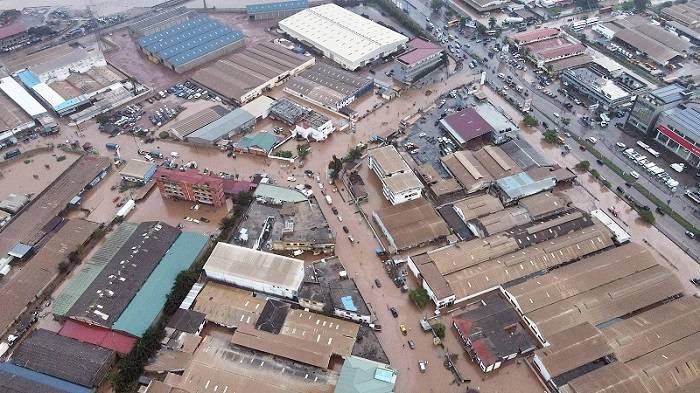
The devastating floods that recently swept through Accra and several parts of the country should not be remembered merely as another unfortunate natural disaster. They should serve as a national wake-up call.
Once again, lives were disrupted, businesses destroyed, roads submerged, homes washed away, and public resources redirected towards emergency relief and reconstruction. Once again, Ghanaians asked the same question they have asked after every major flood over the past two decades:
Could this have been prevented?
Perhaps the more important question is this:
Why do we have national coordination systems for almost every major security threat, yet none that comprehensively coordinates environmental and public health intelligence before disasters occur?
In response to the threat of terrorism, Ghana strengthened national security coordination and information-sharing among security agencies.
The government established the Ghana Revenue Authority to bring revenue collection under a single coordinated system after years of fragmentation.
When illegal mining emerged as a national emergency, an Emergency Committee was formed to coordinate enforcement activities involving agencies such as the military, police, forestry, minerals, environmental, and national security institutions.
Similarly, during the COVID-19 pandemic, a national coordinating mechanism brought together health experts, security agencies, local governments, and development partners to manage the public health crisis.
During disasters, the National Disaster Management Organisation (NADMO) is responsible for coordinating emergency response efforts.
The lesson is clear.
Whenever Ghana faces a complex national challenge, the response has often been the creation of a coordinating mechanism because coordination improves efficiency, reduces duplication, and strengthens decision-making.
Yet one of Ghana’s most persistent and costly challenges — environmental and public health threats — continues to be managed through fragmented institutional arrangements.
We are not yet smart enough about our environment
Several institutions collect and manage critical environmental and health information.
The Ghana Meteorological Agency provides weather forecasts and climate information.
Hydrological monitoring is undertaken by another institution.
River monitoring falls under separate agencies.
Air quality monitoring is handled elsewhere.
Public health surveillance remains within the health sector.
NADMO focuses on disaster preparedness and response.
The Environmental Protection Agency (EPA) is responsible for environmental regulation and enforcement.
National security agencies also possess valuable intelligence on illegal environmental activities.
Each institution performs an important function.
The problem is that these pieces of intelligence rarely come together continuously within a single operational framework capable of producing a comprehensive national picture before disaster strikes.
That institutional gap was exposed once again during the recent floods.
Speaking in Parliament after the disaster, the Minister for the Interior indicated that Ghana received a warning of the impending heavy rainfall only the night before the incident.
Whether the warning came one night before or several days earlier is not the central issue.
The real question is:
What happened after the warning was received?
Was rainfall information immediately integrated with river-level data?
Was it compared with drainage capacity in flood-prone communities?
Were satellite observations combined with real-time hydrological monitoring?
Were high-risk communities already identified through historical flood mapping?
Were emergency responders pre-positioned?
Were hospitals placed on alert?
Were transport diversions activated before roads became impassable?
Were local authorities provided with location-specific intelligence rather than general weather forecasts?
If the answer to many of these questions is no, then Ghana’s greatest challenge is not simply forecasting the weather.
It is coordinating intelligence.
Weather forecasts alone do not prevent disasters.
Coordinated decisions do.
Environmental threats are national security threats
Across the world, governments are increasingly recognising that environmental degradation is a national security issue.
Climate change is intensifying rainfall patterns.
Floodplains are expanding.
Sea levels are rising.
Urbanisation is increasing surface runoff.
Natural boundaries of water bodies are being altered.
Environmental crimes are becoming more complex.
Threats to public health are increasingly linked to ecological changes.
A new paradigm is emerging — one that Ghana must seriously consider.
Evidence of this shift is already visible.
In Accra, flooding has become almost an annual occurrence.
Illegal mining continues to threaten the Pra, Ankobra, Offin, and Birim river systems.
Air pollution in major urban centres continues to affect respiratory health.
Forest cover is being lost, reducing natural flood buffers.
The 2023 spillage from the Akosombo Dam exposed the vulnerability of communities across the Volta Basin to hydrological extremes.
Scientific assessments have also highlighted the basin’s vulnerability to rainfall variability, erosion, sedimentation, and climate change. These changes have implications not only for communities within the basin but also for agriculture, hydroelectric generation, fisheries, water security, and national development.
All these challenges are interconnected.
They can no longer be treated in isolation.
A national intelligence platform for environmental risks
What if data from weather stations, river gauges, satellite imagery, environmental sensors, health surveillance units, intelligence agencies, district assemblies, and emergency services were integrated into a single nationwide operational platform?
What if this platform could detect anomalies early, scientifically validate risks, identify vulnerable communities, and trigger coordinated action before emergencies escalate?
Imagine the savings in disaster relief.
Imagine the lives that could be saved.
Imagine the confidence citizens would have in state institutions if disasters were anticipated rather than merely responded to.
This is not an argument for creating another bureaucracy.
It is a call for stronger coordination.
Ghana has capable institutions.
What is needed is an institutional framework that allows these agencies to operate from a shared intelligence picture, with clearly defined responsibilities before disasters occur.
The future of national security
National security can no longer be defined only by the ability to respond to armed threats.
Increasingly, it will depend on a country’s ability to anticipate environmental shocks, public health emergencies, and climate-related disasters before they overwhelm national capacity.
Countries that invest in intelligence-led coordination reduce the resources spent on disaster response because they prevent avoidable losses.
Without environmental intelligence, Ghana will continue spending billions repairing damaged infrastructure, compensating victims, and restoring normalcy after events that could have been better anticipated.
Clean-ups and speeches should not become the only responses after major floods.
Every disaster should force us to ask:
Are the institutions we have today designed for the risks of tomorrow?
If the answer is no, then the time has come to rethink Ghana’s approach to environmental and public health intelligence coordination.
The next flood is not a question of if.
It is a question of when.
The choice before us is whether we will continue responding after disasters strike or build the national coordination framework needed to get ahead of the next one.