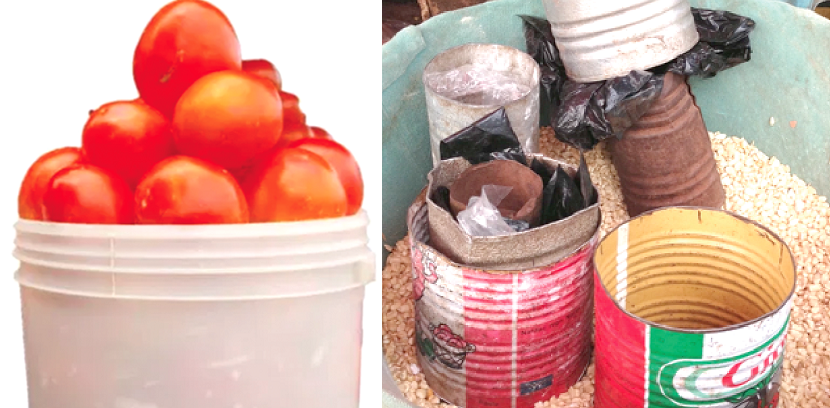
The Ghana Statistical Service (GSS) has released Ghana’s first nationally representative conversion factors for non-standard units of measurement, revealing that commonly used local measures such as cups, olonka tins, margarine tins, heaps, bundles and sacks often represent different weights across various regions.
The findings, contained in three reports from the Non-Standard Units Survey (NSUS), conducted in collaboration with the Ministry of Food and Agriculture, seek to address longstanding inconsistencies in the measurement of agricultural commodities by providing scientifically derived conversion factors to translate local measures into standard metric units such as kilograms and litres.
According to the GSS, non-standard units remain the dominant means by which agricultural commodities are measured, traded and consumed across the country.
However, the Service noted that identical-looking containers and size classifications often represent different quantities depending on the commodity and location, creating challenges in producing reliable and comparable agricultural statistics.
The survey found, for instance, that a small-sized cup of local rice weighs an average of 0.352 kilograms nationally but varies from 0.320 kilograms in the Savannah Region to 0.378 kilograms in the Greater Accra Region.
Similarly, a medium-sized cup of gari weighs an average of 0.267 kilograms in the Bono East Region and 0.292 kilograms in the Eastern Region, while a small-sized yam weighs an average of 1.043 kilograms nationally and reaches 1.564 kilograms in the Bono Region.
The Farmgate Report also uncovered significant variations in the weight of produce sold using the same local units. A cocoa (jute) sack of dried yellow maize weighs an average of 131.1 kilograms in the Greater Accra Region compared with 198.0 kilograms in the Bono East Region, representing a difference of nearly 67 kilograms.
The survey further found that size descriptions such as “small”, “medium” and “large” are unreliable indicators of weight, although container-based units used for oils, including bottles and gallons, were relatively more consistent.
At the market level, the GSS reported similar regional disparities. A medium-sized margarine tin has a national average weight of 0.276 kilograms but ranges from 0.228 kilograms in the Ahafo Region to 0.346 kilograms in the Ashanti Region.
Medium-sized yams also showed considerable variation, weighing between 1.301 kilograms in the Ashanti Region and 2.042 kilograms in the Volta Region.
The GSS said the newly developed conversion factors will improve the accuracy and comparability of agricultural production, trade, household consumption, food security statistics and major economic indicators such as the Gross Domestic Product (GDP) and Consumer Price Index (CPI).
The Statistical Service described the reports as the first nationally representative evidence on non-standard units used across Ghana, adding that they will provide policymakers, researchers and development partners with stronger data for planning, monitoring and decision-making.