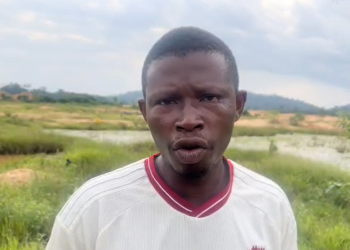
Chairman Wontumi, real name Bernard Antwi Boasiako, Ashanti Regional Chairman of the New Patriotic Party (NPP) has been sentenced to 20 years’ imprisonment with hard labour by an Accra High Court after being found guilty of illegally permitting unlicensed mining operations on his company’s concession at Samreboi in the Western Region.
Justice Audrey Kocuvie-Tay, presiding over Criminal Court 4 of the High Court in Accra, delivered the judgement on Monday, July 20, 2026, convicting the Ashanti Regional Chairman of the NPP and his company, Akonta Mining Company Limited, on all counts brought against them. His co-accused and fellow director, Kwame Antwi, remains at large and was tried in absentia.
The charges
Wontumi and Akonta Mining were arraigned on October 7, 2025, on four counts: two counts of assignment of mineral rights without ministerial approval, contrary to Sections 14(1) and 99(2)(b) of the Minerals and Mining Act, 2006 (Act 703), as amended; and two counts of purposely facilitating an unlicenced mining operation, contrary to Section 99(2)(b) of the same Act. Kwame Antwi faced two similar counts but was not present to answer them. Wontumi pleaded not guilty on his own behalf and on behalf of Akonta Mining.
CLICK HERE TO READ THE FULL JUDGMENT
The facts
The court heard that Wontumi and Kwame Antwi are shareholders and directors of Akonta Mining, which was incorporated in 2010 with mining and exploration as its core business. On April 16, 2025, police conducting an anti-galamsey operation in the Western Region arrested one Michael Gyedu Ayisi and 28 others at a mining site within Akonta Mining’s concession at Samreboi.
Those arrested were occupying a structure bearing Akonta Mining’s name, and police retrieved firearms, ammunition, suspected gold, excavators, vehicles, and over GH¢157,000 in cash from the scene.
Under interrogation, Ayisi named Henry Okum as his employer, who in turn told police he had reached an arrangement with Wontumi in September 2024 to mine gold on the unmined portions of the concession, while also reclaiming previously mined portions by planting coconut seedlings.
Okum said Wontumi did not give him money for the reclamation work, expecting him instead to fund it from proceeds of his mining activities on the concession — an arrangement Okum said Wontumi was fully aware of.
Wontumi’s defence
At trial, Wontumi admitted permitting Okum onto the concession but insisted the permission was strictly for land reclamation, not mining, and that any mining Okum carried out was without his knowledge or authorisation.
He said he was unaware Okum was a small-scale miner, believing him instead to be a mine support service provider.
The prosecution called four witnesses, including Ayisi, Okum, and an investigator, while the defence called five witnesses, among them a mining engineer, a former Western Regional Minister, and the ex-Chairman of the Western Regional Security Council (REGSEC).
Court rejects constitutional challenge
Before delivering judgement, the court dismissed a bid by Wontumi’s lawyers to refer questions to the Supreme Court on whether the relevant provisions of Act 703 were unconstitutionally vague. The court held that the law was clear on its face, defining both the prohibited conduct and the prescribed penalty, and that no genuine question of constitutional interpretation arose warranting a stay of proceedings.
Why the court found him guilty
The court found that no ministerial approval had ever been sought or obtained for the mining activity, a fact Wontumi did not dispute. On the central question of what Okum was actually permitted to do, the court relied on circumstantial evidence, noting that Okum was an experienced small-scale miner with no background in land reclamation, that reclamation is costly yet Wontumi gave him no funds for it, and that Okum was left to fund the exercise from gold he mined on the concession, a fact Wontumi never challenged in cross-examination.
The court found no reasonable explanation could rival the conclusion that Wontumi had, in fact, permitted and expected Okum to mine the land.
The court also lifted Akonta Mining’s corporate veil, finding that the company had no functioning board of directors, had not filed annual returns, and that all dealings with Okum were conducted personally and informally by Wontumi alone.
The court noted that Okum himself testified he did not know Akonta Mining as a company but knew it only as “Chairman Wontumi,” and that Wontumi’s own witness statement acknowledged assisting Okum in sourcing excavators and enlisting REGSEC’s support to protect the operation.
On this basis, the court held that Wontumi was, in fact, the true and de facto holder of the mineral right, and convicted him personally alongside the company.
The verdict and sentence
Wontumi was found guilty and convicted on Count 1 (assignment of mineral rights without approval) and Count 4 (purposely facilitating an unlicenced mining operation). Akonta Mining was found guilty and convicted on the corresponding Counts 3 and 6.
In sentencing, Justice Kocuvie-Tay noted the gravity of the offences and the need for deterrence to avert environmental disaster, given the State’s mineral resources at stake. Taking into account that both accused were first-time offenders, the court sentenced Wontumi to 20 years imprisonment with hard labour on Count 1, and a further 20 years imprisonment with hard labour on Count 4, along with fines of 10,000 penalty units on each count, in default of which he is to serve three years in hard labour. The sentences were ordered to run concurrently.
Akonta Mining, as a corporate entity, was fined 15,000 penalty units each on Counts 3 and 6.
The court further ordered that all items retrieved from the concession, including the excavators, vehicles, and cash seized during the April 2025 raid, be forfeited to the State in accordance with Section 9 of Act 703 as amended.
Legal representation
The Republic was represented by Deputy Attorney-General Dr Justice Srem-Sai, alongside Esi Dentaa Yankah, Priscilla Lartey and Natalie Korkor Hammond. Wontumi and Akonta Mining were represented by Samuel Atta Akyea.