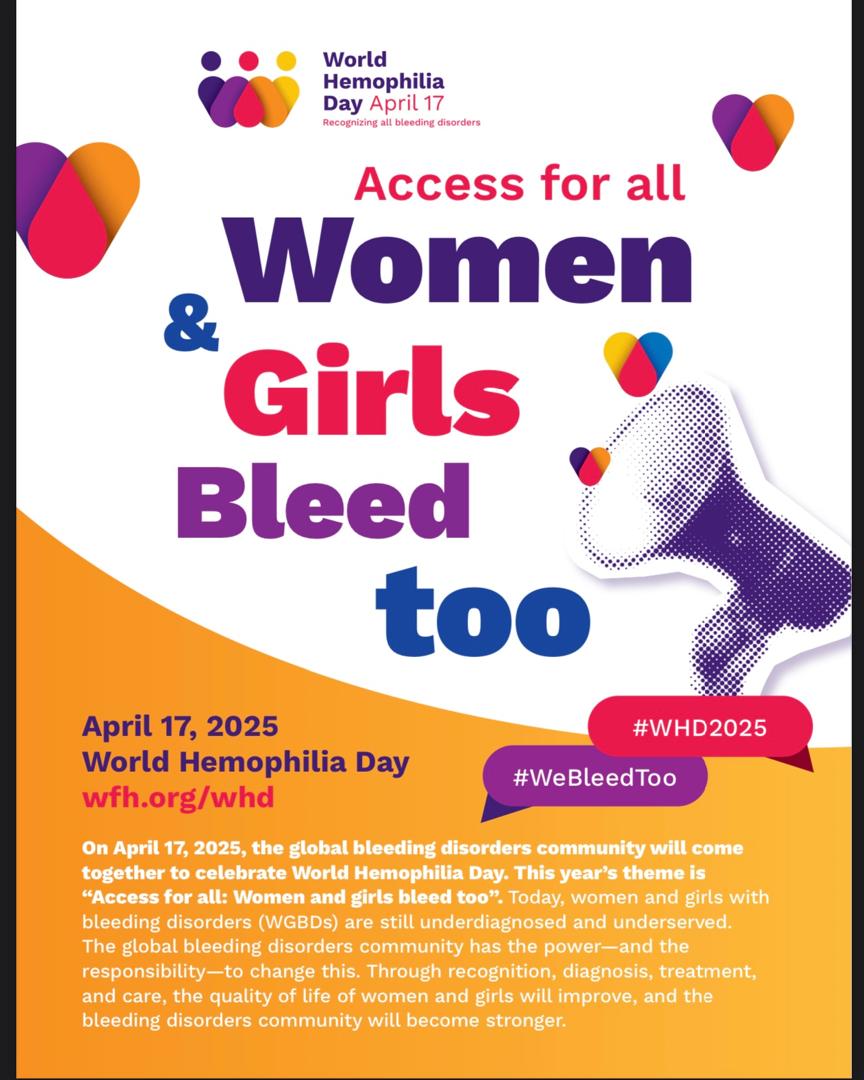
Each year, on April 17, the world unites to raise awareness about haemophilia and other inherited bleeding disorders.
The theme for World Haemophilia Day 2025, “Women and Girls Bleed Too,” seeks to challenge long-held assumptions that bleeding disorders affect only males.
While haemophilia is more frequently diagnosed in males, many females also live with symptoms of undiagnosed or misdiagnosed bleeding disorders—left without treatment or support.
What is a Bleeding Disorder?
Bleeding disorders are medical conditions where the blood does not clot as it should. This happens because certain essential components needed for clotting are missing or not working properly.
As a result, individuals may experience prolonged bleeding, either spontaneously or after injury, surgery, or childbirth. Bleeding disorders may be inherited (passed down from one or both parents through genes) or acquired (developing later in life due to other medical conditions, medications, or unknown causes).
Types of bleeding disorders include:
• Haemophilia A and B – Inherited conditions (mostly affecting males) where clotting factors VIII or IX are deficient. Women and girls can also have symptoms, even if they carry the gene or have low factor levels.
• Von Willebrand Disease (vWD) – The most common inherited bleeding disorder, affecting both men and women, often leading to easy bruising, nosebleeds, and heavy periods.
• Other rare disorders – Include platelet function disorders and deficiencies of other clotting factors.
Common signs and symptoms:
• Frequent nosebleeds or bleeding gums
• Heavy or prolonged menstruation
• Unexplained bruises
• Blood in urine or stools
• Painful, swollen joints or muscles from internal bleeding
• Excessive bleeding after surgery, dental work, or childbirth
Management:
While these bleeding disorders cannot be cured, they can be effectively managed. Treatment may include clotting factor replacement therapy, antifibrinolytic medications, hormone treatments for menstrual symptoms, and supportive care from specialised health professionals.
Early diagnosis is key to improving quality of life.
The Global and Ghanaian Landscape
According to the World Federation of Haemophilia’s 2023 Annual Global Survey, there are 390,630 identified individuals worldwide living with bleeding disorders. Of these:
• 56% have haemophilia
• 26% live with von Willebrand Disease (vWD)
• 18% are diagnosed with other bleeding disorders
Of this global population, 65% are male and 34% are female, revealing a significant representation of females, many of whom experience symptoms that go unnoticed or are wrongly attributed to other causes.
In Africa, the expected number of people living with haemophilia is 93,985, but only 8% have been formally identified. In Ghana, the estimated prevalence of haemophilia is 7,131, yet the number of diagnosed cases is 525 (critically low)—an indication of serious gaps in diagnosis and access.
These statistics reveal a stark reality: thousands of people in Ghana may be living with bleeding disorders without knowing it—and many of them are women and girls.
A Silent Burden on Women and Girls
Females can also experience bleeding symptoms as carriers of the haemophilia gene or through other inherited disorders like von Willebrand Disease.
Women and girls may suffer from:
• Heavy, prolonged menstrual bleeding
• Excessive bleeding during childbirth or surgeries
• Unexplained bruising
Too often, women and girls are told that heavy periods are just something they have to live with, but in many cases, this is a sign of an underlying bleeding disorder. We must listen to them and take their symptoms seriously.
A Call to Action
This year’s theme is a powerful reminder that the narrative must change:
• Women and girls bleed too.
• Women and girls deserve equitable access to diagnosis and treatment.
• Their voices must be heard.
We must launch public education campaigns addressing inequity in care while creating a safe, stigma-free space for women and girls to share their experiences.
In Ghana, key institutions such as Korle Bu Teaching Hospital and Komfo Anokye Teaching Hospital—with immense support from the World Federation of Haemophilia and the Ghana Haemophilia Society—are making important strides to improve haemophilia care.
Despite these efforts, critical gaps remain, particularly in access to diagnostics, treatment, and specialised care. Addressing these challenges requires a collective call.
Government bodies, public health agencies, civil society organisations, and individuals should come together to ensure that every person living with a bleeding disorder receives equitable and timely care—regardless of gender, geography, or financial means.
“Women and Girls Bleed Too” is not just a theme—it’s the truth.
Let us ensure that no woman or girl living with a bleeding disorder in Ghana is left behind. When we listen to them and provide the care they deserve, we improve outcomes not just for individuals but for families, communities, and our entire country.
#WorldHaemophiliaDay2025 #WomenAndGirlsBleedToo #BleedingDisordersAwareness
Written by: Drs Adwoa Agyemang Adu-Gyamfi and Eunice Agyeman Ahmed, in collaboration with the Ghana Haemophilia Society