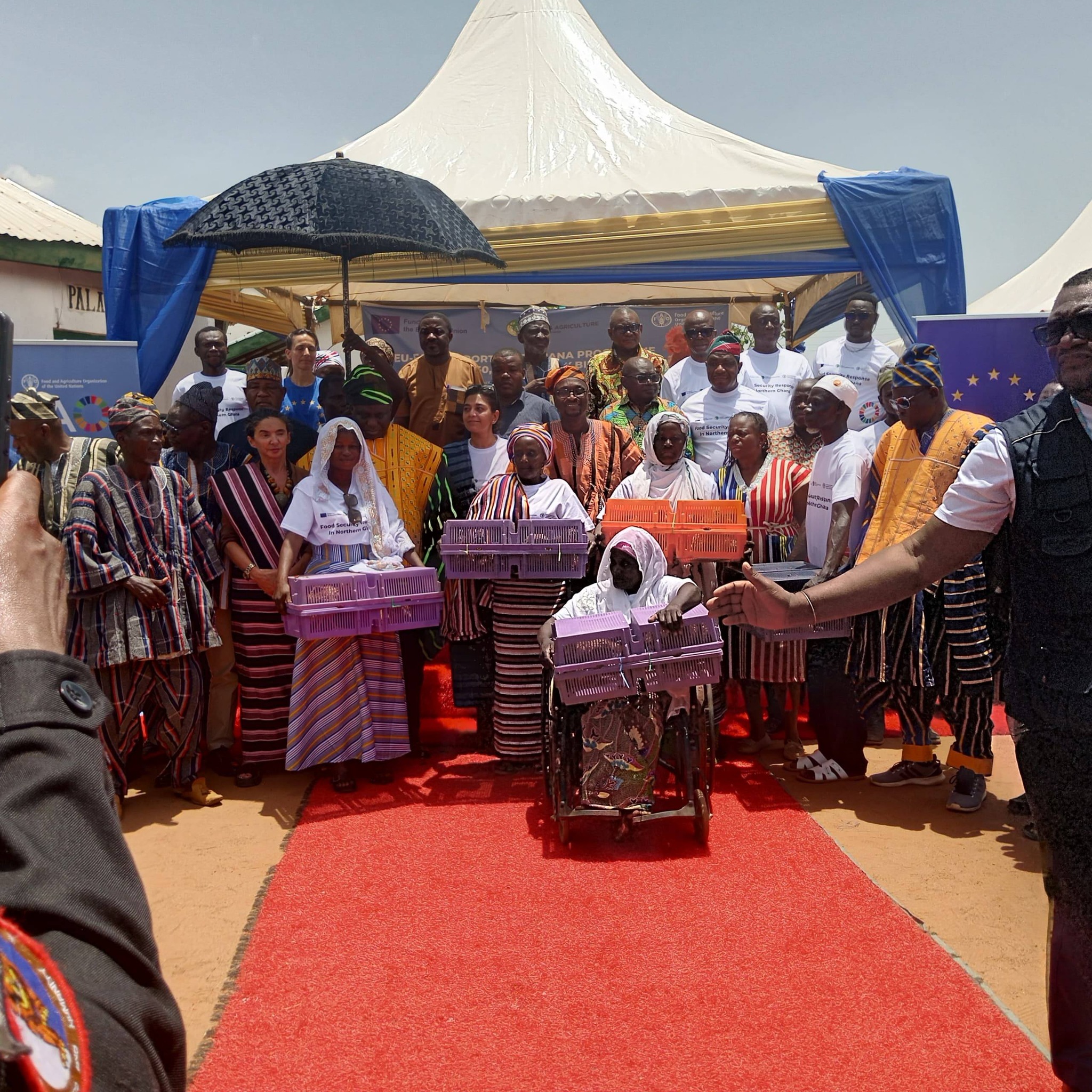
The European Union (EU), in collaboration with the Food and Agriculture Organisation (FAO) and Ghana’s Ministry of Food and Agriculture (MoFA), has distributed 150,000 fully vaccinated poultry birds to farmers across six districts in the Savannah Region.
The exercise, held at Gbung in the North East Gonja District, forms part of efforts to boost local poultry production and improve food security.
The support package includes feed and essential veterinary medication, with about 15,000 rural households expected to benefit directly.
The Minister for Food and Agriculture, Dr Eric Opoku, said the intervention aligns with the government’s Nkonko Nkitikiti initiative, which aims to revitalise Ghana’s poultry sector and reduce reliance on imports.
He urged beneficiary farmers to adopt proper poultry management practices to ensure sustainability and maximise productivity.
Dr. Opoku added that beyond the distribution of chicks, the programme also provides feed, veterinary services, and training in modern animal husbandry to improve survival rates and output.
The Head of Cooperation at the EU Embassy in Ghana, Silvia Severi, said the initiative reflects the EU’s long-term commitment to strengthening agriculture and food systems in the country.
“The EU remains committed. Whether it is through this project, our €132 million EU-Ghana Agriculture Programme, or our broader Team Europe initiatives, we are here to build resilience together,” she stated.
A Senior Regional Resilience Officer at the FAO in Ghana, Priya Gujadhur, noted that the intervention is already yielding measurable results.
She said across six food-insecure districts, more than 12,000 vulnerable smallholder farmers are benefiting from improved crop production, livestock development, and strengthened livelihoods.
According to her, maize productivity among supported farmers has increased significantly—from 0.6 metric tonnes per hectare in 2023 to 1.8 metric tonnes per hectare in 2025—translating into improved household food security and surplus produce for sale.
The project has also provided farmers with post-harvest equipment, including multipurpose grain threshers, moisture meters, and improved storage bags to reduce losses and increase incomes.
She added that community-managed threshers are already generating revenue, which farmers are reinvesting into production.