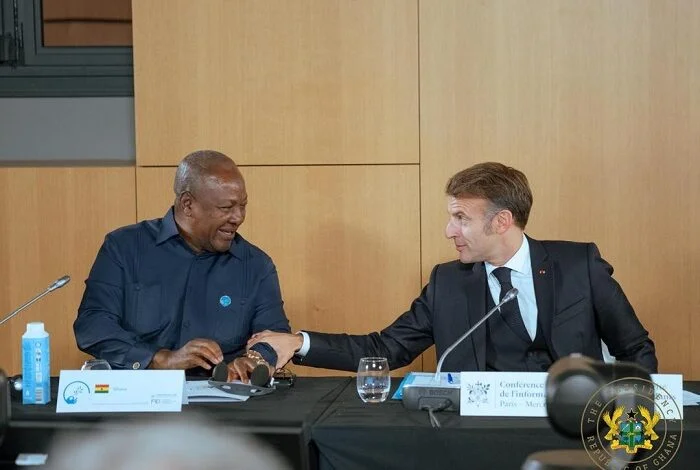
The Government of Ghana has welcomed what it describes as significant new anti-slavery policies announced by French President Emmanuel Macron, including France’s commitment to work with Ghana on reparatory justice for the transatlantic enslavement of Africans.
This follows President Macron’s recent remarks during an event marking the 25th anniversary of France’s law recognising slavery as a crime against humanity, where he outlined plans for deeper engagement on historical accountability and justice.
In a statement issued by the Ministry of Foreign Affairs on Saturday, May 23, 2026, Ghana said the development builds on momentum generated by the landmark Ghana-led United Nations resolution recognising the transatlantic slave trade as the gravest crime against humanity.
President John Dramani Mahama commended President Macron for what he described as “honest, open, conciliatory and exemplary leadership” on the matter, and welcomed France’s willingness to engage on reparatory justice initiatives.
Ghana also confirmed plans to collaborate with France on the proposed establishment of a Ghana–France Scientific Commission to be based in Ghana, aimed at advancing research and dialogue on reparatory justice.
The government further expressed appreciation for France’s acceptance of an invitation to participate in the upcoming Next Steps High-Level Conference on Reparatory Justice, scheduled to take place in Accra from June 17 to 19, 2026.
According to the statement, Ghana views the current engagement as part of a broader international process aimed at translating historical recognition into structured dialogue and concrete action on reparatory justice.
“The Government of Ghana is pleased with the positive momentum and concrete outcomes following the landmark adoption of the Ghana-led UN Resolution declaring the transatlantic enslavement of Africans as the gravest crime against humanity,” the statement said.
Ghana added that discussions with international partners would cover a wide range of reparatory justice issues, including formal apologies, guarantees of non-repetition, return of artefacts, healing initiatives, compensation, and legal reforms related to slavery-era statutes.
The statement also welcomed France’s intention to review and repeal colonial-era slavery laws, including the “Code Noir,” describing it as an important step toward historical reckoning.
It noted that President Macron had acknowledged the incompatibility of such statutes with contemporary values, a position Ghana said it fully supports as part of an “honest engagement with history.”
The Ministry stressed that Ghana remains committed to advancing the global reparatory justice agenda, adding that the upcoming Accra summit will bring together Heads of State, ministers, scholars, and civil society actors from Africa, the Caribbean, the Americas, and Europe.
It said the objective is to build sustained international frameworks for dialogue, institutional cooperation, and long-term redress mechanisms grounded in mutual respect and historical truth.
Ghana further reiterated its openness to engaging with all countries and institutions willing to participate in the process in good faith, describing the current global momentum as a potential turning point in the pursuit of justice for descendants of enslaved Africans.
Read Also:
IMF exit: We won’t have a kenkey party like others did – Mahama