


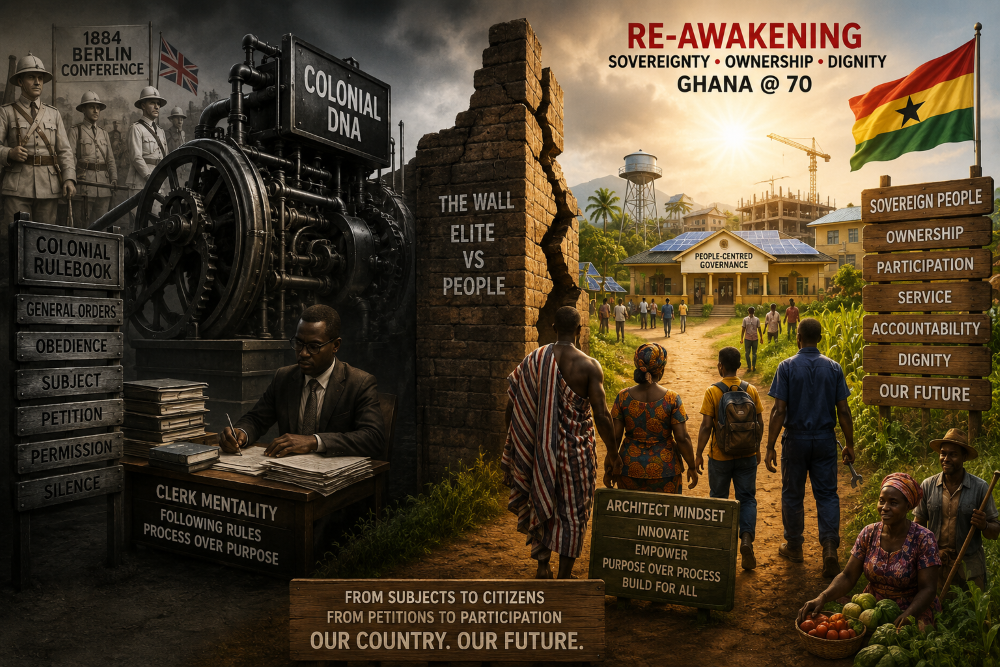
In our previous exploration, we identified the “Colonial DNA” that remains embedded in the modern African state—an administrative machinery designed in Berlin in 1884 for extraction and control, rather than for the flourishing of indigenous society.
If we accept that the tools and logic of governance remained largely unchanged after the Union Jack was lowered in 1957, we are forced to confront a heavy, perhaps even painful, realisation: Much of what we have celebrated as “Independence” for nearly seven decades has been, in structural terms, a myth.
This is not to diminish the heroism of the Big Six or the thousands of foot soldiers who marched for our liberation. Their achievement in securing the right to self-determination was absolute and sacred. However, there is a profound difference between changing the driver of a vehicle and re-engineering the engine for a fundamentally different destination.
The Turnkey State and the Inherited Engine
At the moment of independence, the newly formed Ghanaian government inherited what is known in industry as a “turnkey” operation. We took over the physical buildings of the ministries, the police barracks, the civil service protocols, and the centralised legal frameworks of the British Gold Coast.
Crucially, we also inherited the “General Orders”—the literal colonial rulebook that governed the behaviour of every state official. These rules were never intended to facilitate a public servant serving a citizen; they were designed for an officer to administer a subject. In the colonial engine, power is a one-way street: it flows from the centre outward to the periphery.
When we kept this engine running without a fundamental overhaul, we inadvertently kept the “top-down” relationship between the ruler and the ruled.
We replaced the Governor with a President and the District Commissioner with a DCE, but the distance between the office and the ordinary Ghanaian remained unchanged. The engine was still built for control; we simply changed the hands on the steering wheel.
The Wall Between the “Elite” and the “People”
Perhaps the most damaging legacy of this Independence Myth is the enduring wall between the so-called “educated elite” and the rest of the population. This is the “Colonial DNA” of our social classes.
The colonial project relied on an “intermediary class”—Ghanaians trained in Western traditions to act as a bridge between the British crown and the “natives.” Tragically, seventy years later, this hierarchy persists.
There is a deep-seated disconnect where many among the educated elite fancy themselves the sole architects of Ghana’s future, viewing the trader in Makola, the farmer in Wenchi, or the artisan in Suame as “unsophisticated” bystanders to history.
It is important to acknowledge that not all within this elite class are satisfied with this status quo. There are many “frustrated architects” within our civil service and academia who recognise these flaws and yearn for change. However, they often find themselves trapped within the same rigid “General Orders” they wish to dismantle.
Yet, the overarching colonial success remains: getting Ghanaians to view their own brothers and sisters through the eyes of the former occupier. We have created a society of “lanes,” where the “unsophisticated” are told to stay in the lane of labour and obedience, while the elite occupy the lane of thought and leadership. True sovereignty cannot exist in a house divided by such intellectual arrogance.
The Entitlement of the Intermediary
Beyond intellectual arrogance, we must confront the material betrayal that this class wall facilitates. The post-colonial elite have traditionally acted as if they are entitled to the lion’s share of the nation’s rewards. They have inherited the colonial governor’s taste for privilege, sprawling bungalows, and state-funded comforts, viewing these not as tools for service, but as the “spoils” of their position.
This has created a grotesque paradox: the “Clerks” of the state live in a world of high-end rewards, while the “Employers”—the citizens whose taxes and resources fund this lifestyle—are left to wallow in poverty and want. When the servant lives in luxury while the master goes hungry, the project of independence has clearly lost its way. The elite have become an extraction class of their own, maintaining the very “Colonial DNA” that allows them to remain comfortable while the masses struggle for basic dignity.
The Language of the Petition
One of the most visible symptoms of this myth is the “Language of the State.” In a truly sovereign nation, the state speaks the language of the people’s souls. In Ghana, the state speaks the language of the Petition.
Observe how an ordinary citizen interacts with the state. Whether it is asking for a road, a school, or a water pipe, the language used is rarely the language of ownership. Instead, it is the language of “begging” or “petitioning” a distant power. This is a carry-over from the colonial era, where the subject had no rights, only “privileges” granted by the Governor.
When a farmer in the rural heartland feels he must “humbly request” basic dignity from a government official in Accra, the myth of independence is laid bare. In a sovereign Republic, the official is the employee; the farmer is the employer. The fact that this relationship feels reversed in our daily lives proves that we are still living in the shadow of the colonial administrative state.
The “Clerk Mentality” vs. The “Architect Mindset”
For decades, our education and governance systems have been geared toward producing “Clerks for the Empire”—individuals who are excellent at following established colonial protocols but hesitant to innovate outside of them. This “Clerk Mentality” values the process over the purpose, and the “English way” over the “Effective way.”
We see the measurable consequences of this mentality in our modern institutions every day. Consider the “paperwork loop” in our civil service. A simple project to build a rural clinic or procure life-saving equipment can be trapped for years in a maze of bureaucratic delays. The clerks are so focused on whether every form is filled in the “correct” colonial style that they lose sight of the citizens waiting for care. In this system, the procedure is sacred, but the person is secondary.
To move toward Ghana @ 70, we must shift to an “Architect Mindset.” An architect does not just move into an old building; they imagine a new one that suits the inhabitants. We must empower the “unsophisticated”—those whose wisdom is forged in the fires of survival and indigenous tradition—to become the architects of our new systems. Their “real thoughts,” long suppressed by the requirement to stay in their “lane,” are precisely the ingredients we need to bake a truly Ghanaian sovereignty.
Beyond the Myth
To move toward our 70th anniversary with honesty, we must stop asking why our “imported” systems are failing and start asking why we haven’t built systems that reflect who we actually are. If our current governance feels like a garment that doesn’t fit, it is not because the body (the Ghanaian people) is the wrong shape. It is because the garment was tailored for someone else, in a different climate, for a different purpose.
The myth of independence suggests that the struggle ended in March 1957. The reality is that 1957 was merely the acquisition of the site upon which a sovereign nation was to be built. The actual construction—the dismantling of class walls, the re-engineering of the administrative engine, and the elevation of the “unsophisticated” voice—is the work that remains.
We have mastered the art of being a country, but we have yet to begin the work of being a People.
As we look toward March 2027, the invitation is to wake up from the myth and begin the hard, glorious work of the Re-Awakening.
____________________________
A Note to My Readers: For too long, the conversation about Ghana’s future has been a monologue by the elite. I want to turn this into a dialogue. I want to hear from the builders, the market women, the drivers, and the youth.
Tell me in the comments: Do you feel like an “owner” of the state, or do you still feel like a “subject” waiting for permission from above? I will read your real thoughts, and they will help shape our next exploration.
This article forms part of the Re-Awakening Series examining governance, legitimacy and the future of African civilization – Ghana @ 70 | Independence Revisited: Completing the Sovereignty Project.