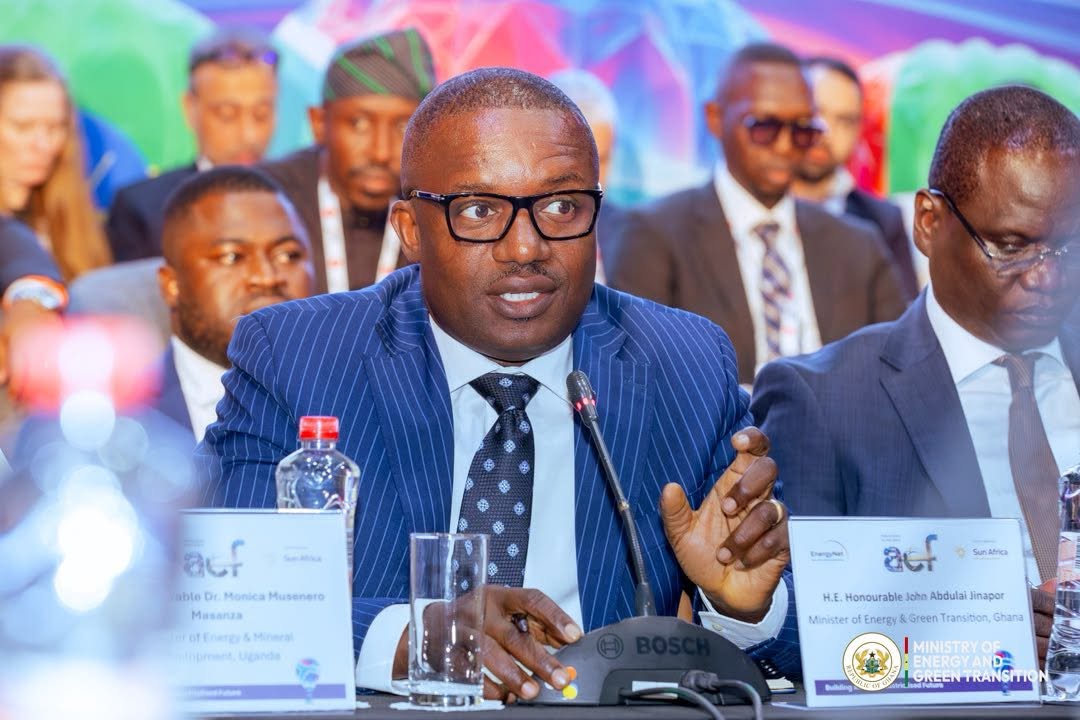
The Minister for Energy and Green Transition, John Abdulai Jinapor, has outlined ongoing reforms in Ghana’s energy sector as critical to the country’s ambition of becoming a leading hub for industrial production and regional trade in Africa.
Speaking during a Town Hall session at the Africa Energy Forum (AEF), Dr. Jinapor joined fellow African energy ministers to discuss how regional production hubs can accelerate industrialisation, economic growth and intra-African trade.
According to the Minister, government’s reform agenda is focused on strengthening the operational and financial foundations of the energy sector to support long-term industrial development and attract greater private sector investment.
He noted that recent interventions have already begun yielding results, particularly in improving payments to utility service providers and enhancing the financial sustainability of the sector.
These developments, he said, are helping to restore investor confidence at a time when reliable and affordable energy is increasingly becoming a key determinant of industrial competitiveness.
“Energy remains the backbone of industrialisation. Our objective is to build a resilient and efficient energy sector that can support manufacturing, value addition and economic transformation,” he stated.
Reliable power for industrial growth
Dr. Jinapor indicated that government is continuing to invest in power generation, transmission infrastructure and renewable energy projects to strengthen electricity reliability and improve access for businesses.
He explained that a stable energy supply is essential if Ghana is to position itself as a preferred destination for manufacturing and industrial investment within the West African sub-region.
The Minister stressed that improving power reliability will not only reduce production costs for industries but also enhance Ghana’s competitiveness under regional trade frameworks such as the African Continental Free Trade Area (AfCFTA).
Industry analysts have consistently identified energy reliability and affordability as among the most important factors influencing investment decisions in manufacturing and export-oriented industries.
Moving beyond raw materials
Dr. Jinapor said government is pursuing policies aimed at transforming Ghana from a largely raw-material-exporting economy into a value-added industrial economy.
He noted that greater emphasis is being placed on local processing of natural resources and agricultural commodities to increase domestic value retention, create jobs and strengthen industrial capacity.
According to him, the strategy forms a central pillar of President John Dramani Mahama’s Accra Reset Agenda, which seeks to drive economic transformation through industrial expansion, higher productivity and inclusive growth.
The policy direction aligns with broader efforts across Africa to deepen local manufacturing, reduce dependence on commodity exports and strengthen participation in global and regional value chains.
Regional production hub
Dr. Jinapor argued that Ghana’s geographic location, improving infrastructure and expanding energy investments provide a strong foundation for the country to emerge as a regional production and trade hub.
He said the combination of energy sector reforms, industrial policy initiatives and value-addition strategies could unlock significant opportunities for businesses while supporting employment creation and export growth.
As governments across Africa seek to accelerate industrialisation, Ghana is positioning itself to leverage its energy resources and strategic location to attract investment and strengthen its role in regional supply chains.
Sustaining this ambition will require continued improvements in energy sector efficiency, stronger private sector participation and consistent policy implementation to ensure that industrial growth translates into broader economic transformation and job creation.