For all of England’s possession and star power, it was Ghana and Carlos Queiroz who emerged with the greater satisfaction after a hard-fought goalless draw that could prove pivotal in the Black Stars’ quest for a place in the knockout stages of the FIFA World Cup.
Football is often described as a game of systems, discipline and execution. Against England, Ghana delivered all three in abundance.
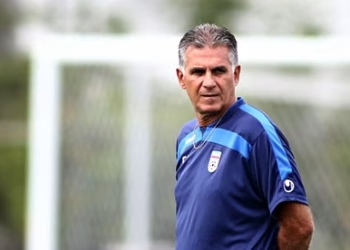
Carlos Queiroz deserves enormous credit for what can only be described as a tactical masterpiece. The veteran coach set up his team in a fluid 4-1-4-1 formation, but on closer observation, it was much more than the numbers on a team sheet. Whenever England had possession, Ghana’s two wide attackers dropped deep into midfield, transforming the shape into a compact and disciplined block that crowded out the Three Lions and denied them the spaces they thrive in.
The result was a Ghanaian side that consistently outnumbered England in key areas of the pitch. Despite enjoying the lion’s share of possession, England found it difficult to penetrate Ghana’s defensive structure. Their passes often led them into congested areas where Ghana’s players, meticulously drilled and tactically aware, closed down space with remarkable efficiency.
What stood out most was the discipline of the players. Every member of the team understood his role and executed it with conviction. There were no unnecessary forays forward, no lapses in concentration and no moments of panic under pressure. Ghana remained compact, organised and focused from the first whistle to the last.
A significant factor in Ghana’s improved balance was the return of Thomas Partey. The experienced midfielder brought calmness, authority and composure to the centre of the park. His positioning shielded the defence, while his ability to retain possession under pressure provided Ghana with much-needed stability whenever England threatened to build momentum. Partey’s presence reminded everyone why he remains one of the most important players in the Black Stars setup.
The performance against England also serves as a vindication of one of the most difficult football decisions taken in Ghana in recent years. Barely seven weeks before the World Cup, the government and football authorities took the bold step of entrusting the national team to Carlos Queiroz. It was a decision that attracted criticism and skepticism in equal measure. However, as Sports and Recreation Minister Kofi Adams remarked in a personal conversation with me after the appointment, “when His Excellency President John Dramani Mahama demands excellence and results from those entrusted with national responsibility, difficult decisions must be taken rather than settling for mediocrity.”
The temptation to maintain the status quo is often strong, particularly in football where sentiment frequently clouds judgment. Yet leadership is ultimately measured by outcomes. At the time of Queiroz’s appointment, many questioned whether such a significant change could yield results with so little time before the tournament. Today, those doubts are beginning to fade.
Looking at Ghana’s performances so far in this World Cup, it is difficult to escape the conclusion that the Black Stars have undergone a remarkable transformation in 3weeks. The discipline, organisation, tactical clarity and belief that have become evident under Queiroz have turned Ghana from hopeful participants into genuine contenders. Few would argue that navigating a difficult Group L featuring England, Croatia and Panama was going to be straightforward. Yet with one match remaining, Ghana has earned qualification to the Round of 32.
At the back, goalkeeper Benjamin Asare justified the confidence shown in him by the technical team. Selected ahead of Ati Zigi, Asare delivered a composed and assured performance that vindicated the decision. He commanded his area well, communicated effectively with his defenders and displayed the confidence expected of a goalkeeper on the biggest stage in world football. While England rarely created clear-cut chances, Asare was alert whenever called upon and exuded the calmness that spread throughout the entire defensive unit.
This was not a performance built on flair or attacking brilliance. It was built on tactical intelligence, collective sacrifice and unwavering discipline. It was a reminder that football matches are not won by possession statistics alone. England may have controlled the ball, but Ghana controlled the game.
As impressive as Ghana’s tactical execution was, there will remain a lingering sense of what might have been. For all of England’s possession, the clearest game-changing moment came when Ghana appeared to have a legitimate claim for a penalty waved away by the match officials. Had justice prevailed, the Black Stars might well have been celebrating one of the most famous victories in their World Cup history. Nevertheless, the performance served notice to the rest of the tournament: Ghana is no longer merely participating; under Carlos Queiroz, the Black Stars are competing with conviction, discipline and belief.
As the Black Stars now prepare for their decisive final group encounter against Croatia, they can draw immense confidence from a performance that showcased not only their resilience but also the strategic brilliance of their coach. As Ghana progresses to the Round of 32, the draw against England may well be remembered as the night Carlos Queiroz produced one of the finest tactical displays by a Ghana coach at a World Cup.
More importantly, it may be remembered as the moment Ghana’s bold decision to prioritize excellence over comfort, results over sentiment, and courage over convention was emphatically vindicated.
In football, as in leadership, there are moments when difficult choices must be made. They are rarely popular. They are often fiercely debated. But when those decisions are guided by a commitment to excellence and validated by results, they become defining moments. For Ghana, the draw against England was not merely another point on the road to qualification. It was the night a bold decision was vindicated. A night H. E President John Mahama’s Reset Agenda manifested in Ghana football.
By George Spencer Quaye
Member, Ghana World Cup Fundraising and Sponsorship Committee