


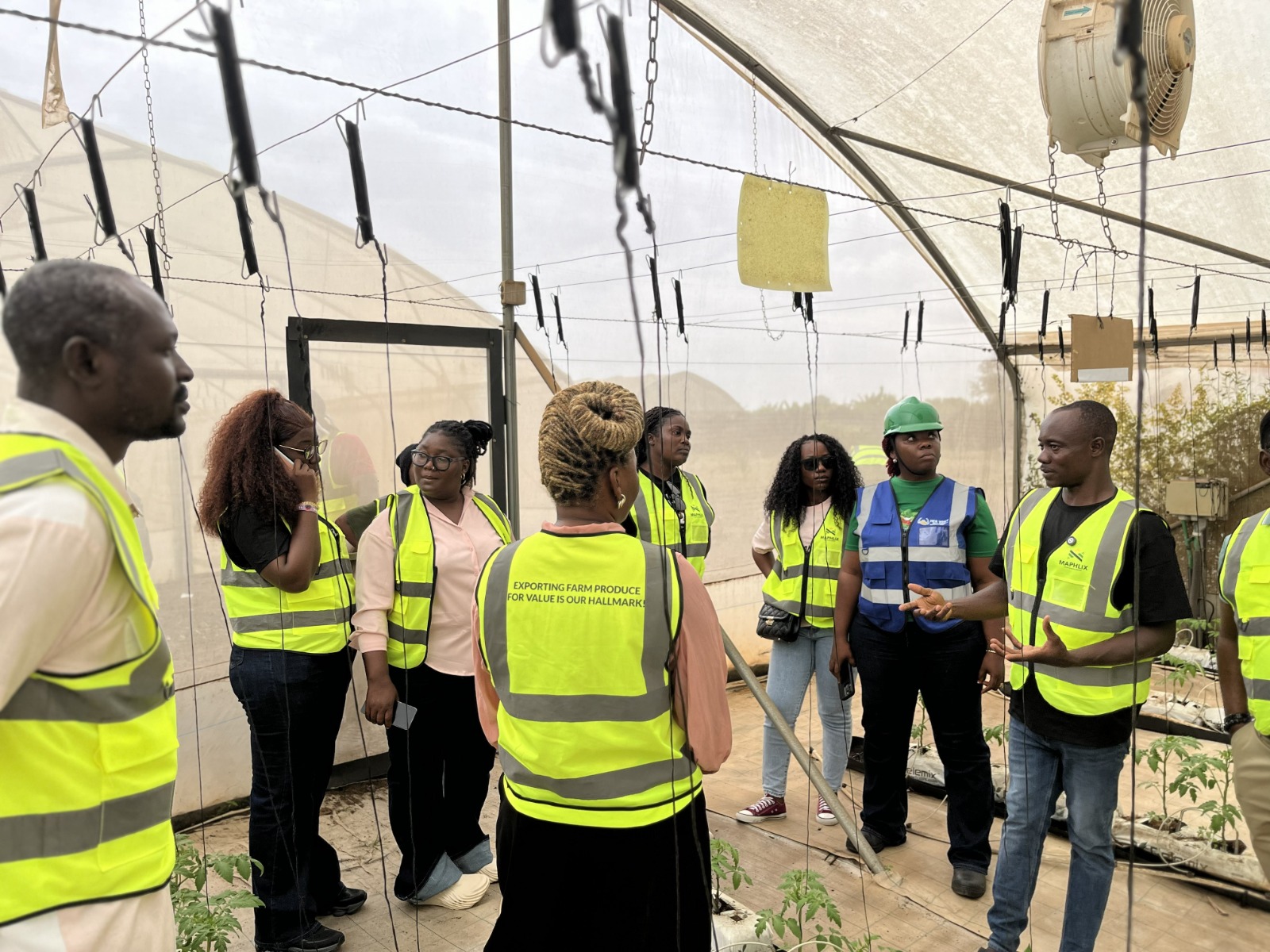
International interest in a greenhouse facility in Dawhenya is drawing attention to a largely untapped opportunity for Ghana: exporting agricultural expertise alongside agricultural produce.
Visits by agribusiness executives from the United States, development agencies, government officials and a delegation from Liberia suggest that Ghana’s most successful farms are increasingly being recognised not only for what they grow, but also for the production systems, technologies and business models behind their success.
At the centre of this trend is Maphlix Trust Ghana Limited, a Tadzevu-based agribusiness company in the Volta region that operates across farming, aggregation, processing and exports. Since taking over the previously idle greenhouse and irrigation facility at Dawhenyain 2025, the company has transformed it into a centre for agricultural production, skills development and knowledge exchange.
What began as a commercial greenhouse operation supplying vegetables to local and export markets and serving as a training ground for young agripreneurs has increasingly become a destination for policymakers, investors, entrepreneurs and development practitioners seeking practical lessons in modern agriculture.
The latest visitors included officials from Liberia’s Ministry of Agriculture and selected Micro, Small and Medium Enterprises participating in a United Nations Industrial Development Organisation (UNIDO) programme. The delegation visited the facility to study production systems, value addition strategies, sustainable sourcing practices and export market integration.
The visit followed an earlier engagement this year involving 27 agribusiness chief executives from Indiana in the United States, who toured the facility to explore collaboration opportunities with Ghanaian agricultural enterprises.
For industry observers, the growing number of such visits reflects a broader shift in how agricultural assets create value. Beyond producing food, commercial farms are increasingly becoming centres for training, innovation, technology transfer and regional cooperation.
Beyond Food Production
Traditionally, the value of agriculture has been measured in output, exports and employment. Increasingly, however, successful agribusiness enterprises are generating a different kind of value: knowledge.
Across countries such as the Netherlands, Israel and the United States, commercial farms serve as practical learning centres for students, investors, policymakers and researchers seeking to understand modern production systems and agribusiness models.
Agricultural analysts believe Ghana could develop a similar niche by leveraging successful agribusiness ventures as centres for learning, innovation and technical exchange.
Maphlix’s Dawhenya operation increasingly reflects that possibility.
Since assuming management of the facility, the company has revived infrastructure that had remained largely underutilised for years under the Ministry of Food and Agriculture. Today, the greenhouse and irrigation project functions not only as a production centre but also as a training platform for thousands of young Ghanaians interested in agribusiness and export-oriented farming.
The facility integrates greenhouse production, irrigation management, technology adoption, market-led agriculture and skills development within a single operation, making it an attractive case study for countries seeking to improve productivity and food security.
Exporting Expertise
For Maphlix Chief Executive Officer Dr. Felix Mawuli Kamassah, the growing international interest demonstrates that African countries have much to learn from one another as they seek to strengthen agricultural production and reduce food imports.
“We want Africa to know that we can do it. This is the time for us to believe in ourselves. We have the expertise here and we are happy for other countries to visit and learn from what we are doing,” he said.
According to him, agriculture should increasingly be viewed as a platform for cooperation rather than competition.
The CEO believes knowledge exchange can strengthen production systems across the continent while creating new opportunities for trade, investment and regional food security.
“We can exchange knowledge and support each other. Many African countries consume similar foods. Where there is a shortage, we should be able to work together and support each other,” he noted.
For Liberia, which continues to import significant volumes of vegetables, the visit provided an opportunity to examine production techniques that could help improve domestic output and reduce import dependence.
Discussions also explored opportunities for technical cooperation, capacity building and regional trade.
From Greenhouse to Economic Diplomacy
The transformation of the Dawhenya greenhouse project is particularly significant because it demonstrates how underutilised public agricultural infrastructure can be repurposed to support commercial farming, youth employment and export growth.
What was once a dormant facility has become a platform for investment promotion, skills development and international engagement.
Such visits often generate benefits that extend beyond immediate commercial transactions. They can lead to technology transfer agreements, training programmes, investment partnerships, export contracts and stronger regional value chains.
In effect, agricultural enterprises are increasingly becoming instruments of economic diplomacy.
The trend aligns closely with the objectives of the African Continental Free Trade Area (AfCFTA), which seeks to deepen intra-African trade and strengthen productive capacity across the continent.
As countries pursue greater food security and agricultural modernisation, successful farms are evolving into demonstration centres where practical solutions can be observed, tested and adapted.
Climate Change Raises the Stakes
While opportunities are expanding, climate change remains a growing challenge for African agriculture.
Dr. Kamassah noted that changing rainfall patterns and rising temperatures are making traditional farming methods increasingly unpredictable.
“The climate has changed. We can no longer rely on old assumptions about when rains will come. This is why smart agriculture is becoming essential,” he said.
He called for increased investment in research, irrigation, water harvesting and climate-resilient farming systems to ensure future agricultural productivity.
A New Export Industry?
The emergence of agricultural knowledge exchange presents a potentially significant opportunity for Ghana.
Beyond generating revenue from agricultural products, successful agribusiness enterprises can create value through training, consultancy, technology transfer, investment attraction and regional partnerships.
The economic impact extends beyond farms themselves, creating opportunities for educational institutions, hospitality providers, transport operators and local businesses that support visiting delegations and study tours.
As more international visitors continue to arrive at facilities such as Maphlix, Ghana may be witnessing the emergence of a new export category—one measured not only in tonnes of produce shipped abroad, but also in expertise, innovation and practical agricultural know-how shared across borders.
If sustained, the trend could strengthen Ghana’s position not only as a producer of food, but also as a regional source of agricultural solutions for a continent seeking to modernise its food systems and build climate-resilient agriculture.
–
Author: Robert Aidoo




![School prefect Asuo Angela, on behalf of students of Sagnarigu Girls’ Model JHS [right], presents a petition to Sagnarigu MCE Abdulai Gong [left].](https://www.citinewsroom.com/wp-content/uploads/2026/06/SAGNARIGU-1-350x250.jpeg)









