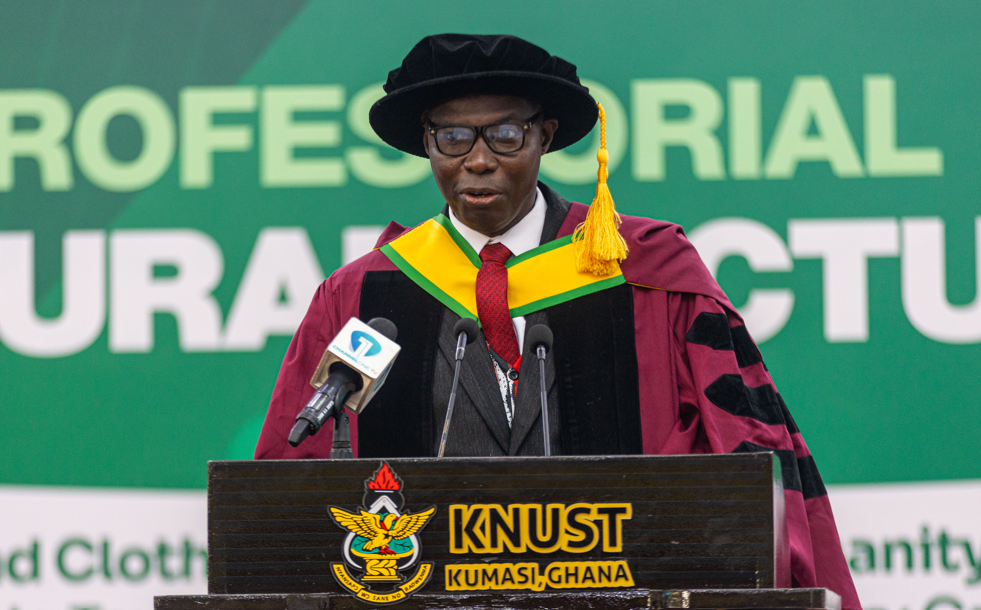
A Professor at the Kwame Nkrumah University of Science and Technology (KNUST), Professor Ebenezer Kofi Howard, has proposed the establishment of a dedicated Ministry of Textiles and Apparel as a critical step towards reviving Ghana’s ailing textile and apparel industry and unlocking its immense economic potential.
Prof. Howard, an academic and professional in Textile Design and Technology at the Department of Industrial Art under the College of Art and Built Environment (CABE), made the proposal during his inaugural lecture on the theme, “Beyond Clothing the Nudity of Humanity: How Sustainable Textiles and Apparel Industry can Rescue Ghana from its Socio-Economic and Environmental Quagmire.”
According to him, the proposed ministry would spearhead the implementation of policies and innovations needed to transform Ghana’s textile and apparel (T&A) sector into a major driver of economic growth.
“In order to take full advantage of the long value chain of the textile and apparel sector amplified by its economic worth, it is recommended that a dedicated Ministry of Textiles and Apparel be established to promote and champion Ghana’s T&A industry for accelerated development,” he stated.
He cited India as an example of a country that has successfully transformed its textile industry through dedicated institutional support, resulting in significant global impact.
Prof. Howard explained that the ministry would operationalise the national textile and apparel policy, advance technological innovations and champion the development of large-scale industries to fully optimise the value chain from agriculture through textile production to garment manufacturing and distribution.
The professor lamented the deteriorating state of Ghana’s textile and apparel industry, describing it as a sector that was once the backbone of the country’s industrial development.
“The crux of today’s lecture lies in the dwindling state of the textile and apparel industry, which is supposed to be the bedrock of supplying the needed raw materials for the apparel industry,” he observed.
He noted that Ghana’s apparel industry currently depends heavily on imported textiles due to inadequate domestic production, while local textile manufacturers also rely extensively on imported mercerised cotton following the collapse of the country’s cotton industry.
“Ironically, due to the collapse of the cotton industry, the textile industry also relies heavily on the importation of mercerised cotton for production, thereby relinquishing more than 70 per cent of its value chain operations to offshore counterparts,” he said.
According to Prof. Howard, the situation has contributed significantly to the closure of many domestic textile firms, declining productivity and high redundancy rates within the sector.
To ensure the long-term viability of the industry, he advocated the development of a sustainable raw material base for textile and apparel production.
Among his recommendations was the restructuring of the Cotton Development Authority with a clear mandate to regulate, coordinate and promote the cotton sector.
“This authority will provide a legal framework, enforce standards and research innovations to boost productivity and ensure high-quality cotton production in Ghana,” he said.
The professor also proposed the establishment of a Petrochemical and Textile Industrial Zone as well as a National Textile and Petrochemical Research Institute to leverage Ghana’s petrochemical resources for synthetic fibre production.
Additionally, he called for the establishment of an Industrial Dyes Park dedicated to research, development and the commercial production of textile dyes and auxiliaries to reduce the industry’s dependence on expensive imported inputs.
Touching on government’s proposed 24-hour economy policy, Prof. Howard described the textile and apparel industry as the most practical vehicle for achieving the initiative.
“The industry has been tried and tested by giant economies and even Ghana in the 1970s and has proven to be the most feasible driver when it comes to shift systems in industrial production,” he noted.
He added that the labour-intensive nature of the industry makes it possible to operate three shifts within a 24-hour period, thereby creating more jobs and increasing productivity.
“Its labour-intensive nature makes it possible to run three shifts within 24 hours, employing workers for morning, afternoon and night shifts. This will create more employment, improve livelihoods and increase productivity for economic growth,” he added.
Prof. Howard expressed optimism that establishing textile and apparel firms across all sixteen regions of Ghana would be a game-changer for the country’s industrialisation agenda.
He also underscored the need for a favourable national policy framework to guide the industry’s development.
While commending government for drafting the Ghana Textiles and Garment Manufacturing Policy in 2025, he argued that the policy requires substantial revisions.
“A critical review of the National Textile and Apparel Policy reveals an insufficient strategic focus on developing the domestic raw material base for the industry,” he stressed.
He disclosed that Ghana currently imports approximately 95 per cent of its textile raw materials, including dyes, auxiliaries, and both natural and synthetic fabrics.
“This heavy reliance on external supply chains undermines national efforts to capitalise on the rapidly evolving global textile and apparel market,” he cautioned.
Prof. Howard therefore recommended that the policy be revised to expand the domestic raw material base and ensure greater participation of Ghanaian textile experts and institutions in its implementation.
“A revision to expand the raw material base and empower Ghanaian textile and apparel experts and institutions to fully participate and play key roles is highly recommended to ensure feasible implementation of the policy,” he concluded.