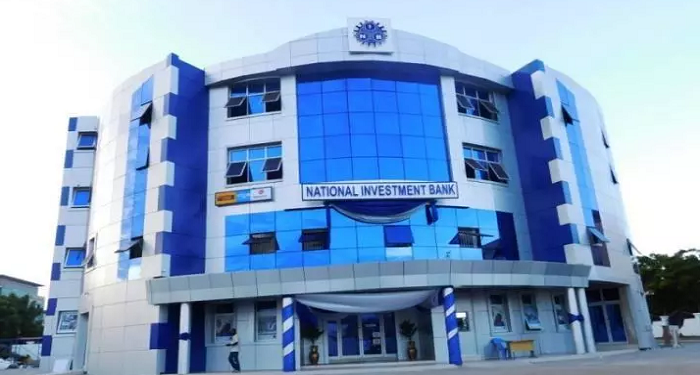
The National Investment Bank (NIB) says it is positioning for a stronger performance in 2026 after recording a profit after tax of GH¢34.3 million in the first quarter, extending the momentum from a remarkable turnaround achieved in 2025.
At a media engagement in Accra, management said the bank’s recovery is being driven by core operations and deliberate reforms rather than one-off gains, providing a solid foundation for sustained growth.
Chief Executive Officer, Chief Doli-Wura Zakaria, said the latest figures demonstrate that NIB’s resurgence is now firmly rooted in structural changes within the institution.
“Our Q1-2026 results are clear evidence that NIB’s recovery is real and self-sustaining. We moved from operating loss in 2024 to a core operating profit of GH¢275 million in 2025, and we carried that performance into the first quarter of 2026 without leaning on one-off items. Our people, our depositors, and shareholders are seeing the results of a turnaround that is now structural, not seasonal,” he said.
The first-quarter results followed a strong performance in 2025, when NIB recorded a core operating profit before associate income of GH¢275.4 million, reversing an operating loss of GH¢5.6 million in 2024.
The turnaround was underpinned by a sharp increase in net interest income, which more than tripled to GH¢633 million in 2025. Interest income rose to GH¢1.23 billion, while interest expenses increased at a slower pace to GH¢592 million, reflecting stronger margins and improved operational efficiency.
Net operating income, comprising net interest income, fees, commissions, trading and other income, more than doubled to GH¢885.5 million. Total profit after tax reached GH¢343.9 million, including a GH¢106.7 million contribution from associate companies Nestlé and Nexans.
The growth momentum continued into 2026, with net interest income for the first quarter standing at GH¢151.6 million, equivalent to an annualised figure of about GH¢606 million and broadly consistent with the previous year’s performance.
NIB’s balance sheet also strengthened during the period. Total assets increased by 7.7 percent to GH¢13.16 billion, while customer deposits rose by 9.4 percent to GH¢11.16 billion. Loans and advances grew by 6.5 percent to GH¢778.8 million.
The bank’s total equity improved further to GH¢1.58 billion, while the retained earnings deficit narrowed by another GH¢34.3 million, indicating that current profits are being channelled into rebuilding the institution’s financial position.
Despite the gains, management acknowledged that legacy challenges remain, particularly the high stock of non-performing loans (NPLs). The bank’s gross NPL ratio declined from 69.7 percent in 2025 to 66 percent in the first quarter of 2026, although it remains significantly above the industry average.
Chief Financial Officer Mohammed Gausu said the bank has adopted a funded and time-bound strategy to address the issue through aggressive recoveries, restructurings, regulatory-approved write-offs and disciplined cost management.
“We have been fully transparent about our elevated NPL ratio, emanating almost entirely from a legacy loan book. What matters going forward to analysts and depositors is that every one of these issues now has a funded, time-bound remediation plan behind it,” he said.
NIB returned to positive total equity of GH¢1.55 billion in 2025, supported by GH¢3.43 billion in committed government capital that is awaiting formal conversion into stated capital as part of a broader recapitalisation programme. The positive equity position was maintained in the first quarter of 2026.
Looking ahead, the bank aims to establish itself as Ghana’s premier development bank and a leading financier of the country’s industrial transformation agenda.
Management says its strategy for 2026 will focus on capital optimisation, building a stronger industrial-focused loan book, accelerating digital transformation and deepening operational efficiency.
Chief of Treasury Operations, Osman Soale Atchulo, said the bank’s planned core banking upgrade, aggressive mobilisation of low-cost current and savings deposits, and capital-raising initiatives are designed to reinforce one another and support sustainable growth.
“Our three decisive actions for 2026 — the core banking upgrade, aggressive CASA mobilisation and raising capital — are deliberately sequenced to reinforce one another. A modern core banking platform lets us deepen low-cost current and savings account relationships at scale, which in turn lowers our cost of funds and strengthens the balance sheet ahead,” he said.
With profitability returning and key reforms underway, NIB believes it is well positioned to deliver a stronger performance in 2026 while advancing its long-term ambition of becoming a catalyst for Ghana’s industrial development.