Every rainy season, the images are painfully familiar.
Plastic bottles floating through flooded streets. Choked gutters spilling onto roads. Refuse piling up in markets. Communities scrambling to clear drains after hours of rainfall. Then come the conversations, the public outrage, the clean-up campaigns and the renewed promises that Ghana must do better.
A few weeks later, the cycle begins again.
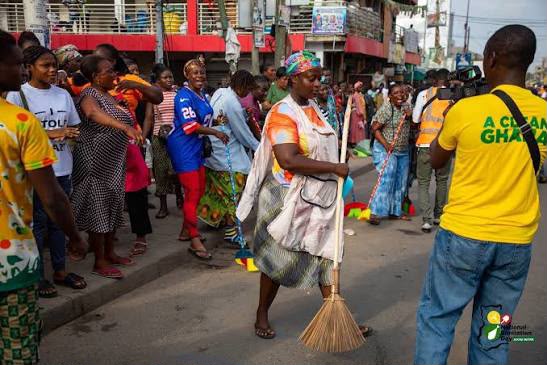
That is why President John Dramani Mahama’s announcement of a nationwide two-day cleaning exercise deserves attention. It is a call for collective action, civic responsibility and a reminder that sanitation cannot be left to government alone.
But it also presents an opportunity to ask a more important question.
Can two days of cleaning solve a problem that has been decades in the making?
The answer is no.
Not because the exercise is unnecessary. Far from it. The real challenge is that Ghana’s sanitation crisis has never been simply about dirty streets. It is about broken systems, weak enforcement, inadequate infrastructure and years of treating waste as something to dispose of instead of something to manage.
Unless those underlying issues are addressed, we will continue sweeping the same streets, clearing the same drains and having the same conversations year after year.
That is the uncomfortable truth.
A national clean-up exercise is good optics. It brings people together. It encourages volunteerism. It reminds citizens that keeping our communities clean is a shared responsibility. It can improve public spaces, clear blocked drains and create awareness around environmental sanitation.
These are important outcomes.
In fact, countries that have successfully improved sanitation have often relied on strong public participation. Government policies alone cannot keep communities clean if citizens continue littering indiscriminately.
So the President’s initiative should not be dismissed.
But neither should it be mistaken for a long-term solution.
The reality is that a clean-up exercise is like mopping a floor while the tap is still leaking. The floor becomes clean, yes. But if nobody fixes the leaking tap, the water returns.
Ghana’s waste management system is that leaking tap.
Consider the experience of many households across the country. Residents may separate their waste, keep their compounds clean and wait for collection services, only for bins to remain unemptied for days or even weeks. Eventually, overflowing containers become another source of pollution.
In other communities, there are simply not enough collection points. Residents travel long distances to dispose of refuse or resort to dumping waste in drains, open spaces and abandoned plots.
When people do not have convenient and reliable waste collection services, poor disposal practices become almost inevitable.
Cleaning the environment without fixing the collection system is treating the symptom while ignoring the disease.
The challenge extends beyond collection.
Ghana has sanitation laws. Metropolitan, Municipal and District Assemblies have by-laws. Environmental regulations exist. Yet enforcement remains one of the weakest links in our sanitation chain.
People dump refuse into drains with little fear of consequences.
Businesses dispose of waste irresponsibly.
Construction debris blocks waterways.
Plastic waste finds its way into rivers and beaches.
The problem is rarely the absence of rules. It is the absence of consistent enforcement.
No country has achieved sustainable environmental sanitation through occasional campaigns alone. It has happened because institutions worked, regulations were enforced and citizens understood that irresponsible behaviour carried consequences.
Discipline is not built during a two-day exercise. It is built through daily accountability.
There is another dimension of this conversation that deserves far more attention.
We continue to speak about waste as though it is merely an environmental nuisance.
It is much more than that.
Waste is an economic issue.
Every clogged drain that contributes to flooding destroys homes, damages businesses and disrupts economic activity. Every sanitation-related disease places additional pressure on our healthcare system and reduces productivity. Every piece of recyclable plastic dumped into a landfill represents lost income, lost jobs and lost industrial potential.
In other words, Ghana is not only managing waste poorly. We are wasting economic opportunities.
Around the world, countries are increasingly treating waste as a resource rather than rubbish.
Plastic becomes raw material for new products.
Organic waste becomes compost for agriculture.
Waste generates electricity.
Recycling industries employ thousands of people.
Entire value chains have emerged around what was once considered useless.
That is where Ghana’s conversation should be heading.
The question should no longer be, “How do we remove waste?”
It should be, “How do we create value from waste?”
This shift in thinking changes everything.
Instead of seeing sanitation merely as a public expenditure, we begin to see it as an investment.
Instead of viewing waste management companies simply as contractors, we recognise them as partners in economic development.
Instead of looking at refuse dumps as the end of the process, we begin building industries around recycling, composting, waste processing and circular manufacturing.
That is how nations transform environmental challenges into economic opportunities.
Rapid urbanisation makes this transition even more urgent.
Ghana’s cities are expanding faster than the systems designed to serve them. More people mean more consumption. More consumption means more waste. Yet investment in collection infrastructure, transfer stations, recycling facilities and engineered landfill sites has not kept pace with population growth.
The result is predictable.
Communities generate more waste than existing systems can efficiently manage.
Our Metropolitan, Municipal and District Assemblies find themselves under enormous pressure. Many struggle with inadequate funding, ageing equipment, insufficient personnel and competing development priorities.
Expecting these assemblies to solve Ghana’s sanitation challenge without strengthening their capacity is unrealistic.
The conversation, therefore, should move beyond what citizens can do during two days of cleaning to what institutions must do throughout the year.
This is where policy matters.
Government must invest in modern waste collection systems that make responsible disposal convenient and accessible.
Enforcement of sanitation by-laws must become consistent rather than seasonal.
Private sector participation should be expanded to encourage innovation, investment and efficiency across the waste value chain.
Recycling infrastructure must receive the attention it deserves.
Schools should integrate practical environmental education that shapes behaviour from an early age.
Media organisations must continue sustained public education instead of limiting sanitation discussions to periods of flooding or national campaigns.
Above all, Ghana needs a behavioural shift.
Infrastructure matters.
Policy matters.
Investment matters.
But culture matters just as much.
No amount of investment will keep our cities clean if citizens continue throwing sachet water wrappers onto the streets from moving vehicles.
Likewise, no amount of public education will succeed if government fails to provide accessible disposal facilities.
Sanitation is a shared responsibility.
Government must build systems.
Institutions must enforce standards.
Businesses must adopt responsible waste practices.
Citizens must change behaviour.
Each pillar depends on the others.
That is why the national cleaning exercise should be seen not as the destination but as the starting point.
If these two days inspire stronger policies, greater investment, better enforcement and sustained behavioural change, then they will have achieved something meaningful.
If they become another annual event followed by a return to business as usual, then the impact will be short-lived.
Ghana has organised clean-up campaigns before. Many communities have been swept clean, only for the same gutters to become clogged again months later.
The lesson is obvious.
Cleaning without reform is temporary.
Systems create permanence.
As a country, we must stop measuring success by how much waste we remove after it accumulates. We should measure success by how little waste reaches our drains, streets and public spaces in the first place.
That is what effective waste management looks like.
Ultimately, Ghana’s sanitation challenge is not a crisis of brooms. It is a crisis of systems.
The broom is important. Every citizen should be willing to pick one up when duty calls.
But no nation has ever swept its way to lasting cleanliness.
It planned its way there.
It invested its way there.
It enforced its way there.
It educated its way there.
And above all, it built institutions that made cleanliness the norm rather than the exception.
The President’s nationwide cleaning exercise is therefore a welcome initiative. It can mobilise citizens, renew public consciousness and demonstrate our collective commitment to cleaner communities.
But when the last broom is put away, and the final truck leaves the landfill, the real work will only be beginning.
The future of Ghana’s sanitation will not be decided over two days.
It will be decided by what we choose to do on the remaining 363.
If we truly want a cleaner Ghana, then the national conversation must move beyond periodic cleaning exercises to building the systems, institutions and culture that keep the country clean every single day.
Because in the end, the cleanest cities are not those that organise the biggest clean-up exercises.
They are the ones that have built systems that make such exercises largely unnecessary.
The author of this piece is a broadcast journalist, host of Business Breakfast on Zed 101.9FM, corporate MC and development communicator by name, Nii Trebi Hammond. He writes on business, leadership, governance, and social impact issues. You can reach him on 0545038182 or [email protected]