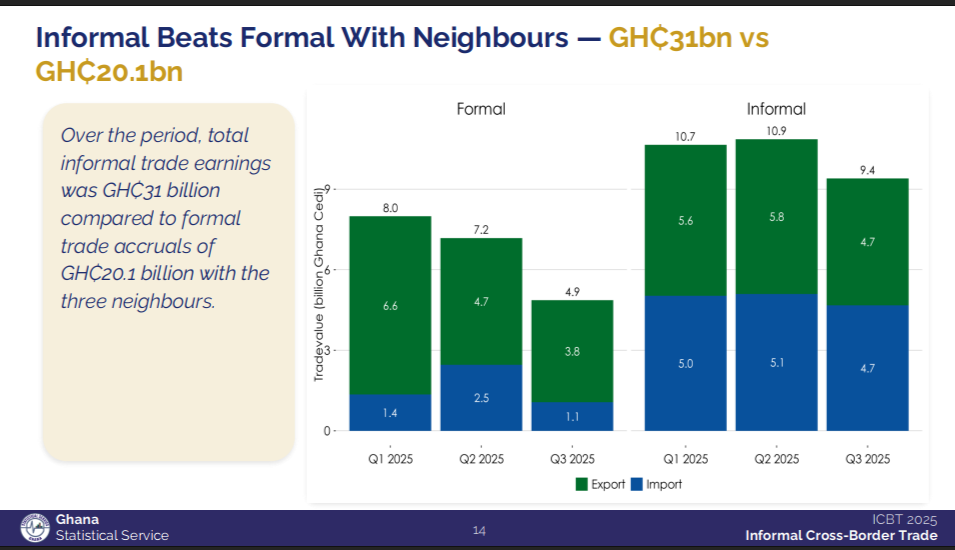
Ghana’s informal cross-border trade reached GH¢31 billion between January and September 2025, surpassing the value of formal trade with the country’s three neighbouring countries, according to a new report by the Ghana Statistical Service (GSS).
The figure, recorded in the first-ever extended survey of informal cross-border trade for the first three quarters of 2025, shows that unrecorded trade accounted for about 6% of Ghana’s total trade during the period.
The GSS report on Informal Cross-Border Trade (ICBT) found that informal trade with Togo, Burkina Faso and Côte d’Ivoire amounted to GH¢31 billion, compared with GH¢20.1 billion in formal trade earnings with the same countries.
The findings highlight the scale of Ghana’s border economy, which for years remained largely outside official economic statistics despite supporting livelihoods, supplying markets and creating jobs in border communities.
 Government Statistician, Professor Alhassan Iddrisu, said measuring informal trade was necessary to provide a clearer picture of Ghana’s economy and improve policy decisions.
The report noted that informal cross-border trade had previously been a “blind spot” in Ghana’s economic data, making it difficult for policymakers to fully understand the movement of goods and the contribution of small-scale traders to national development.
The survey covered 206 active border points with Togo, Burkina Faso and Côte d’Ivoire across 10 regions, with data collected through direct observation and interviews with traders.
A total of 676 officers were deployed for the exercise, which captured the movement of goods between January and September 2025.
The report showed that informal trade remained consistently responsible for about 6% of Ghana’s total trade across the three quarters.
Among Ghana’s neighbours, trade with Togo recorded the highest level of informality, with informal transactions accounting for between 70.5% and 77.8% of Ghana-Togo trade during the period.
In Côte d’Ivoire, informal trade accounted for more than three-fifths of total trade across all three quarters.
The report also found that Ghana maintained trade surpluses in both formal and informal trade across the period, although the informal trade surplus narrowed sharply from GH¢665.3 million in the second quarter of 2025 to GH¢49.3 million in the third quarter.
Beyond the economic value of the trade, the GSS said the findings provide important information for improving border management, supporting traders and strengthening Ghana’s participation in regional trade initiatives, including the African Continental Free Trade Area (AfCFTA).
The report recommended measures including simplifying registration and licensing processes for small-scale traders, improving roads and facilities at major border crossings, and strengthening data-sharing between the Ghana Statistical Service, Ghana Revenue Authority and Ghana Immigration Service.
It also called for greater investment in local production and value chains, particularly for commodities such as rice, cooking oil and livestock, which dominate informal trade flows.
The GSS said continued measurement of informal cross-border trade would help Ghana move the sector from an overlooked economic activity to one that is properly understood, supported and integrated into national planning.