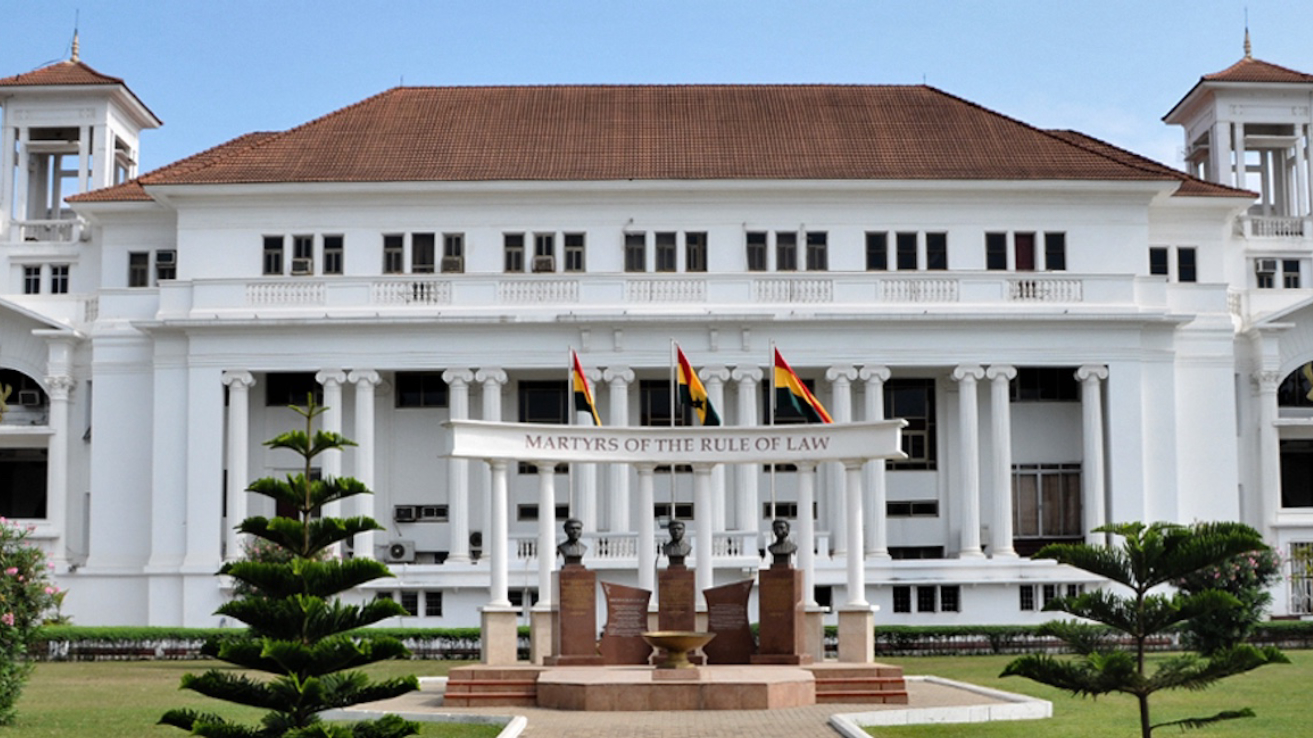
The Supreme Court has dismissed an application by Ashanti Port Services Ltd. (APSL) challenging a High Court decision that set aside a US$33.3 million arbitral award previously granted in its favour against Justmoh Construction Ltd.
The apex court’s ruling leaves intact the earlier judgment of the High Court, Commercial Division 2, which nullified the arbitral award in May this year.
A five-member panel of the Supreme Court, chaired by Chief Justice Baffoe-Bonnie and comprising Justices Asiedu, Kwofie, Kodwo and Amaleboba, unanimously held that APSL’s application lacked merit.
APSL had invoked the Supreme Court’s supervisory jurisdiction, seeking to quash the High Court’s decision that invalidated the arbitral award against Justmoh Construction.
Reacting to the judgment delivered on Tuesday, July 14, counsel for Justmoh Construction Ltd., Professor Kwame Gyan, described the ruling as a victory for due process and the rule of law.
“We have always had confidence in our brief because we know the facts support our case. It comes as no surprise that the Supreme Court agrees with us. We are grateful to his lordships for the ruling, due process has won.”
The ruling marks another significant development in the long-running legal dispute over the Boankra Inland Logistics Terminal Project, effectively affirming the High Court’s decision to set aside the US$33.3 million award in favour of APSL.
High Court decision
On May 6, 2026, the Commercial Division 2 of the High Court, presided over by Justice John-Mark Nuku Alifo, nullified in its entirety the arbitral award issued on December 10, 2025, in favour of APSL.
The court held that APSL lacked the corporate capacity to commence the arbitration proceedings and further found that the company’s board was not properly constituted under the applicable Shareholders’ Agreement.
“The ex post facto attempt to ratify the Chief Executive Officer’s decision to refer the dispute to arbitration could not cure a fundamental defect which goes to the very root of the case.”
Dispute over Boankra project
The dispute stems from the Boankra Inland Logistics Terminal Project, an inland port development involving the Government of Ghana through the Ministry of Transport and the Ghana Shippers’ Authority, together with the Ghana Ports and Harbours Authority (GPHA) and Afum Quality Limited.
In August 2022, APSL engaged Justmoh Construction Ltd. as the Engineering, Procurement and Construction contractor for Phase 1A of the project.
Court documents showed that APSL subsequently failed to secure the required financing and did not achieve financial close under the concession agreement.
The court heard that GPHA later paid US$33.3 million under a share subscription arrangement in APSL, with the funds transferred directly into Justmoh’s account as mobilisation payment to commence work.
Following the termination of the concession agreement by the Ghana Shippers’ Authority in August 2023 and the state’s takeover of the project, APSL initiated arbitration proceedings in December 2023, seeking a refund of the US$33.3 million.
The arbitral tribunal subsequently ruled in APSL’s favour, ordering Justmoh Construction to repay the amount together with interest and other reliefs.
Court findings
However, in a 40-page judgment, the High Court upheld substantial portions of the submissions advanced by Professor Gyan on behalf of Justmoh Construction and identified multiple defects in APSL’s case.
The court ruled that APSL failed to obtain valid board authorisation before initiating arbitration proceedings, stressing that corporate capacity must exist at the time legal proceedings are commenced and cannot be acquired retrospectively.
It further held that the purported January 2024 board meeting convened to ratify the arbitration proceedings was itself invalid because the board had not been properly constituted under the Shareholders’ Agreement, which required representation from key stakeholders, including the GPHA and the Ghana Shippers’ Authority.
The court also found that granting APSL a refund would amount to unjust enrichment because APSL had itself contributed to the contractual breaches that ultimately led to the state’s intervention in the project.
“It would.. be unfair for APSL to receive, by way of refund, monies which were not in fact advanced by it.”
With the Supreme Court dismissing APSL’s application, the High Court’s decision remains in force, bringing another chapter of the protracted dispute firmly in Justmoh Construction’s favour.