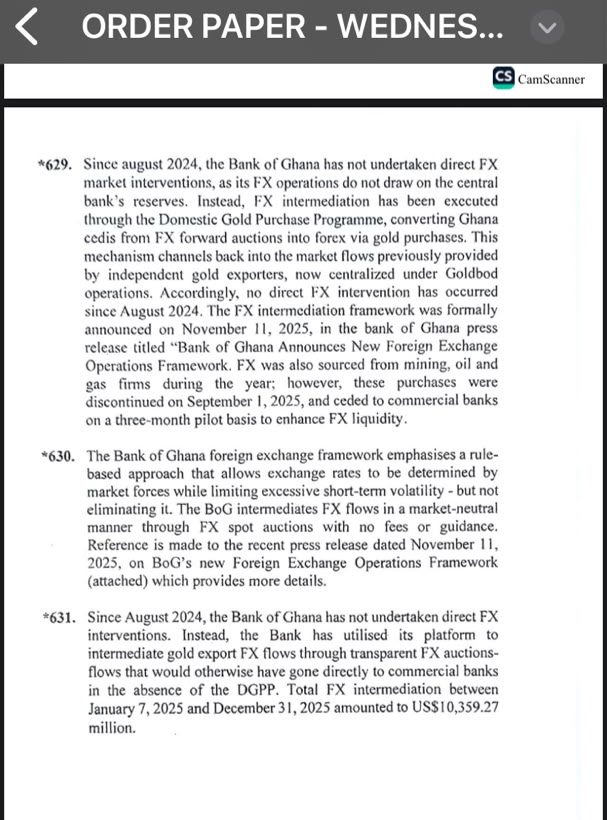
The Governor of the Bank of Ghana (BoG), Dr. Johnson Asiama, has disclosed that the central bank has not conducted any direct foreign exchange (FX) market interventions from August 2024 to the end of December 2025, stressing that its current FX operations do not rely on the use of the country’s reserves.
The disclosure was contained in responses submitted by the Governor to Parliament on Wednesday, July 15, during a briefing with the House.
The engagement was held behind closed doors after First Deputy Speaker Bernard Ahiafor ruled that the proceedings would not be open to the media, a decision that was criticised by the Minority.
According to Dr. Asiama, the Bank of Ghana has instead relied on the Domestic Gold Purchase Programme to support foreign exchange intermediation in the market.
“Since August 2024, the Bank of Ghana has not undertaken direct FX market interventions, as its FX operations do not draw on the central bank’s reserves. Instead, FX intermediation has been executed through the Domestic Gold Purchase Programme, converting Ghana cedis from FX forward auctions into forex via gold purchases,” the Governor stated.
He explained that the arrangement has helped centralise foreign exchange flows that were previously supplied by independent gold exporters, with proceeds now channelled back into the market through Goldbod operations.
Dr. Asiama said the current FX intermediation framework was formally introduced on November 11, 2025, under the Bank of Ghana’s New Foreign Exchange Operations Framework.
He added that, aside from gold proceeds, foreign exchange sourced from mining, oil and gas companies also contributed to FX liquidity during part of the year. However, those purchases were discontinued on September 1, 2025, and transferred to commercial banks on a three-month pilot basis to improve market liquidity.
The Governor said the Bank’s foreign exchange framework is guided by market principles aimed at reducing excessive short-term volatility while allowing exchange rates to be determined by market forces.
“The Bank of Ghana foreign exchange framework emphasises a rule-based approach that allows exchange rates to be determined by market forces while limiting excessive short-term volatility but not eliminating it,” he said.
Dr. Asiama further stated that the Bank conducts spot foreign exchange auctions in a market-neutral manner without charging fees or providing guidance on exchange rate pricing.
He disclosed that between January 7 and December 31, 2025, the Bank of Ghana intermediated export foreign exchange flows worth US$10.36 billion through the Domestic Gold Purchase Programme.
The closed-door parliamentary briefing followed the First Deputy Speaker’s ruling that the media would not be allowed to cover the session. The Minority objected to the decision, arguing that the Governor’s responses addressed matters of public interest and should have been discussed in an open sitting.