



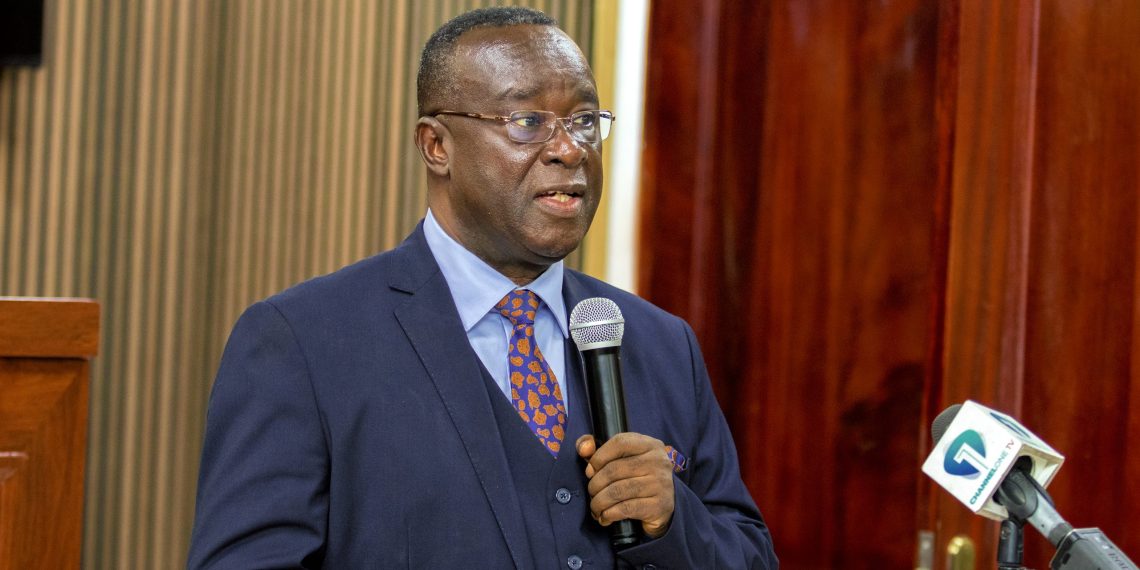
Chief Justice Paul Baffoe-Bonnie has warned that Ghana’s justice system must not become a preserve of powerful individuals and institutions, stressing that its true measure lies in its ability to protect ordinary citizens in their everyday lives.
He said justice must be accessible to all citizens, including farmers, traders, entrepreneurs and pensioners, arguing that a system that protects only the powerful would fail its constitutional purpose.
In a speech read on his behalf by Justice Sophia Rosetta Bernasko-Essah at the commemoration of 50 years of rural banking and the conversion to community banking at the Bank Square on Thursday, July 16, 2026, the Chief Justice said access to justice and financial inclusion were closely connected.
“Sometimes when we speak about justice, our minds instinctively tend to the larger institutions, to multinational corporations, major commercial banks, and the high-value disputes that command public attention,” he said.
“But justice was never designed only for the powerful. Its true test is found just as much in the everyday lives of ordinary people.”
Justice Baffoe-Bonnie said the justice system must be relevant to citizens whose daily activities often depend on access to financial support and institutional protection.
He cited situations where farmers seek credit to cultivate their lands, market women deposit proceeds from their businesses, young entrepreneurs obtain their first loans to expand their ventures, and pensioners entrust their savings to community banks.
“It is tested when a farmer seeks credits to cultivate a few acres of land, when a market woman deposits the proceeds of a day’s work, when a young entrepreneur secures the first loan to expand a business, or when an elderly pensioner entrusts a lifetime of savings to the community bank that has served generations before him,” he said.
“If justice protects only the powerful, then it has failed its constitutional purpose.”
The Chief Justice said Ghana’s Constitution envisioned a legal system that protects every person, enterprise and institution, irrespective of their size or location.
He noted that rural banks, now evolving into community banks, had played a significant role in bringing financial services closer to citizens, particularly those outside major commercial centres.
According to him, these institutions had supported ordinary Ghanaians engaged in farming, trading, fishing, teaching, manufacturing and other forms of economic activity.
“Many of them may never enter the imposing banking halls of our large commercial banks, yet they deserve the same confidence that their savings are secure, the same opportunity to access credits, the same financial dignity, and the same protection of the law,” he said.
Justice Baffoe-Bonnie argued that communities with stronger access to financial services were better positioned to create opportunities, reduce poverty, strengthen local enterprises and promote social stability.
“Financial inclusion and access to justice are closer companions than we sometimes appreciate,” he said.
“In that sense, community banking does far more than finance development. It quietly strengthens the very communities upon which the rule of law ultimately depends.”
The Chief Justice also used the occasion to reaffirm the judiciary’s commitment to creating a fair and predictable legal environment where businesses can operate with confidence.
He said effective dispute resolution and respect for contracts were essential foundations for economic growth.
“Commerce prospers where contracts are honoured. Investment grows where disputes are resolved fairly and without undue delay. And confidence deepens where public institutions remain independent and faithful to the rule of law,” he said.
Justice Baffoe-Bonnie said the 50th anniversary of rural banking should not only be viewed as a celebration of the past but as an opportunity to strengthen the future of community banking.
He called for stronger institutions built on good governance, sound regulation, innovation and integrity.
“History is never a resting place. It is an invitation to build further,” he said.
He congratulated the Bank of Ghana, the Association of Rural Banks, Apex Bank, community banks, past and present leaders, and other stakeholders whose efforts had sustained the sector over five decades.
The Chief Justice said the next phase of community banking should be defined not only by financial growth but also by stronger communities and greater inclusion.
“May the next 50 years be remembered, not only for stronger balance sheets, but for stronger communities. Not only for greater prosperity, but for greater inclusion,” he said.
“And above all, for preserving the trust of the Ghanaian people. For trust remains the greatest currency any financial institution can possess.”