All affiliated with this great university, and indeed, Ghanaians at large, would now never forget October 22, 2018. The day represents a piece of history that invokes sad memories: smashed cars, burnt motorbikes, other property vandalized beyond recognition.
Students were protesting against what they felt was “oppression” by the school authorities, but what had largely started as a civil, peaceful process turned ugly, leading to a full-blown crisis situation: soldiers, curfew, shut down, government intervention and a school governing council dissolution.
We must all condemn the behaviour of students who couldn’t persist with the peaceful approach to make their voices heard by the powers that be.
But as we look for lasting solutions to avoid future occurrences we should not fail to examine the remote factors that led to the ugly student unrest. Of course, naturally, the focus has been on the immediate cause – the brutalization of an innocent student, who per reports, almost lost his memory.
What led to all of this? It was a build up of events. The signs screamed.
No one should deceive themselves by not acknowledging the elephant in the room: the conversion of Unity Hall (Conti) and University Hall (Katanga) from male to mixed halls was the root cause of the irresponsible act by students on the KNUST campus.
As a historian, having studied the cause of wars and inter-tribal conflicts, as well as as a former student leader of the Kwame Nkrumah University of Science and Technology, I am fully aware of the impact of remote causes in conflicts.
When you do a chronological occurrence of events prior to the 22nd October riots, you would attest to the fact that peace largely reigned on campus before the start of the 2018-19 academic year, despite occasional clashes between the two male halls.
Tensions started in January 2018, when the Dean of Students announced the university’s intention to convert Conti and Katanga into mixed halls.
Alumni of Conti presented a petition to the Minister for Education, Dr. Matthew Opoku Prempeh, protesting the imminent conversion, in an attempt to preserve the hall’s tradition.
In July, the Alumni and the student leadership of the two male halls sued the University at the Kumasi High Court by placing an injunction on the University’s quest to carry on with the conversion. The injunction was however thrown out in August on the grounds that fresh students had already received admission letters which contained their assigned halls, so it would inconvenience them.
Alumni of both Conti and Katanga organized joint demonstrations in Kumasi and Accra – presented petitions to Otumfuo Osei Tutu,(the Chancellor of KNUST) and the Council of State respectively over their displeasure with the planned conversion.
Again in August, students of Katanga and Conti protested against the conversion of the halls – eventually presenting a petition to the university authorities.
Despite all of these, the university went ahead and admitted female students into the two male halls, and indeed, male students into Africa hall (an all-female which was not initially part of the conversion plan but also suffered a similar fate, with male admissions for the first time).
The university’s security apparatus was empowered on how to deal with the challenges that would come after the conversion – they even underwent special training.
One would say that once the university authorities had fairly (after a court order) succeeded in converting the two male halls to unisex, there should have been some level of calmness on campus, a feeling of letting go and moving on.
But the bitterness brewed on the quiet.
Katanga and Conti have a peculiar ritual, and they continued to carry on with it despite the arrival of females in their midst.
This is what they call the “Friday morale”; also known as jama, a practice where boys sing, dance, and cavort in a rowdy manner.
The university authorities, however decided to effect several rules to put the students in check during Friday Morale, in order to prevent any excesses due to the excitement, especially with women in their mix.
Also, residents of the two male halls have another tradition that sees them embark on vigils, but when females were admitted into the hall the campus security was ordered to stop any such attempt by students unless they received official permits from the university authorities.
The authorities were basically trying to tame the culture of male boisterousness in the wake of the female addition, and this was always going to spark friction.
At a point, some residents of Katanga who went on a vigil were attacked by campus security, and one of the students was assaulted in the process, leading to speculations that he almost lost his memory.
A video of the assaulted student went viral on social media, drawing sympathy while stirring anger.
That incident was, in hindsight, the second serious piece of brutality meted out to a resident of one of the two male halls – the first assault, that also went viral, was against a resident of Conti.
In between all of these, students also felt dissatisfied with the policy approach of the university’s administrative brass. The university rolled out unpopular policy after unpopular policy: the concurrent celebration of hall weeks in a specified week, the consolidation of all college and faculty accounts, among many others. Student leaders felt left out, voiceless, policies forced down their throats without dialogue.
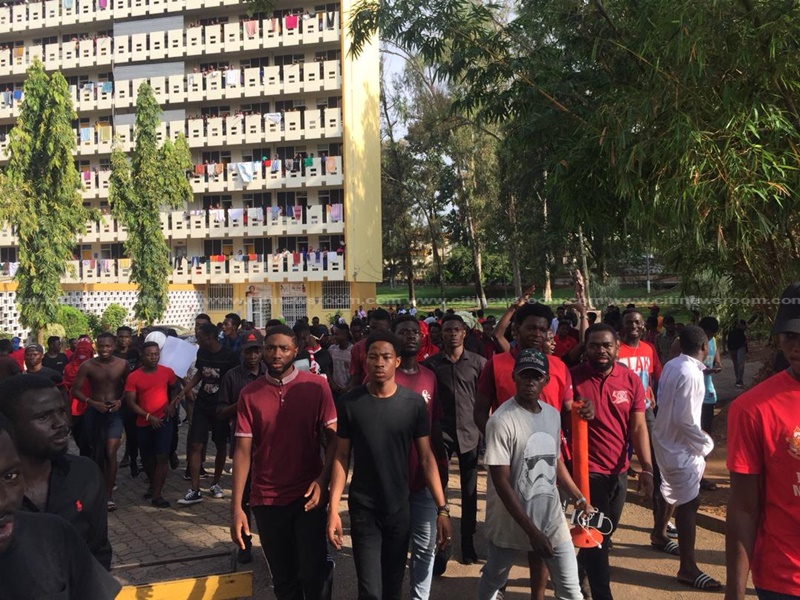
And so of course, anger grew. Thus when the brutalities kicked in, students became incited. Incensed. They felt hard done, victims of injustice. And so they decided to hit back by hitting the streets.
The Students Representative Council (SRC) called for a boycott of lectures and led a demonstration dubbed ‘Ya bre mo’, which literally means “we are fed up with you”.
Now, we have to pay attention to an interesting detail: The university operates an accommodation system which sees the halls mainly populated by freshmen, with continuing students having to find accommodation off campus. It is thus very unlikely for the actual residents of the halls to take to the streets and demonstrate because these people are first-year students who by virtue of their newness are not expected to be radical activists.
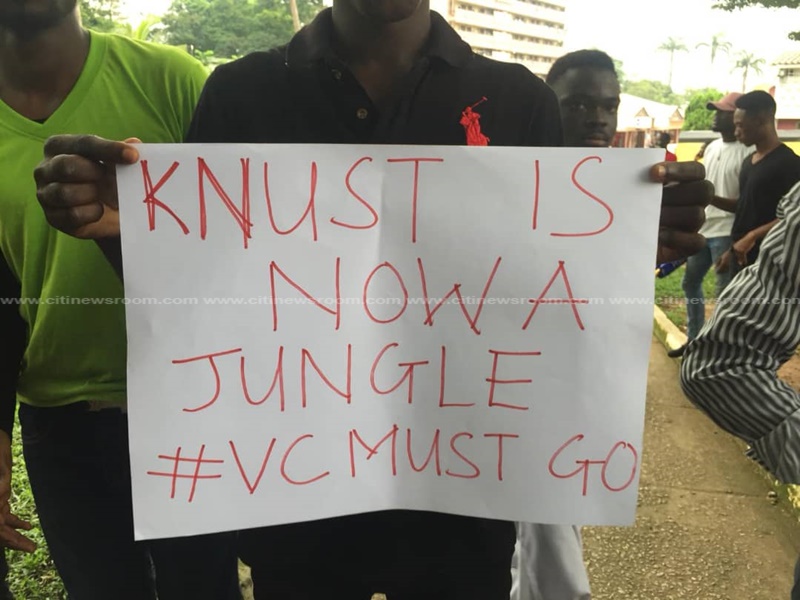
According to an investigation I did after the unrest by students, it was the continuing students off campus who came in to urge the first year students and the entire university to stand up for their rights.
It is even more evident from the videos and photos from the demonstration that the continuing students outnumbered the first year students who took part in the unrest.
Most of the students were in wine (Conti) and yellow (Katanga) shirts and they could only be continuing students because first years are yet to get their hall paraphernalia and souvenirs.
The demonstrators, with a majority of them being males, obviously felt peeved because the university converted the all-male halls they once resided in, compromising tradition and suppressing their expression.
The university’s reason to convert the male halls was to enable more females to gain accommodation on campus, apparently, but this motive became questionable when Africa hall, which used to be an all-female hall, was also converted into a mixed one.
Proponents against the conversion argued that the university could have maintained these traditional single-sex halls while at the same time increasing female residents on campus through the traditionally mixed halls.
Women population in the traditionally mixed halls, namely Queens, Independence and Republic Hall, could have been increased while decreasing the male population.
Statistics on enrolment in KNUST shows that every academic year roughly 60% of males get admission as against 40% females so that already means that the prospect of having more males is systemic.
It is believed that the university authorities were worried about actually the occasional violent clashes between Conti and Katanga, who are rival halls with a history of hostility, and this worry informed their decision to convert the halls. However, in a bid to swerve the inevitable backlash, they used the “we want to increase the female population” line as a smokescreen to win sympathy for their decision.
Well, it is now clear, from the events that have unfolded so far, that bringing females into the midst of male halls was not a good remedy enough to defuse tensions. It was not a solution to taming the male students, as perceived by the authorities of the university. The demonstration speaks volumes.
The way forward
The Students Representative Council of the university and the university authorities, following the demonstration, have begun dialoguing to find lasting solutions to the grievances of students.
They have agreed to rescind some unpopular policies like the one to have all Hall weeks celebrated simultaneously, and also the one to consolidate of all accounts of colleges and faculties.
However, on the most sensitive issue, a compromise is yet to be realized. A proposal by the SRC to the authorities to revert the decision to convert the single-sex halls to mixed halls was thrown out.
The KNUST’s SRC should do everything to ensure that the conversion of the halls is overturned because that was the major remote cause of the demonstration that made news for its degeneration into violence and vandalism.
It is an open secret that the brutalities on campus to suppress students and the conversion of the halls can’t be separated from each other.
For me, whether the dissolved governing council of the university is reinstated or the government-appointed interim council continue to run the university for the three stipulated months, what I want to see is for a sustainable, mutually-beneficial solution to be found to avert further chaos.
If the embattled Vice Chancellor, Professor Obiri Danso, fails to eat a humble pie and continues to maintain his stubborn stance on the hall conversions, I am afraid I will not be surprised to witness more conflicts. Something has to give. A consensus needs to be built.
Meanwhile, the university should enter into a partnership with private companies to put in place more accommodation avenues for students to absorb the effects of the ever increasing population.
–
By: Thomas Yeboah