The Greater Accra region holds a significant position in Ghana’s electoral cycle. On the surface, it’s the region with the most voters out of the 18,772,795 in the country’s electoral roll.
Greater Accra Region is one of the 16 administrative regions in Ghana. The Greater Accra region is the smallest region by land area but most densely populated.
Accra, the capital city of both Ghana and the Greater Accra Region has a population that is highly diverse, with people from all over the country having migrated there over time, primarily in search of better economic opportunities. As a result, Accra, as the capital is largely seen as a cosmopolitan city.
According to a 2019 Local Migration Governance report by the IOM, Accra has always been a hub for business and commerce and has grown rapidly. “Migrants make up close to 45% of the city’s population.
The demographics of the larger Greater Accra region are somewhat different from those of the capital city in terms of social class, population density, diversity, and economic activities. The Greater Accra region encompasses a broader population with a mix of urban and rural characteristics.
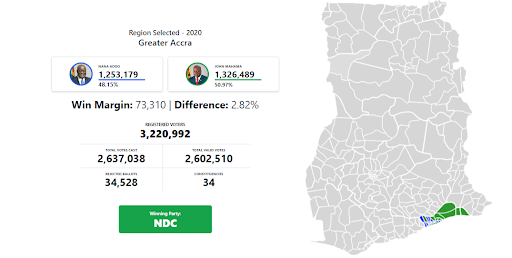
Since 2000, any political party that has won the Greater Accra Region, has gone on to win the presidential election, except in 2020, when the NDC’s John Dramani Mahama won the Greater Accra but lost the national election to Nana Addo Dankwa Akufo-Addo by 73,310 votes in the capital. Registered voters stood at 3,220,992.
A total of 18,772,795 valid voters are expected to participate in the upcoming December general elections, according to provisional statistics released by the Electoral Commission (EC). Of this number, 9,690,173 are females, while 9,082,622 are males. The data also revealed that 708,282 new voters have been added to the electoral roll for the December elections.
In the 2020 general elections, Greater Accra had 3,529,181 registered voters, followed by the Ashanti Region with 3,019,178. The region with the fewest registered voters was the North East Region, with 289,529 voters.
As of the 2021 census, the Greater Accra Region had a population of 5,455,692. 3,765,303 are on the electoral roll for elections 2024, the most of any region. 236,122 more persons have been added to the electoral roll for the election.

Why Is The Greater Accra Region Important?
The Greater Accra Region is crucial in Ghana’s electoral process, not only because of the large number of voters. Greater Accra is the country’s economic and political centre. It hosts the seat of government, along with many state agencies and the headquarters of the two leading political parties.
Presidential campaigns typically begin in the Greater Accra region before spreading to other regions. It is widely believed that the effects of the government’s economic policies are most keenly felt by the region’s residents, who can generally be categorized as middle or lower-middle class.
In rural parts of the Greater Accra region, especially in areas on the outskirts of the city, the social class of residents tend to be lower middle class and working class with some pockets of poverty. Rural Greater Accra is not as developed as the urban centre and many residents rely on agriculture, small-scale trading and informal jobs for livelihoods.
There is also a small percentage of upper-class residents who tend to live in affluent neighbourhoods like Cantonments, Labone, East Legon, and Airport Residential Area. Voters in these areas are likely to base their decisions on the state of the economy and other pressing national issues.
Historical Numerical Analysis
The Greater Accra Region can be described as a swing region. Since 1996, the NDC has won four times, while the NPP has won three times. The party that wins Greater Accra is typically in a strong position to win the national election, as results from the region are often seen as a reflection of the overall national sentiment.
The trend has been that since 1996, up until 2016, the party that won Greater Accra went on to win the presidency. However, in 2020, John Dramani Mahama of the NDC won the region but lost the national election. The NDC also won more parliamentary seats in Greater Accra, including key constituencies such as Ledzokuku, Okaikoi North, Madina, Adentan, and Krowor, as well as Tema East, La Dadekotopon, and Ablekuma Central.
Below is a map showing the constituency voting pattern in the 2016 and 2020 Presidential elections with BLUE representing the NPP and green representing the NDC
(NOTE: The colour of the map is darker in areas where a party won by 60% or more)
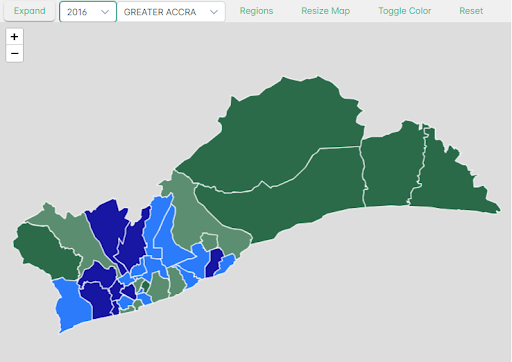
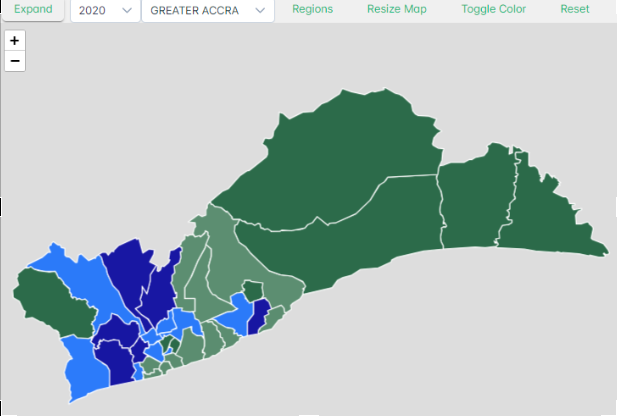
Despite the large voter numbers in the region, no party has won Greater Accra by an overwhelmingly significant margin (60% or more) in recent elections:
– 1996: NPP 43.3%, NDC 54.0%
– 2000: NPP 53.1%, NDC 42.1%
– 2004: NPP 51.7%, NDC 46.6%
– 2008: NPP 46.0%, NDC 52.1%
– 2012: NPP 46.9%, NDC 52.3%
– 2016: NPP 52.4%, NDC 46.7%
The Deciding Issues
The two leading candidates for the December 7 election are former President John Dramani Mahama of the NDC and incumbent Vice-President Dr. Mahamudu Bawumia of the NPP.
Polls suggest the possible emergence of a third force: independent candidate Nana Kwame Bediako of the New Force, and Alan Kwadwo Kyerematen, a long-serving Minister who defected from the NPP to form his ‘Movement for Change’.
Dr. Bawumia has been campaigning on bold solutions, promising to scrap certain taxes introduced by the current government and to scale up the government’s digitalization drive. On the other hand, John Mahama has presented his 24-hour economy policy proposal, which aims to drive job creation. He also pledges to fight corruption through his “Operation Recoup All Loot” (ORAL) initiative.
Recent polls from Global Info Analytics, the EIU, and Fitch have predicted an NDC victory in the 2024 elections. Issues like the economy, job creation, healthcare, infrastructure, and corruption have topped the list of concerns for voters.
Data from Afrobarometer’s Round 9 survey in Ghana shows that 77% of Ghanaians believe corruption increased in the previous year, and 87% think the country is headed in the wrong direction. Additionally, 74% disapprove of the country’s tax regime, particularly the controversial e-levy.
Economic Context and Future Prospects
The numbers certainly don’t make for pleasant reading for supporters of the incumbent NPP. Even supporters of the government admit the challenges and difficulties with the appeal of their flagbearer.
In an interview for this article, Kofi Tontoh, Political Assistant to Dr. Mahamudu Bawumia, explained that despite the challenges facing the government, his boss remains the best option to move the country forward.
“Bawumia is the best person to take the country to the next level. He represents the aspirations of the Ghanaian people. His digitalization agenda is exactly what this country needs for the next industrial revolution.”
The NDC’s flagbearer John Mahama, on the other hand, argues that those responsible for the collapse of the Ghanaian economy should not be seeking to lead the country into the 2024 election.
“Recently, I heard the NPP’s flagbearer, the Vice-President, saying that he has performed excellently as Vice-President, so they should promote him to President. I said, I don’t know who marked his script or whether he marked it himself, but I can tell him that when it comes to his performance, the people of Ghana will give him an ‘F’ for managing the economy.”
There has been recent commentary on the government’s fight against illegal and irresponsible mining. The government’s approach has been viewed as lacklustre, with many on social media accusing it of complicity in the activities of illegal miners.
A recent three-day youth demonstration in the streets of Accra, protesting the government’s failure to tackle illegal mining, and the subsequent arrest of 53 protesters, has further hurt the government’s fortunes in the capital and among younger voters.
While some polls have tipped the NDC to emerge as winners in the December 7 elections, many observers note that with two months left until the election, much remains at stake, and the outcome could still go either way.
The factors that will determine the election are far from settled. A lot can go wrong or right for either of the two leading political parties.
However, with the NDC having won the Greater Accra Region for the first time while the national presidential election was won by the NPP, momentum appears to be on the opposition’s side to win the capital again. This is based on the numbers from the 2020 election when key indicators for the incumbent were slightly better.
In 2020, the average inflation rate, according to the central bank, was 9.9%. The average exchange rate of the Ghanaian cedi to the US dollar was GH¢5.7 to $1, with the cedi experiencing a depreciation of approximately 3.9%. Ghana’s public debt stood at GHC 291.6 billion. As of September 2024, the debt has ballooned to GHC 761.2 billion. Inflation in September 2024 was 20.4%.
The data suggests that the country’s economy has significantly deteriorated over the last four years.
Considering how the NDC managed to win Greater Accra in 2020, despite better economic indicators at the time, it stands to reason that the NPP faces a herculean task in winning the region again.
The outcome of the 2024 elections and what the overall picture will look like for Greater Accra specifically remains to be seen. While the handlers of Ghana’s Vice-President are optimistic about a win, analysts believe that the NPP’s chances of securing a victory in Greater Accra hang by a thread. This has led to a sharp focus on campaigning in their strongholds, particularly the Ashanti Region and the Eastern Region, in the hope that a strong turnout will give them the momentum to push for a second round or even possibly win the election.
However, given historical precedents where the national election outcome has mirrored the results in Accra, the odds are starkly against the incumbent party. That said, victory is still not out of reach.
*The author, Jude Duncan, is a broadcast journalist with Accra-based Citi FM/Channel One News. He hosts Channel One TV’s Breakfast Daily weekend show and produces The Point of View.