Cowpea (Vigna unguiculata) is an indigenous and staple crop in sub-Saharan Africa, but it has an enemy: an insect called the legume pod borer (Maruca vitrata). This pest can cause yield losses of more than 80%. The pod borer, originally from south-east Asia, attacks the flowers, pods and seeds.
Conventional cowpea varieties lack resistance to the insect. Insecticide is the primary control measure, adding costs and environmental and health risks.
We are researchers at different research institutions with expertise in plant biotechnology. We have worked together for nearly 20 years in Ghana, Nigeria, Burkina Faso, Australia and the United States to develop a cowpea that is resistant to pod borer. The result is a genetically modified (GM) cowpea variety, known as Songotra-T.
Ghana officially approved this variety for commercial release in 2024. It was the country’s first GM crop approval, following the earlier success of the pod borer resistant cowpea in Nigeria. There, it was approved in 2019 and commercially launched as Sampea 20-T in 2020.
Our recent research conducted in northern Ghana has demonstrated that Songotra-T is resistant to the legume pod borer and offers environmental and economic benefits.
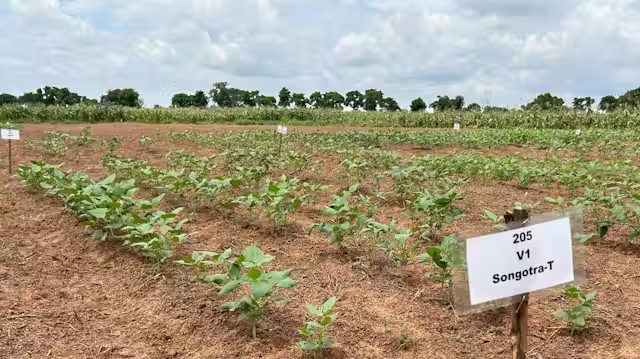
Our field trials evaluated the performance of the GM cowpea in comparison to three conventional cultivars. These were the non-GM equivalent cultivar Songotra, and two other cultivars, Kirkhouse-Benga and Wang-Kae. We confirmed that Songotra-T achieved an average grain yield of 2,534 kg/ha. This outperformed conventional varieties, which yielded between 1,414 kg/ha and 1,757 kg/ha. Economic analysis by our team showed that Songotra-T had the highest return on investment (464%), demonstrating the potential of biotechnology to enhance agricultural productivity. It also affirms profitability for smallholder farmers, who often operate with limited resources.
Field trials in Ghana
The trials were completed over a single growing season, at four locations representing the cowpea growing belt in Ghana. Northern Ghana is a major cowpea-producing region, characterised by a rain-fed farming system and high pest pressure. The team tested Songotra-T’s resilience under real farming conditions, using replicated experimental designs and statistical methods to ensure robust data collection and results.
We discovered that Songotra-T reduces the need to use insecticides by 80%. This lowers production costs and health risks to farmers and consumers through exposure to toxic chemicals. Decreased insecticide applications also help preserve populations of beneficial insects such as spiders and ladybird beetles, which play a vital role in natural pest control.
These environmental benefits reinforce the sustainability of this GM cowpea as an alternative to traditional pest management strategies. The savings in insecticide use and the increase in yield are translated into financial advantage.
We don’t know the price of the GM seeds as this will be established by local seed companies depending on demand and interest. But it is expected that the savings in chemicals and increase in yield will compensate for any increase in seed cost.
GM varieties of crops such as maize, soybean and cotton have been successfully grown around the world. Our findings show that this modern biotechnology can be used to reduce food insecurity in Ghana by increasing the yield of a major staple crop.
Acceptance and regulation
Ghana’s decision to commercialise Songotra-T strengthens the case for broader adoption of this biotechnology in the region.
This approval provides a rebuttal to earlier scepticism about whether Ghana would follow through on its initial regulatory green light in 2022. Then, concerns were raised about regulatory hurdles and public acceptance. Although there were concerns from anti-GM groups, the World Health Organization considersthat “GM foods currently available on the international market have passed safety assessments and are not likely to present risks for human health”.
This step by Ghana shows that African countries can make decisions about agricultural biotechnology based on their specific needs and contexts. It can inspire other nations to explore and adopt similar science-based approaches to their agricultural challenges.
There is still much work to do in developing effective seed production and distribution systems for delivering this new technology to Ghana’s farmers. It must be done at a scale that creates meaningful impact. The continued involvement of international development partners may be needed to close the gap between innovation and impact. But this is a decision for Ghana’s policy makers.
–
This article is a republication from The Conversation. Read original article here.
Authors: , Research Scientist, CSIRO, ,Research Scientist and Plant Breeder, CSIR-Savanna Agricultural Research Institute, , Principal Research Scientist, CSIR-Savanna Agricultural Research Institute and , Honorary Research Fellow, CSIRO. Jean B. Tinegre of the African Agricultural Technology Foundation and Donald J. Mackenzie of the Donald Danforth Plan Science Center were also part of the research team.