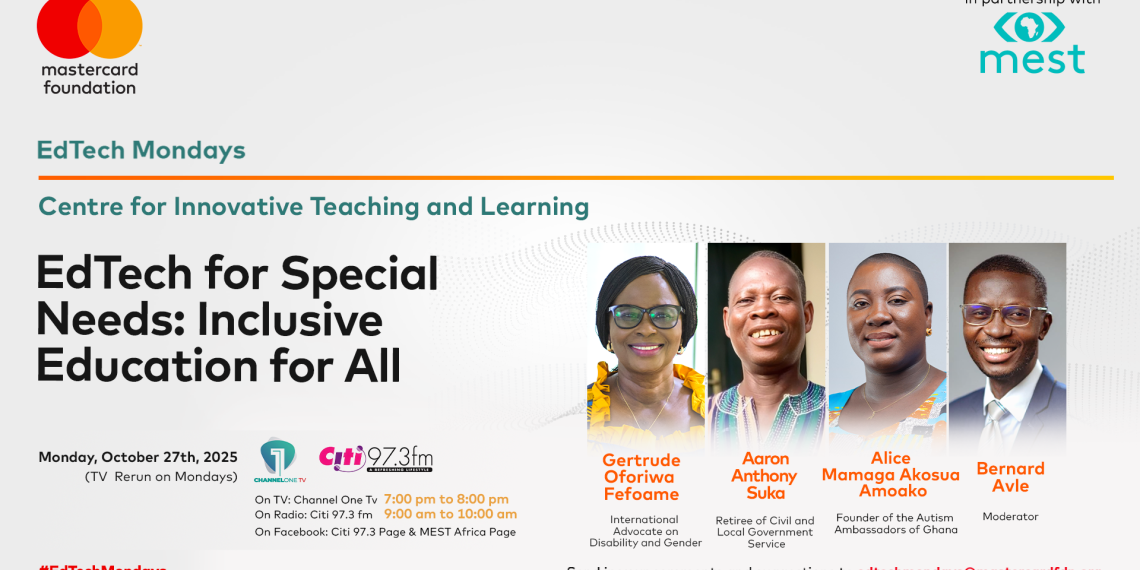
Disability advocates have called for the adoption of technology-driven solutions to promote inclusive education for children with special needs.
Speaking on the Citi Breakfast Show on Monday, October 27, under the theme “EdTech for Special Needs: Inclusive Education for All,” the panelists urged government and educational institutions to prioritise investment in assistive technologies that can enhance teaching and learning for children living with disabilities.
The discussion formed part of the EdTech Monday initiative, a platform created by the Mastercard Foundation in partnership with MEST Africa, to bring together education technology entrepreneurs, policymakers, and government officials to deliberate on key issues within the EdTech ecosystem.
International Advocate on Disability and Gender, Gertrude Oforiwa Fefoame, underscored the critical role of technology in breaking educational barriers for persons with disabilities.
“Technology serves as the foundation for inclusive education. It is a basis for acquiring and imparting knowledge,” she said.
“For learners with disabilities, access to appropriate equipment, accessible content, and confidence-building through training are essential.”
Madam Gertrude Fefoame explained that while assistive tools such as Braille kits and screen readers are vital, affordability and accessibility remain major challenges.
She called for policy measures to reduce the cost of assistive devices and ensure that learning materials are inclusive and user-friendly.
“Technology cannot be underestimated. It helps overcome barriers, but the kits, training, and understanding are often weak and expensive,” she added.
Also contributing to the discussion, Alice Akosua Mamaga Amoako, founder of Autism Ambassadors of Ghana, highlighted how technology can improve communication and behavioural development among children with autism.
“Technology helps persons with autism to communicate their needs and interact with others. Beyond that, it raises awareness and breaks cultural myths around disability,” she said.
She added that digital platforms and social media have become powerful tools for advocacy and knowledge-sharing on autism and special needs education.
“Social media has helped shape these stories to help people understand that autism is not as scary as we’ve all known it to be, but if you are able to provide the necessary therapies and technologies that can help improve the child’s life, then the child will be better. Technology has helped various caregivers and professionals in the circles of autism to enhance their skills,” she said.
A retired social worker and civil servant, Mr. Aaron Anthony Suka, commended the government for existing interventions such as the District Assembly Common Fund and NHIS support for persons with disabilities. He, however, stressed the need to expand digital inclusion efforts.
“ EdTech supports government and community efforts in helping persons with disabilities improve learning and social interaction through virtual platforms,” he noted.
The stakeholders collectively called for increased awareness, affordable assistive devices, and stronger policy support to ensure that technology becomes a driving force for inclusive education in Ghana.
Explore the world of impactful news with CitiNewsroom on WhatsApp!
Click on the link to join the Citi Newsroom channel for curated, meaningful stories tailored just for YOU:
https://whatsapp.com/channel/0029VaCYzPRAYlUPudDDe53x
No spam, just the stories that truly matter! #StayInformed #CitiNewsroom #CNRDigital

![Archbishop of Canterbury, Sarah Mullally [seated] -Photo credit Neil Turner / Lambeth Palace](https://www.citinewsroom.com/wp-content/uploads/2026/07/ARCH-22-350x250.png)