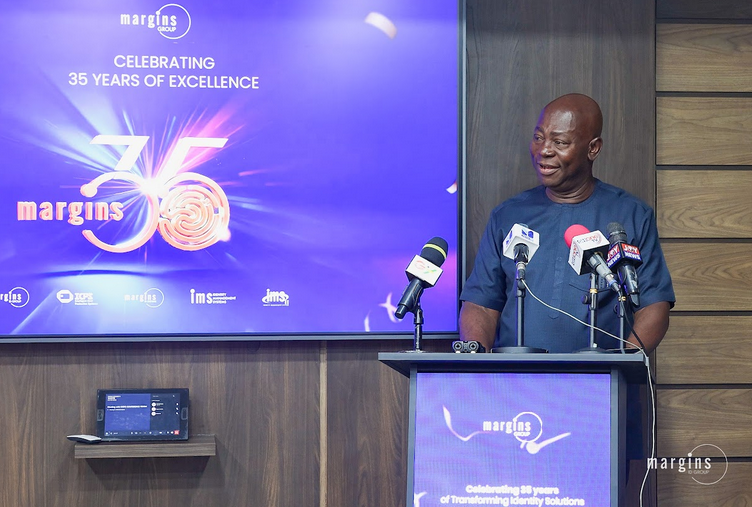
What began as a law student’s fascination with computers has evolved into one of Africa’s most critical digital infrastructure stories. At a media engagement and guided tour of Margins ID Group’s facilities, CEO Moses Baiden pulled back the curtain on a 35-year journey that now underpins Ghana’s national identity system and positions the country at the forefront of digital governance on the continent.

Baiden traced Margins’ origins to a time when personal computers were still a novelty and digital identity in Africa was largely theoretical.
“I actually started the business when I was in law school,” he said. “I was a technology enthusiast at a time when computers were shrinking from massive machines into desktops and laptops. I saved my first earnings in London just to buy a laptop, because I believed computers were the future.”
That belief would become a lifelong pursuit. Though trained as a lawyer and even serving as a teaching assistant at law school, Baiden knew his real passion lay elsewhere. He was not interested in writing code for its own sake; he wanted to build systems that solved real problems.

“I realised early on that I didn’t want to be a programmer. I wanted to build computer networks. I wanted to solve problems.”
Margins’ first chapter was not identity cards but the business of enabling the digital revolution itself — selling computers, printers, paper, and document solutions at a time when governments and businesses were still adjusting to the digital age. That exposure, Baiden explained, revealed a deeper opportunity: documents were changing, but trust in documents had not caught up.
“As computers spread, the form factor of documents changed. Governments still needed a secure way to print, issue, and verify documents. That’s where we saw the gap.”

That gap would eventually lead Margins into the complex world of secure identity systems — a field Baiden describes as one with high barriers, long timelines, and little room for error.
By the mid-1990s, Baiden had begun studying global identity and payment systems, from bank cards in the United States to manufacturing and security standards in Asia and Europe. What he saw was convergence: identity, finance, security, and public services were beginning to merge into a single digital ecosystem.
“If you look at bank cards, airport cards, military cards — it’s all an evolution of customer needs. Identity became the foundation.”
That insight would later prove pivotal for Ghana. Long before the National Identification Authority (NIA) project became reality, Margins had already invested years learning, building partnerships, and developing the capacity to manufacture secure cards locally.

When Ghana finally moved to roll out a national ID system, Baiden said the vision went beyond issuing cards.
“The goal was never just to produce an ID. The vision was to make the NIA a revenue centre for the state, not a cost centre.”
Under the model Margins helped design, the national ID system enables banks, government agencies, and service providers to verify identities securely, reducing fraud, cutting duplication, and saving the country hundreds of millions of dollars that would otherwise be spent building parallel systems.
Baiden pointed to Nigeria, where banks were forced to spend over $200 million to create their own identity infrastructure in the absence of a national system.
“In Ghana, the banks now ride on the NIA infrastructure. They didn’t have to build it themselves.”
Beyond verification, Margins is now working with government on next-generation identity applications — including secure digital wallets, interoperable payment systems, and platforms that could simplify access to passports, social services, and targeted government programmes.
“Once you can identify people properly, you unlock everything — banking, social protection, healthcare, agriculture support. You cut out waste and middlemen.”
The tour of the Intelligent Card Production Systems underscored another strategic pillar of Margins’ approach: local manufacturing and knowledge transfer. For Baiden, a factory is more than machines.
“A factory is a system. It’s knowledge. It’s people. That’s what makes it sustainable.”
Now having operated under six different governments, Baiden said Margins’ longevity comes from long-term thinking and discipline rather than political convenience.
“We’ve had to stay relevant, scale responsibly, and grow every year. Identity is not a quick business. It requires trust, deep collaboration, and patience.”
As Ghana continues to digitise public services and integrate identity into everyday life, Baiden believes the real work is just beginning.
“This is about building systems that serve everyone — not just today, but for generations.”
For Margins ID Group, what started as a young man’s fascination with computers has become a central pillar of Ghana’s digital future — one identity at a time.